

110 Beam-based Correction and Optimization for Accelerators
0
10
20
30
40
50
60
70
80
Index
10 2
10 3
10 4
10 5
10 6
SV
55
60
65
70
75
Quadrupole parameters
-1
-0.5
0
0.5
1
V-vectors
V 77
V 78
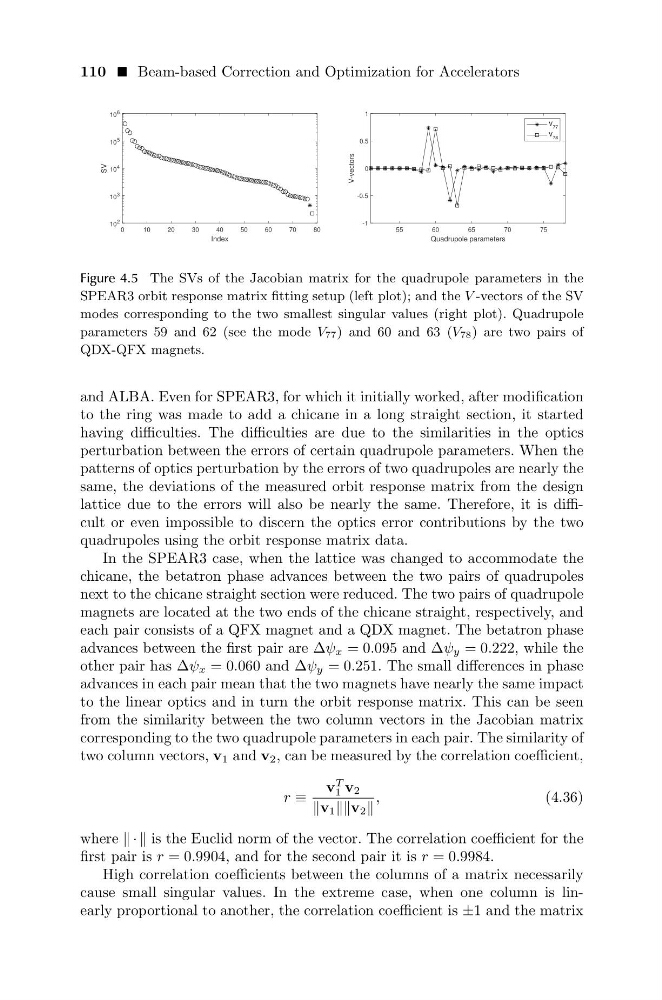
Figure 4.5 The SVs of the Jacobian matrix for the quadrupole parameters in the
SPEAR3 orbit response matrix fitting setup (left plot); and the V -vectors of the SV
modes corresponding to the two smallest singular values (right plot). Quadrupole
parameters 59 and 62 (see the mode V77) and 60 and 63 (V78) are two pairs of
QDX-QFX magnets.
and ALBA. Even for SPEAR3, for which it initially worked, after modification
to the ring was made to add a chicane in a long straight section, it started
having difficulties. The difficulties are due to the similarities in the optics
perturbation between the errors of certain quadrupole parameters. When the
patterns of optics perturbation by the errors of two quadrupoles are nearly the
same, the deviations of the measured orbit response matrix from the design
lattice due to the errors will also be nearly the same. Therefore, it is difficult or even impossible to discern the optics error contributions by the two
quadrupoles using the orbit response matrix data.
In the SPEAR3 case, when the lattice was changed to accommodate the
chicane, the betatron phase advances between the two pairs of quadrupoles
next to the chicane straight section were reduced. The two pairs of quadrupole
magnets are located at the two ends of the chicane straight, respectively, and
each pair consists of a QFX magnet and a QDX magnet. The betatron phase
advances between the first pair are ∆ψ x = 0.095 and ∆ψ y = 0.222, while the
other pair has ∆ψ x = 0.060 and ∆ψ y = 0.251. The small differences in phase
advances in each pair mean that the two magnets have nearly the same impact
to the linear optics and in turn the orbit response matrix. This can be seen
from the similarity between the two column vectors in the Jacobian matrix
corresponding to the two quadrupole parameters in each pair. The similarity of
two column vectors, v 1 and v 2 , can be measured by the correlation coefficient,
r ≡
v
T
1 v 2
v 1 v 2
,
(4.36)
where · · is the Euclid norm of the vector. The correlation coefficient for the
first pair is r = 0.9904, and for the second pair it is r = 0.9984.
High correlation coefficients between the columns of a matrix necessarily
cause small singular values. In the extreme case, when one column is linearly proportional to another, the correlation coefficient is ±1 and the matrix
0
10
20
30
40
50
60
70
80
Index
10 2
10 3
10 4
10 5
10 6
SV
55
60
65
70
75
Quadrupole parameters
-1
-0.5
0
0.5
1
V-vectors
V 77
V 78
Figure 4.5 The SVs of the Jacobian matrix for the quadrupole parameters in the
SPEAR3 orbit response matrix fitting setup (left plot); and the V -vectors of the SV
modes corresponding to the two smallest singular values (right plot). Quadrupole
parameters 59 and 62 (see the mode V77) and 60 and 63 (V78) are two pairs of
QDX-QFX magnets.
and ALBA. Even for SPEAR3, for which it initially worked, after modification
to the ring was made to add a chicane in a long straight section, it started
having difficulties. The difficulties are due to the similarities in the optics
perturbation between the errors of certain quadrupole parameters. When the
patterns of optics perturbation by the errors of two quadrupoles are nearly the
same, the deviations of the measured orbit response matrix from the design
lattice due to the errors will also be nearly the same. Therefore, it is difficult or even impossible to discern the optics error contributions by the two
quadrupoles using the orbit response matrix data.
In the SPEAR3 case, when the lattice was changed to accommodate the
chicane, the betatron phase advances between the two pairs of quadrupoles
next to the chicane straight section were reduced. The two pairs of quadrupole
magnets are located at the two ends of the chicane straight, respectively, and
each pair consists of a QFX magnet and a QDX magnet. The betatron phase
advances between the first pair are ∆ψ x = 0.095 and ∆ψ y = 0.222, while the
other pair has ∆ψ x = 0.060 and ∆ψ y = 0.251. The small differences in phase
advances in each pair mean that the two magnets have nearly the same impact
to the linear optics and in turn the orbit response matrix. This can be seen
from the similarity between the two column vectors in the Jacobian matrix
corresponding to the two quadrupole parameters in each pair. The similarity of
two column vectors, v 1 and v 2 , can be measured by the correlation coefficient,
r ≡
v
T
1 v 2
v 1 v 2
,
(4.36)
where · · is the Euclid norm of the vector. The correlation coefficient for the
first pair is r = 0.9904, and for the second pair it is r = 0.9984.
High correlation coefficients between the columns of a matrix necessarily
cause small singular values. In the extreme case, when one column is linearly proportional to another, the correlation coefficient is ±1 and the matrix