

Top Curr Chem (Z) (2018) 376:6
1 3
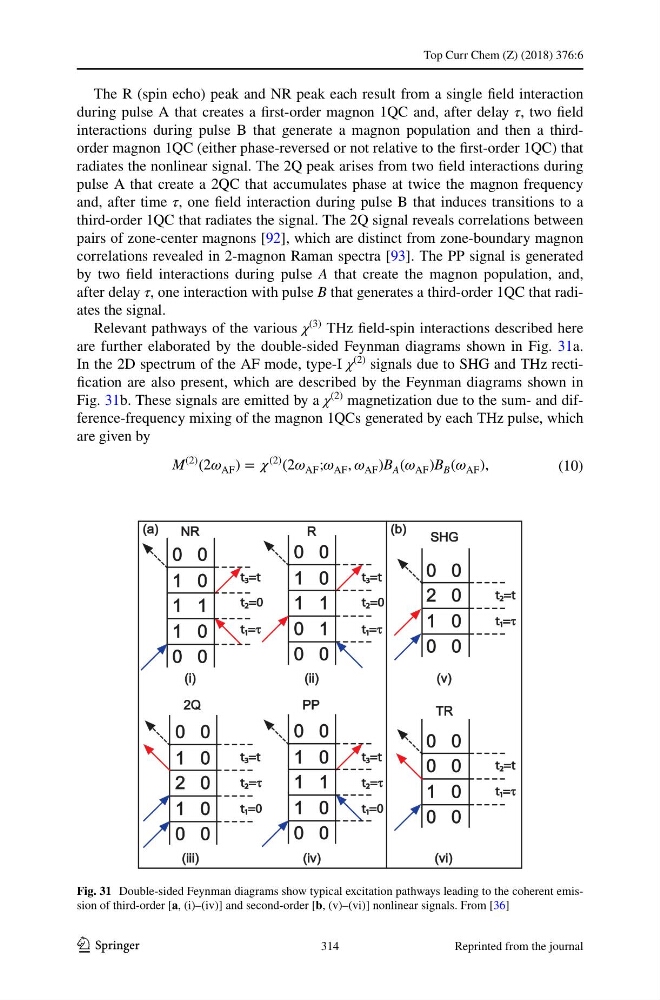
The R (spin echo) peak and NR peak each result from a single field interaction
during pulse A that creates a first-order magnon 1QC and, after delay τ, two field
interactions during pulse B that generate a magnon population and then a thirdorder magnon 1QC (either phase-reversed or not relative to the first-order 1QC) that
radiates the nonlinear signal. The 2Q peak arises from two field interactions during
pulse A that create a 2QC that accumulates phase at twice the magnon frequency
and, after time τ, one field interaction during pulse B that induces transitions to a
third-order 1QC that radiates the signal. The 2Q signal reveals correlations between
pairs of zone-center magnons [92], which are distinct from zone-boundary magnon
correlations revealed in 2-magnon Raman spectra [93]. The PP signal is generated
by two field interactions during pulse A that create the magnon population, and,
after delay τ, one interaction with pulse B that generates a third-order 1QC that radiates the signal.
Relevant pathways of the various χ
(3)
THz field-spin interactions described here
are further elaborated by the double-sided Feynman diagrams shown in Fig. 31a.
In the 2D spectrum of the AF mode, type-I χ
(2)
signals due to SHG and THz rectification are also present, which are described by the Feynman diagrams shown in
Fig. 31b. These signals are emitted by a χ
(2)
magnetization due to the sum- and difference-frequency mixing of the magnon 1QCs generated by each THz pulse, which
are given by
(10)
M
(2) (2 AF ) =
(2) (2 AF ; AF , AF )B A ( AF )B B ( AF ),
Fig. 31 Double-sided Feynman diagrams show typical excitation pathways leading to the coherent emission of third-order [a, (i)–(iv)] and second-order [b, (v)–(vi)] nonlinear signals. From [36]
314
Reprinted from the journal
1 3
The R (spin echo) peak and NR peak each result from a single field interaction
during pulse A that creates a first-order magnon 1QC and, after delay τ, two field
interactions during pulse B that generate a magnon population and then a thirdorder magnon 1QC (either phase-reversed or not relative to the first-order 1QC) that
radiates the nonlinear signal. The 2Q peak arises from two field interactions during
pulse A that create a 2QC that accumulates phase at twice the magnon frequency
and, after time τ, one field interaction during pulse B that induces transitions to a
third-order 1QC that radiates the signal. The 2Q signal reveals correlations between
pairs of zone-center magnons [92], which are distinct from zone-boundary magnon
correlations revealed in 2-magnon Raman spectra [93]. The PP signal is generated
by two field interactions during pulse A that create the magnon population, and,
after delay τ, one interaction with pulse B that generates a third-order 1QC that radiates the signal.
Relevant pathways of the various χ
(3)
THz field-spin interactions described here
are further elaborated by the double-sided Feynman diagrams shown in Fig. 31a.
In the 2D spectrum of the AF mode, type-I χ
(2)
signals due to SHG and THz rectification are also present, which are described by the Feynman diagrams shown in
Fig. 31b. These signals are emitted by a χ
(2)
magnetization due to the sum- and difference-frequency mixing of the magnon 1QCs generated by each THz pulse, which
are given by
(10)
M
(2) (2 AF ) =
(2) (2 AF ; AF , AF )B A ( AF )B B ( AF ),
Fig. 31 Double-sided Feynman diagrams show typical excitation pathways leading to the coherent emission of third-order [a, (i)–(iv)] and second-order [b, (v)–(vi)] nonlinear signals. From [36]
314
Reprinted from the journal