

1 3
Top Curr Chem (Z) (2018) 376:6
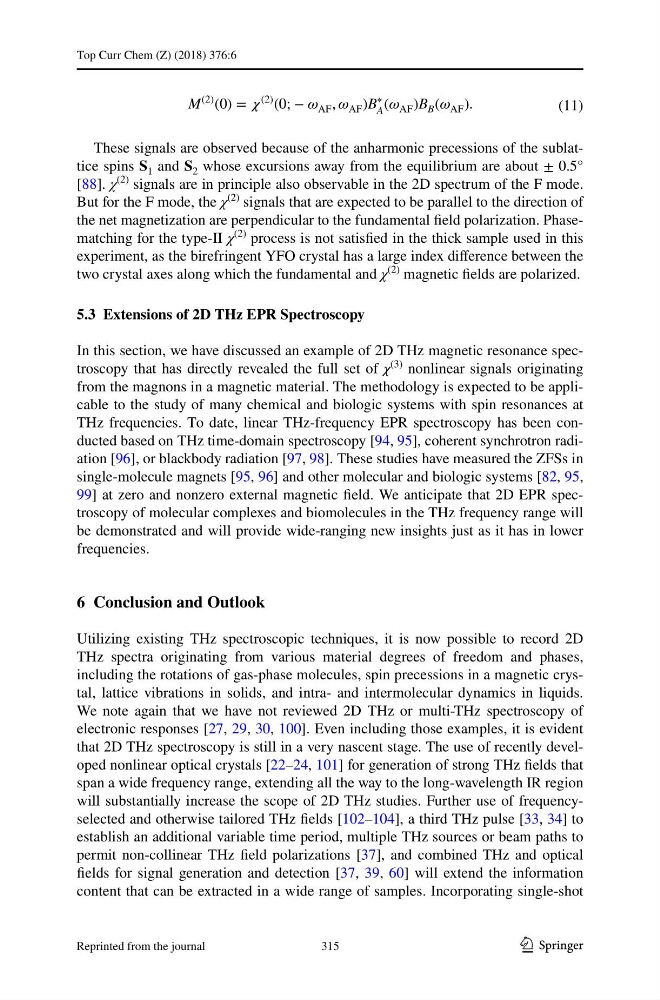
These signals are observed because of the anharmonic precessions of the sublattice spins S 1 and S 2 whose excursions away from the equilibrium are about ± 0.5°
[88]. χ
(2)
signals are in principle also observable in the 2D spectrum of the F mode.
But for the F mode, the χ
(2)
signals that are expected to be parallel to the direction of
the net magnetization are perpendicular to the fundamental field polarization. Phasematching for the type-II χ
(2)
process is not satisfied in the thick sample used in this
experiment, as the birefringent YFO crystal has a large index difference between the
two crystal axes along which the fundamental and χ
(2)
magnetic fields are polarized.
5.3 Extensions of 2D THz EPR Spectroscopy
In this section, we have discussed an example of 2D THz magnetic resonance spectroscopy that has directly revealed the full set of χ
(3)
nonlinear signals originating
from the magnons in a magnetic material. The methodology is expected to be applicable to the study of many chemical and biologic systems with spin resonances at
THz frequencies. To date, linear THz-frequency EPR spectroscopy has been conducted based on THz time-domain spectroscopy [94, 95], coherent synchrotron radiation [96], or blackbody radiation [97, 98]. These studies have measured the ZFSs in
single-molecule magnets [95, 96] and other molecular and biologic systems [82, 95,
99] at zero and nonzero external magnetic field. We anticipate that 2D EPR spectroscopy of molecular complexes and biomolecules in the THz frequency range will
be demonstrated and will provide wide-ranging new insights just as it has in lower
frequencies.
6 Conclusion and Outlook
Utilizing existing THz spectroscopic techniques, it is now possible to record 2D
THz spectra originating from various material degrees of freedom and phases,
including the rotations of gas-phase molecules, spin precessions in a magnetic crystal, lattice vibrations in solids, and intra- and intermolecular dynamics in liquids.
We note again that we have not reviewed 2D THz or multi-THz spectroscopy of
electronic responses [27, 29, 30, 100]. Even including those examples, it is evident
that 2D THz spectroscopy is still in a very nascent stage. The use of recently developed nonlinear optical crystals [22–24, 101] for generation of strong THz fields that
span a wide frequency range, extending all the way to the long-wavelength IR region
will substantially increase the scope of 2D THz studies. Further use of frequencyselected and otherwise tailored THz fields [102–104], a third THz pulse [33, 34] to
establish an additional variable time period, multiple THz sources or beam paths to
permit non-collinear THz field polarizations [37], and combined THz and optical
fields for signal generation and detection [37, 39, 60] will extend the information
content that can be extracted in a wide range of samples. Incorporating single-shot
(11)
M
(2) (0) =
(2) (0; − AF , AF )B
∗
A
( AF )B B ( AF ).
315
Reprinted from the journal
Top Curr Chem (Z) (2018) 376:6
These signals are observed because of the anharmonic precessions of the sublattice spins S 1 and S 2 whose excursions away from the equilibrium are about ± 0.5°
[88]. χ
(2)
signals are in principle also observable in the 2D spectrum of the F mode.
But for the F mode, the χ
(2)
signals that are expected to be parallel to the direction of
the net magnetization are perpendicular to the fundamental field polarization. Phasematching for the type-II χ
(2)
process is not satisfied in the thick sample used in this
experiment, as the birefringent YFO crystal has a large index difference between the
two crystal axes along which the fundamental and χ
(2)
magnetic fields are polarized.
5.3 Extensions of 2D THz EPR Spectroscopy
In this section, we have discussed an example of 2D THz magnetic resonance spectroscopy that has directly revealed the full set of χ
(3)
nonlinear signals originating
from the magnons in a magnetic material. The methodology is expected to be applicable to the study of many chemical and biologic systems with spin resonances at
THz frequencies. To date, linear THz-frequency EPR spectroscopy has been conducted based on THz time-domain spectroscopy [94, 95], coherent synchrotron radiation [96], or blackbody radiation [97, 98]. These studies have measured the ZFSs in
single-molecule magnets [95, 96] and other molecular and biologic systems [82, 95,
99] at zero and nonzero external magnetic field. We anticipate that 2D EPR spectroscopy of molecular complexes and biomolecules in the THz frequency range will
be demonstrated and will provide wide-ranging new insights just as it has in lower
frequencies.
6 Conclusion and Outlook
Utilizing existing THz spectroscopic techniques, it is now possible to record 2D
THz spectra originating from various material degrees of freedom and phases,
including the rotations of gas-phase molecules, spin precessions in a magnetic crystal, lattice vibrations in solids, and intra- and intermolecular dynamics in liquids.
We note again that we have not reviewed 2D THz or multi-THz spectroscopy of
electronic responses [27, 29, 30, 100]. Even including those examples, it is evident
that 2D THz spectroscopy is still in a very nascent stage. The use of recently developed nonlinear optical crystals [22–24, 101] for generation of strong THz fields that
span a wide frequency range, extending all the way to the long-wavelength IR region
will substantially increase the scope of 2D THz studies. Further use of frequencyselected and otherwise tailored THz fields [102–104], a third THz pulse [33, 34] to
establish an additional variable time period, multiple THz sources or beam paths to
permit non-collinear THz field polarizations [37], and combined THz and optical
fields for signal generation and detection [37, 39, 60] will extend the information
content that can be extracted in a wide range of samples. Incorporating single-shot
(11)
M
(2) (0) =
(2) (0; − AF , AF )B
∗
A
( AF )B B ( AF ).
315
Reprinted from the journal