

1 3
Top Curr Chem (Z) (2018) 376:6
where γ is the gyromagnetic ratio. In the linear response region, two THz-active
magnon modes, the quasi-AFM (AF) and quasi-FM (F) modes, can be constructed
based respectively on the out-of-phase and in-phase cooperative precessional
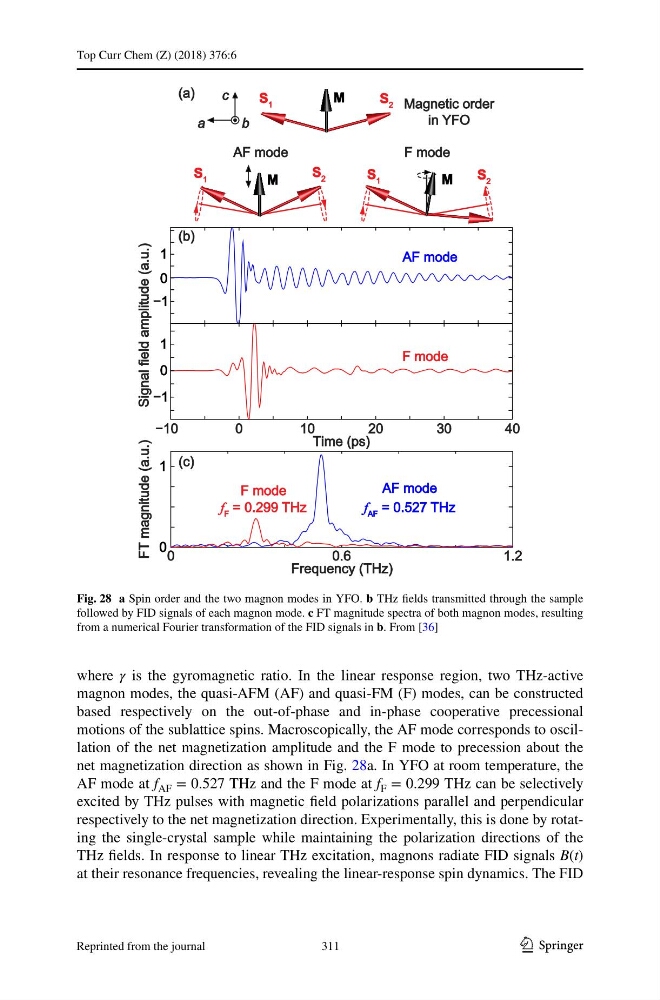
motions of the sublattice spins. Macroscopically, the AF mode corresponds to oscillation of the net magnetization amplitude and the F mode to precession about the
net magnetization direction as shown in Fig. 28a. In YFO at room temperature, the
AF mode at f AF = 0.527 THz and the F mode at f F = 0.299 THz can be selectively
excited by THz pulses with magnetic field polarizations parallel and perpendicular
respectively to the net magnetization direction. Experimentally, this is done by rotating the single-crystal sample while maintaining the polarization directions of the
THz fields. In response to linear THz excitation, magnons radiate FID signals B(t)
at their resonance frequencies, revealing the linear-response spin dynamics. The FID
Fig. 28 a Spin order and the two magnon modes in YFO. b THz fields transmitted through the sample
followed by FID signals of each magnon mode. c FT magnitude spectra of both magnon modes, resulting
from a numerical Fourier transformation of the FID signals in b. From [36]
311
Reprinted from the journal
Top Curr Chem (Z) (2018) 376:6
where γ is the gyromagnetic ratio. In the linear response region, two THz-active
magnon modes, the quasi-AFM (AF) and quasi-FM (F) modes, can be constructed
based respectively on the out-of-phase and in-phase cooperative precessional
motions of the sublattice spins. Macroscopically, the AF mode corresponds to oscillation of the net magnetization amplitude and the F mode to precession about the
net magnetization direction as shown in Fig. 28a. In YFO at room temperature, the
AF mode at f AF = 0.527 THz and the F mode at f F = 0.299 THz can be selectively
excited by THz pulses with magnetic field polarizations parallel and perpendicular
respectively to the net magnetization direction. Experimentally, this is done by rotating the single-crystal sample while maintaining the polarization directions of the
THz fields. In response to linear THz excitation, magnons radiate FID signals B(t)
at their resonance frequencies, revealing the linear-response spin dynamics. The FID
Fig. 28 a Spin order and the two magnon modes in YFO. b THz fields transmitted through the sample
followed by FID signals of each magnon mode. c FT magnitude spectra of both magnon modes, resulting
from a numerical Fourier transformation of the FID signals in b. From [36]
311
Reprinted from the journal