

Top Curr Chem (Z) (2018) 376:6
1 3
was conducted on magnons in a magnetic material [36]. We review it here in the
expectation that the methodology will be extended to molecular and biomolecular
samples.
5.2 2D THz Spectroscopy of Collective Spin Waves
Magnons are the elementary excitations in material systems with spin order such
as ferromagnetic (FM) and antiferromagnetic (AFM) phases. In these systems, the
high magnetic anisotropy and strong spin-spin interactions result in an intrinsic
internal magnetic field that is commonly on the order of 10 T. As a result, magnon
resonances are usually found in the THz range. Some of these materials have been
studied with continuous-wave and pulsed THz fields, revealing the magnon frequencies through their FID signals [85, 86] and demonstrating linear superposition in the
responses to time-delayed pulse pairs [55, 85]. So far, there are very limited examples of nonlinear THz driving of spins [87–89]. As in other types of 2D spectroscopy, 2D magnetic resonance allows the distinct nonlinear responses to be separated
from each other and from linear responses.
An initial demonstration of 2D THz spectroscopy using THz magnetic fields was
conducted on magnons in yttrium orthoferrite (YFeO 3 or YFO), which has canted
AFM order, as shown in Fig. 22a. The static spin Hamiltonian describing the two
sublattice spins is given by [90, 91],
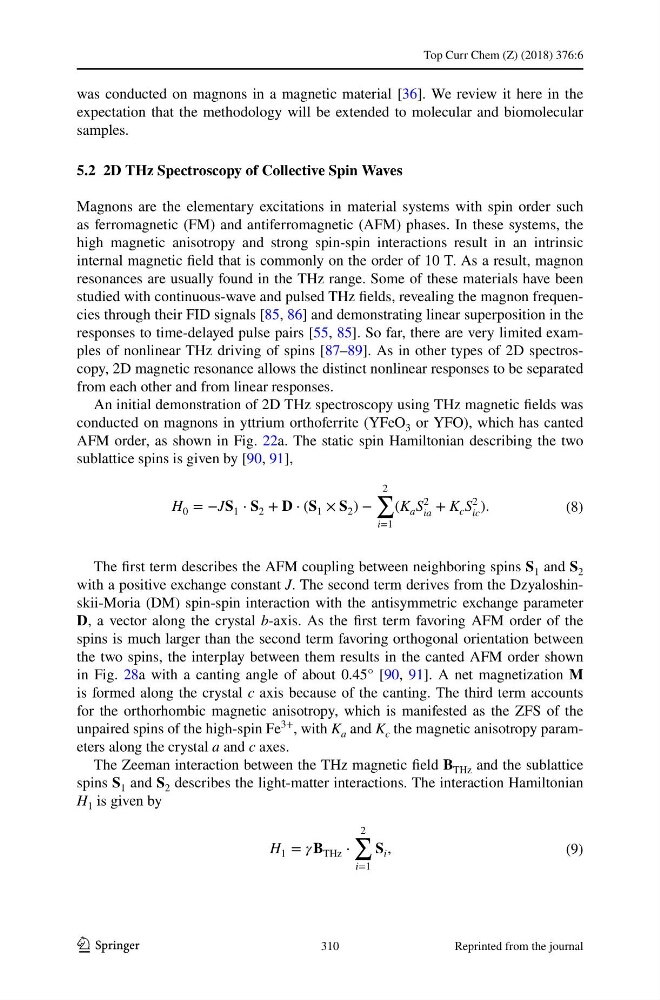
The first term describes the AFM coupling between neighboring spins S 1 and S 2
with a positive exchange constant J. The second term derives from the Dzyaloshinskii-Moria (DM) spin-spin interaction with the antisymmetric exchange parameter
D, a vector along the crystal b-axis. As the first term favoring AFM order of the
spins is much larger than the second term favoring orthogonal orientation between
the two spins, the interplay between them results in the canted AFM order shown
in Fig. 28a with a canting angle of about 0.45° [90, 91]. A net magnetization M
is formed along the crystal c axis because of the canting. The third term accounts
for the orthorhombic magnetic anisotropy, which is manifested as the ZFS of the
unpaired spins of the high-spin Fe
3+
, with K a and K c the magnetic anisotropy parameters along the crystal a and c axes.
The Zeeman interaction between the THz magnetic field B THz and the sublattice
spins S 1 and S 2 describes the light-matter interactions. The interaction Hamiltonian
H 1 is given by
(8)
H 0 = −J 1 ⋅ 2 + ⋅ ( 1 × 2 ) −
2
∑
i=1
(K a S
2
ia + K c S
2
ic ).
(9)
H 1 = THz ⋅
2
∑
i=1
i ,
310
Reprinted from the journal
1 3
was conducted on magnons in a magnetic material [36]. We review it here in the
expectation that the methodology will be extended to molecular and biomolecular
samples.
5.2 2D THz Spectroscopy of Collective Spin Waves
Magnons are the elementary excitations in material systems with spin order such
as ferromagnetic (FM) and antiferromagnetic (AFM) phases. In these systems, the
high magnetic anisotropy and strong spin-spin interactions result in an intrinsic
internal magnetic field that is commonly on the order of 10 T. As a result, magnon
resonances are usually found in the THz range. Some of these materials have been
studied with continuous-wave and pulsed THz fields, revealing the magnon frequencies through their FID signals [85, 86] and demonstrating linear superposition in the
responses to time-delayed pulse pairs [55, 85]. So far, there are very limited examples of nonlinear THz driving of spins [87–89]. As in other types of 2D spectroscopy, 2D magnetic resonance allows the distinct nonlinear responses to be separated
from each other and from linear responses.
An initial demonstration of 2D THz spectroscopy using THz magnetic fields was
conducted on magnons in yttrium orthoferrite (YFeO 3 or YFO), which has canted
AFM order, as shown in Fig. 22a. The static spin Hamiltonian describing the two
sublattice spins is given by [90, 91],
The first term describes the AFM coupling between neighboring spins S 1 and S 2
with a positive exchange constant J. The second term derives from the Dzyaloshinskii-Moria (DM) spin-spin interaction with the antisymmetric exchange parameter
D, a vector along the crystal b-axis. As the first term favoring AFM order of the
spins is much larger than the second term favoring orthogonal orientation between
the two spins, the interplay between them results in the canted AFM order shown
in Fig. 28a with a canting angle of about 0.45° [90, 91]. A net magnetization M
is formed along the crystal c axis because of the canting. The third term accounts
for the orthorhombic magnetic anisotropy, which is manifested as the ZFS of the
unpaired spins of the high-spin Fe
3+
, with K a and K c the magnetic anisotropy parameters along the crystal a and c axes.
The Zeeman interaction between the THz magnetic field B THz and the sublattice
spins S 1 and S 2 describes the light-matter interactions. The interaction Hamiltonian
H 1 is given by
(8)
H 0 = −J 1 ⋅ 2 + ⋅ ( 1 × 2 ) −
2
∑
i=1
(K a S
2
ia + K c S
2
ic ).
(9)
H 1 = THz ⋅
2
∑
i=1
i ,
310
Reprinted from the journal