

1 3
Top Curr Chem (Z) (2018) 376:6
orthogonal polarizations and a relative time delay τ are generated from two DSTMS
crystals and are focused into the sample to excite the liquid. An optical probe pulse
that is delayed from the second THz pulse by time t and polarized parallel to the
first THz pulse is incident onto the sample to probe the THz-induced response. The
birefringence of the probe pulse is measured as a function of THz inter-pulse delay τ
and measurement time t.
Let us first consider the experiment with a single THz excitation pulse, i.e., a
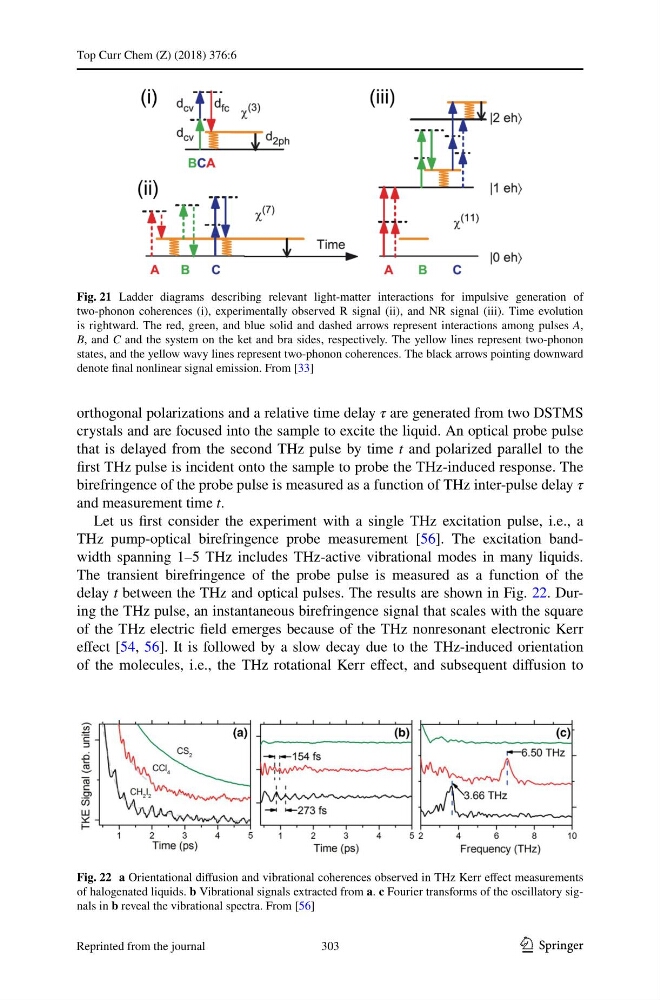
THz pump-optical birefringence probe measurement [56]. The excitation bandwidth spanning 1–5 THz includes THz-active vibrational modes in many liquids.
The transient birefringence of the probe pulse is measured as a function of the
delay t between the THz and optical pulses. The results are shown in Fig. 22. During the THz pulse, an instantaneous birefringence signal that scales with the square
of the THz electric field emerges because of the THz nonresonant electronic Kerr
effect [54, 56]. It is followed by a slow decay due to the THz-induced orientation
of the molecules, i.e., the THz rotational Kerr effect, and subsequent diffusion to
Fig. 21 Ladder diagrams describing relevant light-matter interactions for impulsive generation of
two-phonon coherences (i), experimentally observed R signal (ii), and NR signal (iii). Time evolution
is rightward. The red, green, and blue solid and dashed arrows represent interactions among pulses A,
B, and C and the system on the ket and bra sides, respectively. The yellow lines represent two-phonon
states, and the yellow wavy lines represent two-phonon coherences. The black arrows pointing downward
denote final nonlinear signal emission. From [33]
Fig. 22 a Orientational diffusion and vibrational coherences observed in THz Kerr effect measurements
of halogenated liquids. b Vibrational signals extracted from a. c Fourier transforms of the oscillatory signals in b reveal the vibrational spectra. From [56]
303
Reprinted from the journal
Top Curr Chem (Z) (2018) 376:6
orthogonal polarizations and a relative time delay τ are generated from two DSTMS
crystals and are focused into the sample to excite the liquid. An optical probe pulse
that is delayed from the second THz pulse by time t and polarized parallel to the
first THz pulse is incident onto the sample to probe the THz-induced response. The
birefringence of the probe pulse is measured as a function of THz inter-pulse delay τ
and measurement time t.
Let us first consider the experiment with a single THz excitation pulse, i.e., a
THz pump-optical birefringence probe measurement [56]. The excitation bandwidth spanning 1–5 THz includes THz-active vibrational modes in many liquids.
The transient birefringence of the probe pulse is measured as a function of the
delay t between the THz and optical pulses. The results are shown in Fig. 22. During the THz pulse, an instantaneous birefringence signal that scales with the square
of the THz electric field emerges because of the THz nonresonant electronic Kerr
effect [54, 56]. It is followed by a slow decay due to the THz-induced orientation
of the molecules, i.e., the THz rotational Kerr effect, and subsequent diffusion to
Fig. 21 Ladder diagrams describing relevant light-matter interactions for impulsive generation of
two-phonon coherences (i), experimentally observed R signal (ii), and NR signal (iii). Time evolution
is rightward. The red, green, and blue solid and dashed arrows represent interactions among pulses A,
B, and C and the system on the ket and bra sides, respectively. The yellow lines represent two-phonon
states, and the yellow wavy lines represent two-phonon coherences. The black arrows pointing downward
denote final nonlinear signal emission. From [33]
Fig. 22 a Orientational diffusion and vibrational coherences observed in THz Kerr effect measurements
of halogenated liquids. b Vibrational signals extracted from a. c Fourier transforms of the oscillatory signals in b reveal the vibrational spectra. From [56]
303
Reprinted from the journal