

1 3
Top Curr Chem (Z) (2018) 376:6
consists of J-resolved spectral peaks located at the frequencies of rotational 1QCs or
2QCs as will be discussed below.
The NR and R quadrants of the 2D magnitude spectrum of CH 3 CN are plotted
separately in Fig. 16, with the excitation frequency ν of the R quadrant made positive. Enlarged spectra at the centers of each quadrant are shown and plotted as a
function of rotational J quantum number. Each quadrant is normalized to its maximum amplitude. Weak spectral features of the fifth-order 2Q-R signals appear along
the frequency diagonal ν = 2f when they are magnified. The THz field-dipole interaction pathways for the different types of signal are discussed as follows.
In the NR and R signals, J-state-resolved diagonal peaks are clearly observed
along the frequency diagonals ν = f in Fig. 16a, b. For these diagonal peaks,
THz pulse A interacts once with the molecular dipoles to induce first-order 1QCs
described by density matrix elements |J〉〈J + 1|. After inter-pulse delay τ, pulse
B interacts twice with the dipoles to induce in succession second-order rotational
populations |J + 1〉〈J + 1| and third-order 1QCs |J〉〈J + 1| (NR) or |J + 1〉〈J| (R).
The NR and R signals are radiated by these third-order 1QCs and are measured
during the detection time t. The third-order nonlinear signal field E NL (t, τ) shows
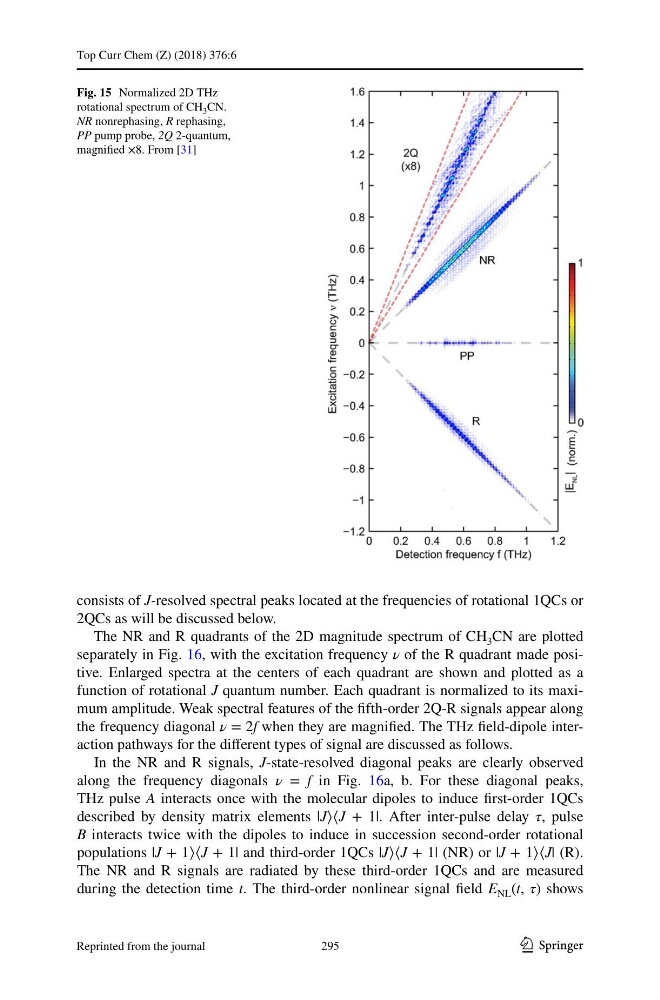
Fig. 15 Normalized 2D THz
rotational spectrum of CH 3 CN.
NR nonrephasing, R rephasing,
PP pump probe, 2Q 2-quantum,
magnified ×8. From [31]
295
Reprinted from the journal
Top Curr Chem (Z) (2018) 376:6
consists of J-resolved spectral peaks located at the frequencies of rotational 1QCs or
2QCs as will be discussed below.
The NR and R quadrants of the 2D magnitude spectrum of CH 3 CN are plotted
separately in Fig. 16, with the excitation frequency ν of the R quadrant made positive. Enlarged spectra at the centers of each quadrant are shown and plotted as a
function of rotational J quantum number. Each quadrant is normalized to its maximum amplitude. Weak spectral features of the fifth-order 2Q-R signals appear along
the frequency diagonal ν = 2f when they are magnified. The THz field-dipole interaction pathways for the different types of signal are discussed as follows.
In the NR and R signals, J-state-resolved diagonal peaks are clearly observed
along the frequency diagonals ν = f in Fig. 16a, b. For these diagonal peaks,
THz pulse A interacts once with the molecular dipoles to induce first-order 1QCs
described by density matrix elements |J〉〈J + 1|. After inter-pulse delay τ, pulse
B interacts twice with the dipoles to induce in succession second-order rotational
populations |J + 1〉〈J + 1| and third-order 1QCs |J〉〈J + 1| (NR) or |J + 1〉〈J| (R).
The NR and R signals are radiated by these third-order 1QCs and are measured
during the detection time t. The third-order nonlinear signal field E NL (t, τ) shows
Fig. 15 Normalized 2D THz
rotational spectrum of CH 3 CN.
NR nonrephasing, R rephasing,
PP pump probe, 2Q 2-quantum,
magnified ×8. From [31]
295
Reprinted from the journal