

1 3
Top Curr Chem (Z) (2018) 376:6
3.3 2D THz Rotational Spectroscopy of Acetonitrile
In molecular rotations, there have been theoretical works that predict the possibility to observe THz photon echoes using both classical calculation of the rigidrotor angular distribution [68] and quantum mechanical calculation of the dipolar
orientation [26] in response to pairs of time-delayed THz pulses. The characteristic frequency patterns and the narrow linewidths typically observed in molecular
rotational spectroscopy make it an ideal testbed for measurement of rephasing (R
or photon echo) and other contributions to 2D THz spectra. The 2D THz rotational
spectra were observed for the first time in CH 3 CN [31].
The experimental setup is the same as shown in Fig. 6, where a static pressure
gas cell with CH 3 CN is placed at the sample position. Nonlinear signal traces E NL
as a function of EOS detection time t at various inter-pulse delays τ are measured by
the differential chopping detection technique. The nonlinear signals E NL are shown
in Fig. 14. THz pulse B is fixed at t = 0, and a positive inter-pulse delay τ is incremented, which means THz pulse A appears earlier than pulse B. At each delay τ
shown in the insets, a burst of THz signal appears at t = τ, which confirms that the
observed signals are photon echoes. As THz signal emission results from the collective polarization formed during the orientation of the molecular dipoles, the photon
echo signals also show periodic revivals, of the same form as the linear FID signals. In this process, pulse A interacts with the dipoles once and generates first-order
1QCs that evolve and accumulate phase during τ. Pulse B interacts with the dipoles
twice, generating second-order populations and third-order 1QCs with reversed
phase accumulation with respect to the first-order 1QCs. The third-order 1QCs are
in phase at t = τ and at t = τ + nT rev , (n = 1, 2, 3…), at which times they form collective polarizations that radiate the photon echo signals. At the revivals of THz pulse
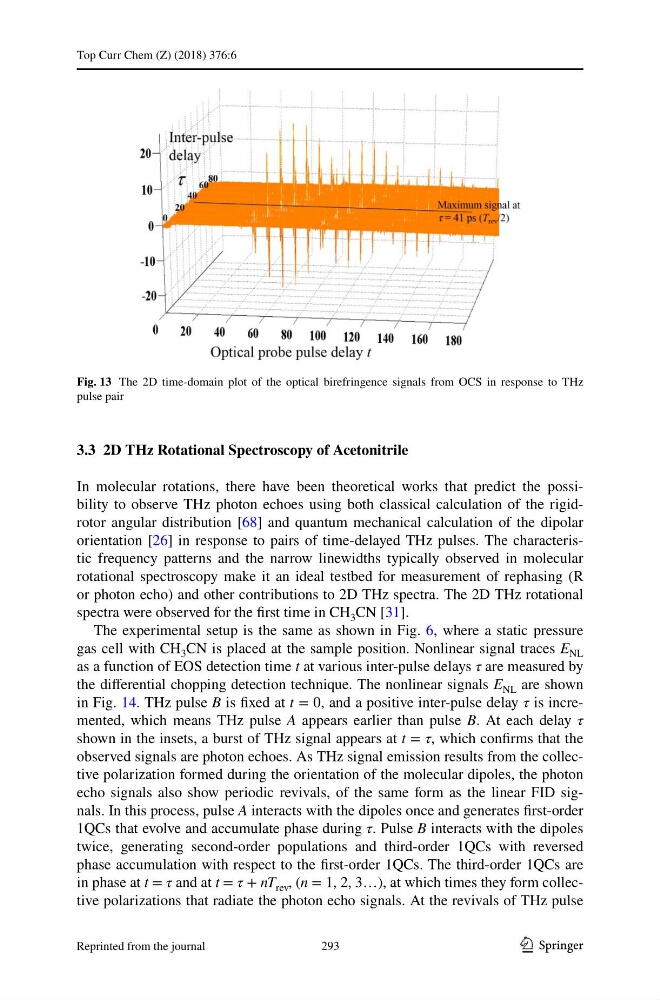
Fig. 13 The 2D time-domain plot of the optical birefringence signals from OCS in response to THz
pulse pair
293
Reprinted from the journal
Top Curr Chem (Z) (2018) 376:6
3.3 2D THz Rotational Spectroscopy of Acetonitrile
In molecular rotations, there have been theoretical works that predict the possibility to observe THz photon echoes using both classical calculation of the rigidrotor angular distribution [68] and quantum mechanical calculation of the dipolar
orientation [26] in response to pairs of time-delayed THz pulses. The characteristic frequency patterns and the narrow linewidths typically observed in molecular
rotational spectroscopy make it an ideal testbed for measurement of rephasing (R
or photon echo) and other contributions to 2D THz spectra. The 2D THz rotational
spectra were observed for the first time in CH 3 CN [31].
The experimental setup is the same as shown in Fig. 6, where a static pressure
gas cell with CH 3 CN is placed at the sample position. Nonlinear signal traces E NL
as a function of EOS detection time t at various inter-pulse delays τ are measured by
the differential chopping detection technique. The nonlinear signals E NL are shown
in Fig. 14. THz pulse B is fixed at t = 0, and a positive inter-pulse delay τ is incremented, which means THz pulse A appears earlier than pulse B. At each delay τ
shown in the insets, a burst of THz signal appears at t = τ, which confirms that the
observed signals are photon echoes. As THz signal emission results from the collective polarization formed during the orientation of the molecular dipoles, the photon
echo signals also show periodic revivals, of the same form as the linear FID signals. In this process, pulse A interacts with the dipoles once and generates first-order
1QCs that evolve and accumulate phase during τ. Pulse B interacts with the dipoles
twice, generating second-order populations and third-order 1QCs with reversed
phase accumulation with respect to the first-order 1QCs. The third-order 1QCs are
in phase at t = τ and at t = τ + nT rev , (n = 1, 2, 3…), at which times they form collective polarizations that radiate the photon echo signals. At the revivals of THz pulse
Fig. 13 The 2D time-domain plot of the optical birefringence signals from OCS in response to THz
pulse pair
293
Reprinted from the journal