

Top Curr Chem (Z) (2018) 376:6
1 3
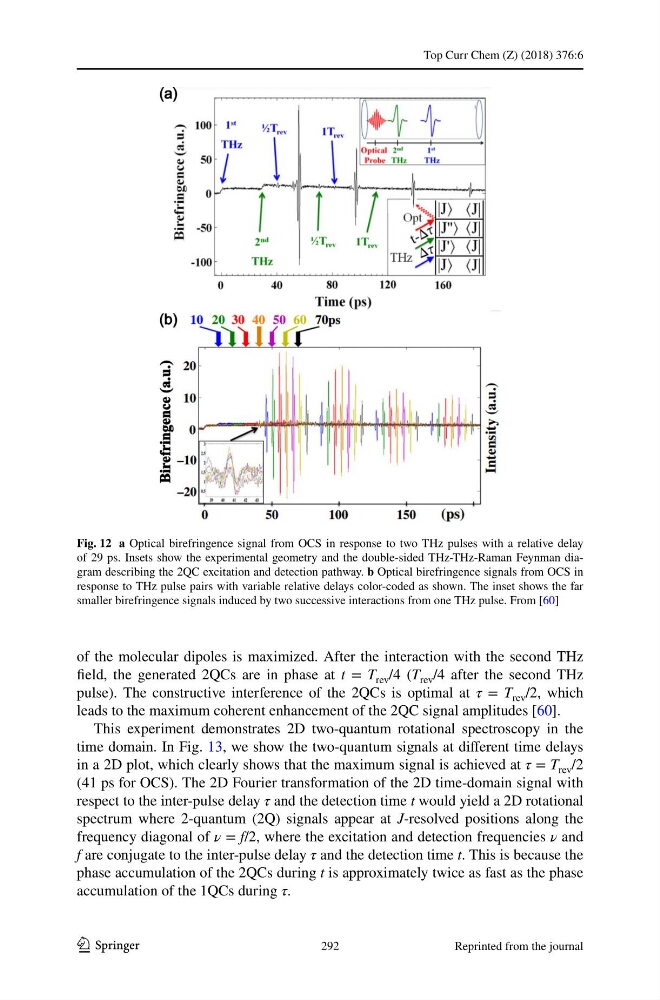
of the molecular dipoles is maximized. After the interaction with the second THz
field, the generated 2QCs are in phase at t = T rev /4 (T rev /4 after the second THz
pulse). The constructive interference of the 2QCs is optimal at τ = T rev /2, which
leads to the maximum coherent enhancement of the 2QC signal amplitudes [60].
This experiment demonstrates 2D two-quantum rotational spectroscopy in the
time domain. In Fig. 13, we show the two-quantum signals at different time delays
in a 2D plot, which clearly shows that the maximum signal is achieved at τ = T rev /2
(41 ps for OCS). The 2D Fourier transformation of the 2D time-domain signal with
respect to the inter-pulse delay τ and the detection time t would yield a 2D rotational
spectrum where 2-quantum (2Q) signals appear at J-resolved positions along the
frequency diagonal of ν = f/2, where the excitation and detection frequencies ν and
f are conjugate to the inter-pulse delay τ and the detection time t. This is because the
phase accumulation of the 2QCs during t is approximately twice as fast as the phase
accumulation of the 1QCs during τ.
Fig. 12 a Optical birefringence signal from OCS in response to two THz pulses with a relative delay
of 29 ps. Insets show the experimental geometry and the double-sided THz-THz-Raman Feynman diagram describing the 2QC excitation and detection pathway. b Optical birefringence signals from OCS in
response to THz pulse pairs with variable relative delays color-coded as shown. The inset shows the far
smaller birefringence signals induced by two successive interactions from one THz pulse. From [60]
292
Reprinted from the journal
1 3
of the molecular dipoles is maximized. After the interaction with the second THz
field, the generated 2QCs are in phase at t = T rev /4 (T rev /4 after the second THz
pulse). The constructive interference of the 2QCs is optimal at τ = T rev /2, which
leads to the maximum coherent enhancement of the 2QC signal amplitudes [60].
This experiment demonstrates 2D two-quantum rotational spectroscopy in the
time domain. In Fig. 13, we show the two-quantum signals at different time delays
in a 2D plot, which clearly shows that the maximum signal is achieved at τ = T rev /2
(41 ps for OCS). The 2D Fourier transformation of the 2D time-domain signal with
respect to the inter-pulse delay τ and the detection time t would yield a 2D rotational
spectrum where 2-quantum (2Q) signals appear at J-resolved positions along the
frequency diagonal of ν = f/2, where the excitation and detection frequencies ν and
f are conjugate to the inter-pulse delay τ and the detection time t. This is because the
phase accumulation of the 2QCs during t is approximately twice as fast as the phase
accumulation of the 1QCs during τ.
Fig. 12 a Optical birefringence signal from OCS in response to two THz pulses with a relative delay
of 29 ps. Insets show the experimental geometry and the double-sided THz-THz-Raman Feynman diagram describing the 2QC excitation and detection pathway. b Optical birefringence signals from OCS in
response to THz pulse pairs with variable relative delays color-coded as shown. The inset shows the far
smaller birefringence signals induced by two successive interactions from one THz pulse. From [60]
292
Reprinted from the journal