

1 3
Top Curr Chem (Z) (2018) 376:6
the 2J + 1 degenerate rotational sublevels labeled by quantum number M, where
M = − J, − J + 1, …, J − 1, J, while the excited population in level J + 1 includes
only the same sublevels and not the two sublevels − (J + 1) and (J + 1) because of
the ΔM = 0 selection rule.
As the molecular alignment involves two THz field-dipole interactions, one can
separate these two interactions and control the amplitudes of 2QCs using two timedelayed THz pulses. Molecular alignment in response to two time-delayed THz
pulses has been measured [60], yielding the results shown in Fig. 12. The pulse
sequence used in the experiment is shown in the inset of Fig. 12a, which is the same
as the THz-THz-Raman sequence shown in Fig. 4b. In Fig. 12a, the birefringence
signal induced by two THz pulses with an inter-pulse delay of τ is separated from the
second THz pulse by τ/2. The 2QC signal level from time-delayed field-dipole interactions is far higher than that induced by two field-dipole interactions from either
individual THz pulse. In Fig. 12b, the birefringence signals are measured at several
different inter-pulse delays, and the 2QCs signals achieve the maximum amplitude
when the delay τ is close to T rev /2 = 41 ps. This is because at τ = T rev /2, the 1QCs
induced by the first THz pulse with odd-number J are in phase with each other, and
those with even-number J are also in phase with each other, and the alignment factor
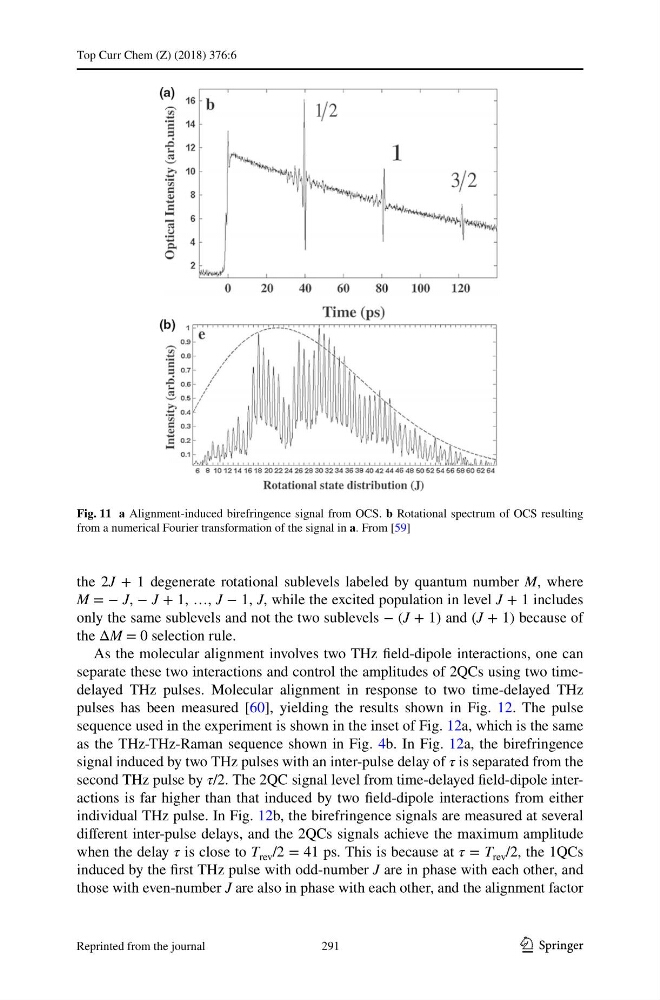
Fig. 11 a Alignment-induced birefringence signal from OCS. b Rotational spectrum of OCS resulting
from a numerical Fourier transformation of the signal in a. From [59]
291
Reprinted from the journal
Top Curr Chem (Z) (2018) 376:6
the 2J + 1 degenerate rotational sublevels labeled by quantum number M, where
M = − J, − J + 1, …, J − 1, J, while the excited population in level J + 1 includes
only the same sublevels and not the two sublevels − (J + 1) and (J + 1) because of
the ΔM = 0 selection rule.
As the molecular alignment involves two THz field-dipole interactions, one can
separate these two interactions and control the amplitudes of 2QCs using two timedelayed THz pulses. Molecular alignment in response to two time-delayed THz
pulses has been measured [60], yielding the results shown in Fig. 12. The pulse
sequence used in the experiment is shown in the inset of Fig. 12a, which is the same
as the THz-THz-Raman sequence shown in Fig. 4b. In Fig. 12a, the birefringence
signal induced by two THz pulses with an inter-pulse delay of τ is separated from the
second THz pulse by τ/2. The 2QC signal level from time-delayed field-dipole interactions is far higher than that induced by two field-dipole interactions from either
individual THz pulse. In Fig. 12b, the birefringence signals are measured at several
different inter-pulse delays, and the 2QCs signals achieve the maximum amplitude
when the delay τ is close to T rev /2 = 41 ps. This is because at τ = T rev /2, the 1QCs
induced by the first THz pulse with odd-number J are in phase with each other, and
those with even-number J are also in phase with each other, and the alignment factor
Fig. 11 a Alignment-induced birefringence signal from OCS. b Rotational spectrum of OCS resulting
from a numerical Fourier transformation of the signal in a. From [59]
291
Reprinted from the journal