

Top Curr Chem (Z) (2018) 376:6
1 3
3 2D THz Rotational Spectroscopy of Gas‑Phase Molecules
3.1 Molecular Orientation Induced by THz Pulses
Rotational dynamics of polar molecules have been the subject of extensive efforts
in coherent spectroscopy and coherent control. Motivated by interests in rotational
angular momentum, energy relaxation processes, and high-order optical interactions
with multilevel quantum systems, rotational excitations were examined by optical,
microwave, and THz spectroscopies. Due to their unique energy level structure and
their inherently quantum mechanical behavior, molecular rotations show dramatic
differences from other degrees of freedom such as vibrations and spin precessions.
We first discuss the linear responses of polar molecules to THz excitation.
For small linear molecules with a permanent dipole moment, the Hamiltonian
considering linear THz field-dipole interactions is given by
The static Hamiltonian H 0 is assumed to be a rigid rotor Hamiltonian, which
accounts for the rotational dynamics of linear molecules. In H 0 , ̂
J is the angular
momentum operator and I the moment of inertia, given by I = h/8π
2
cB where h is the
Planck constant, c is the speed of light, and B is the rotational constant of the molecule. ̂
H 0 in this form has an analytical solution. The eigenvectors are constructed
by spherical harmonics, and the eigenenergies are given by E J = 2hBcJ(J + 1)
as shown in Fig. 10a. Here, each eigenstate is denoted by the angular momentum quantum number J, and the energy difference between two adjacent J states
is given by ΔE J,J+1 = 2hBc(J + 1). The field-dipole interaction Hamiltonian is
H 1 = − ⋅ THz (t) = −E THz (t) cos , where θ is the angle between the permanent
(6)
H = H 0 + H 1 = ̂
J
2 ∕2I − ⋅ THz (t).
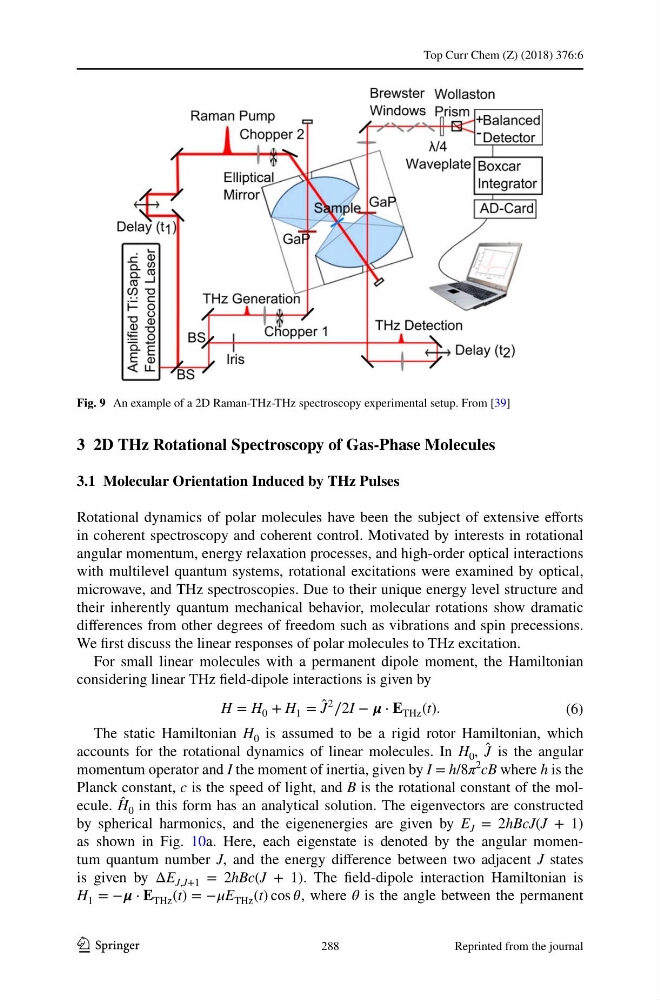
Fig. 9 An example of a 2D Raman-THz-THz spectroscopy experimental setup. From [39]
288
Reprinted from the journal
1 3
3 2D THz Rotational Spectroscopy of Gas‑Phase Molecules
3.1 Molecular Orientation Induced by THz Pulses
Rotational dynamics of polar molecules have been the subject of extensive efforts
in coherent spectroscopy and coherent control. Motivated by interests in rotational
angular momentum, energy relaxation processes, and high-order optical interactions
with multilevel quantum systems, rotational excitations were examined by optical,
microwave, and THz spectroscopies. Due to their unique energy level structure and
their inherently quantum mechanical behavior, molecular rotations show dramatic
differences from other degrees of freedom such as vibrations and spin precessions.
We first discuss the linear responses of polar molecules to THz excitation.
For small linear molecules with a permanent dipole moment, the Hamiltonian
considering linear THz field-dipole interactions is given by
The static Hamiltonian H 0 is assumed to be a rigid rotor Hamiltonian, which
accounts for the rotational dynamics of linear molecules. In H 0 , ̂
J is the angular
momentum operator and I the moment of inertia, given by I = h/8π
2
cB where h is the
Planck constant, c is the speed of light, and B is the rotational constant of the molecule. ̂
H 0 in this form has an analytical solution. The eigenvectors are constructed
by spherical harmonics, and the eigenenergies are given by E J = 2hBcJ(J + 1)
as shown in Fig. 10a. Here, each eigenstate is denoted by the angular momentum quantum number J, and the energy difference between two adjacent J states
is given by ΔE J,J+1 = 2hBc(J + 1). The field-dipole interaction Hamiltonian is
H 1 = − ⋅ THz (t) = −E THz (t) cos , where θ is the angle between the permanent
(6)
H = H 0 + H 1 = ̂
J
2 ∕2I − ⋅ THz (t).
Fig. 9 An example of a 2D Raman-THz-THz spectroscopy experimental setup. From [39]
288
Reprinted from the journal