

1 3
Top Curr Chem (Z) (2018) 376:6
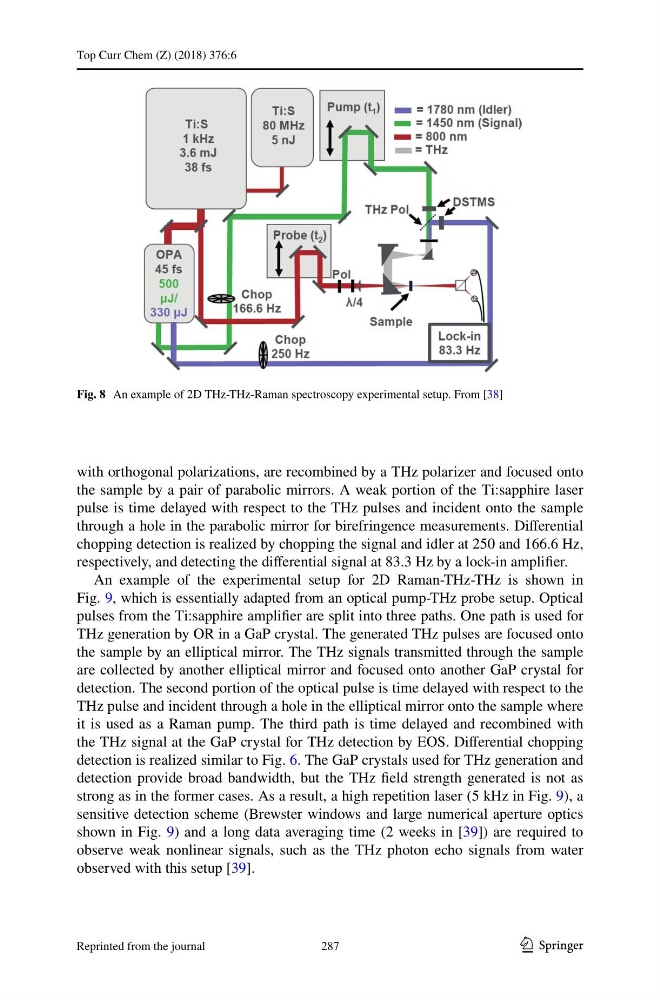
with orthogonal polarizations, are recombined by a THz polarizer and focused onto
the sample by a pair of parabolic mirrors. A weak portion of the Ti:sapphire laser
pulse is time delayed with respect to the THz pulses and incident onto the sample
through a hole in the parabolic mirror for birefringence measurements. Differential
chopping detection is realized by chopping the signal and idler at 250 and 166.6 Hz,
respectively, and detecting the differential signal at 83.3 Hz by a lock-in amplifier.
An example of the experimental setup for 2D Raman-THz-THz is shown in
Fig. 9, which is essentially adapted from an optical pump-THz probe setup. Optical
pulses from the Ti:sapphire amplifier are split into three paths. One path is used for
THz generation by OR in a GaP crystal. The generated THz pulses are focused onto
the sample by an elliptical mirror. The THz signals transmitted through the sample
are collected by another elliptical mirror and focused onto another GaP crystal for
detection. The second portion of the optical pulse is time delayed with respect to the
THz pulse and incident through a hole in the elliptical mirror onto the sample where
it is used as a Raman pump. The third path is time delayed and recombined with
the THz signal at the GaP crystal for THz detection by EOS. Differential chopping
detection is realized similar to Fig. 6. The GaP crystals used for THz generation and
detection provide broad bandwidth, but the THz field strength generated is not as
strong as in the former cases. As a result, a high repetition laser (5 kHz in Fig. 9), a
sensitive detection scheme (Brewster windows and large numerical aperture optics
shown in Fig. 9) and a long data averaging time (2 weeks in [39]) are required to
observe weak nonlinear signals, such as the THz photon echo signals from water
observed with this setup [39].
Fig. 8 An example of 2D THz-THz-Raman spectroscopy experimental setup. From [38]
287
Reprinted from the journal
Top Curr Chem (Z) (2018) 376:6
with orthogonal polarizations, are recombined by a THz polarizer and focused onto
the sample by a pair of parabolic mirrors. A weak portion of the Ti:sapphire laser
pulse is time delayed with respect to the THz pulses and incident onto the sample
through a hole in the parabolic mirror for birefringence measurements. Differential
chopping detection is realized by chopping the signal and idler at 250 and 166.6 Hz,
respectively, and detecting the differential signal at 83.3 Hz by a lock-in amplifier.
An example of the experimental setup for 2D Raman-THz-THz is shown in
Fig. 9, which is essentially adapted from an optical pump-THz probe setup. Optical
pulses from the Ti:sapphire amplifier are split into three paths. One path is used for
THz generation by OR in a GaP crystal. The generated THz pulses are focused onto
the sample by an elliptical mirror. The THz signals transmitted through the sample
are collected by another elliptical mirror and focused onto another GaP crystal for
detection. The second portion of the optical pulse is time delayed with respect to the
THz pulse and incident through a hole in the elliptical mirror onto the sample where
it is used as a Raman pump. The third path is time delayed and recombined with
the THz signal at the GaP crystal for THz detection by EOS. Differential chopping
detection is realized similar to Fig. 6. The GaP crystals used for THz generation and
detection provide broad bandwidth, but the THz field strength generated is not as
strong as in the former cases. As a result, a high repetition laser (5 kHz in Fig. 9), a
sensitive detection scheme (Brewster windows and large numerical aperture optics
shown in Fig. 9) and a long data averaging time (2 weeks in [39]) are required to
observe weak nonlinear signals, such as the THz photon echo signals from water
observed with this setup [39].
Fig. 8 An example of 2D THz-THz-Raman spectroscopy experimental setup. From [38]
287
Reprinted from the journal