

Top Curr Chem (Z) (2018) 376:6
1 3
method. The collinearly propagating THz pulses are collimated and focused into
the sample by a pair of parabolic mirrors. The peak THz electric field strength is
typically larger than 0.3 MV/cm for each pulse. THz signals transmitted through the
sample are collected and re-focused into an EO crystal for detection. Two choppers
are used to modulate the optical beams that generate the THz pulse pair. The differential nonlinear signal E NL is processed by a data acquisition (DAQ) card. The total
data acquisition time depending on the time windows required for τ and t as well as
data averaging typically ranges from 1 day to 1 week.
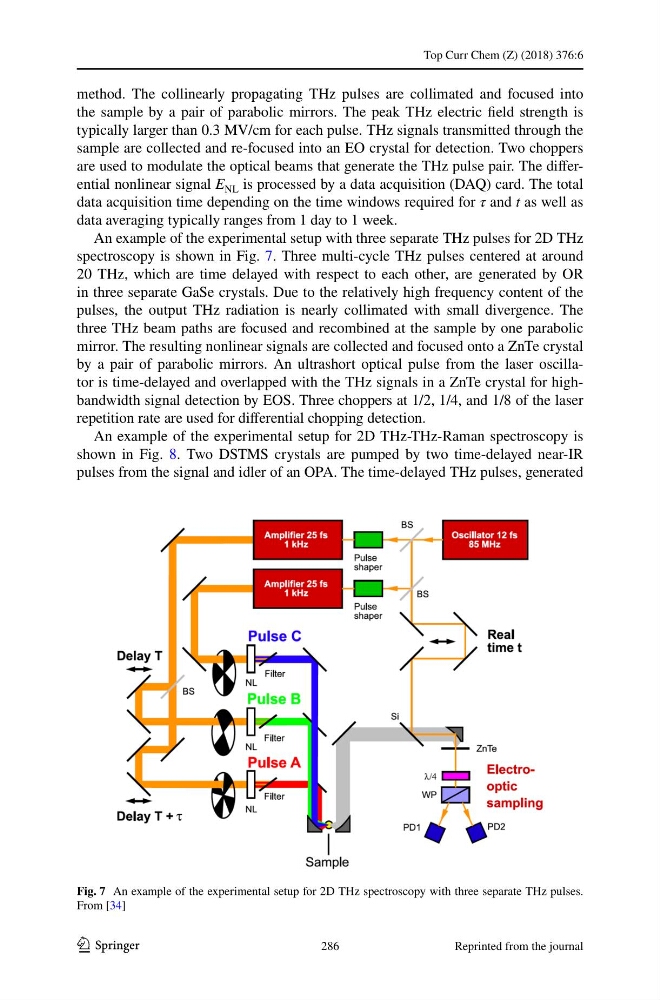
An example of the experimental setup with three separate THz pulses for 2D THz
spectroscopy is shown in Fig. 7. Three multi-cycle THz pulses centered at around
20 THz, which are time delayed with respect to each other, are generated by OR
in three separate GaSe crystals. Due to the relatively high frequency content of the
pulses, the output THz radiation is nearly collimated with small divergence. The
three THz beam paths are focused and recombined at the sample by one parabolic
mirror. The resulting nonlinear signals are collected and focused onto a ZnTe crystal
by a pair of parabolic mirrors. An ultrashort optical pulse from the laser oscillator is time-delayed and overlapped with the THz signals in a ZnTe crystal for highbandwidth signal detection by EOS. Three choppers at 1/2, 1/4, and 1/8 of the laser
repetition rate are used for differential chopping detection.
An example of the experimental setup for 2D THz-THz-Raman spectroscopy is
shown in Fig. 8. Two DSTMS crystals are pumped by two time-delayed near-IR
pulses from the signal and idler of an OPA. The time-delayed THz pulses, generated
Fig. 7 An example of the experimental setup for 2D THz spectroscopy with three separate THz pulses.
From [34]
286
Reprinted from the journal
1 3
method. The collinearly propagating THz pulses are collimated and focused into
the sample by a pair of parabolic mirrors. The peak THz electric field strength is
typically larger than 0.3 MV/cm for each pulse. THz signals transmitted through the
sample are collected and re-focused into an EO crystal for detection. Two choppers
are used to modulate the optical beams that generate the THz pulse pair. The differential nonlinear signal E NL is processed by a data acquisition (DAQ) card. The total
data acquisition time depending on the time windows required for τ and t as well as
data averaging typically ranges from 1 day to 1 week.
An example of the experimental setup with three separate THz pulses for 2D THz
spectroscopy is shown in Fig. 7. Three multi-cycle THz pulses centered at around
20 THz, which are time delayed with respect to each other, are generated by OR
in three separate GaSe crystals. Due to the relatively high frequency content of the
pulses, the output THz radiation is nearly collimated with small divergence. The
three THz beam paths are focused and recombined at the sample by one parabolic
mirror. The resulting nonlinear signals are collected and focused onto a ZnTe crystal
by a pair of parabolic mirrors. An ultrashort optical pulse from the laser oscillator is time-delayed and overlapped with the THz signals in a ZnTe crystal for highbandwidth signal detection by EOS. Three choppers at 1/2, 1/4, and 1/8 of the laser
repetition rate are used for differential chopping detection.
An example of the experimental setup for 2D THz-THz-Raman spectroscopy is
shown in Fig. 8. Two DSTMS crystals are pumped by two time-delayed near-IR
pulses from the signal and idler of an OPA. The time-delayed THz pulses, generated
Fig. 7 An example of the experimental setup for 2D THz spectroscopy with three separate THz pulses.
From [34]
286
Reprinted from the journal