

1 3
Top Curr Chem (Z) (2018) 376:6
S NL (t, τ) is not restricted to χ
(3)
signals, as nonlinear signals of other orders are also
collinear. Numerical 2D Fourier transformation of S NL (t, τ) with respect to t and τ
yields the 2D spectrum as a function of detection and excitation frequencies denoted
as f and ν, respectively. Different contributions to the signal field S NL (t, τ) associated
with different interaction pathways have different characteristics and phase accumulation as functions of t and τ, so spectral peaks of different types can be separated in
the 2D spectrum, which we will elaborate with examples in the subsequent sections.
Differential chopping detection in experiments that have three separate THz
pulses denoted by A, B and C becomes more complicated, as the signals that originate from each individual pulse and each pair of pulses need to be accounted for.
The nonlinear signal field is described by the following equation:
where τ is the coherence time, T w is the population time or waiting time, and t is the
detection time. Details about the nonlinear signal detection method in experiments
that involve three separate THz pulses can be found in references [33, 34].
2.3 Experimental Setups for 2D THz and 2D THz‑Raman Spectroscopies
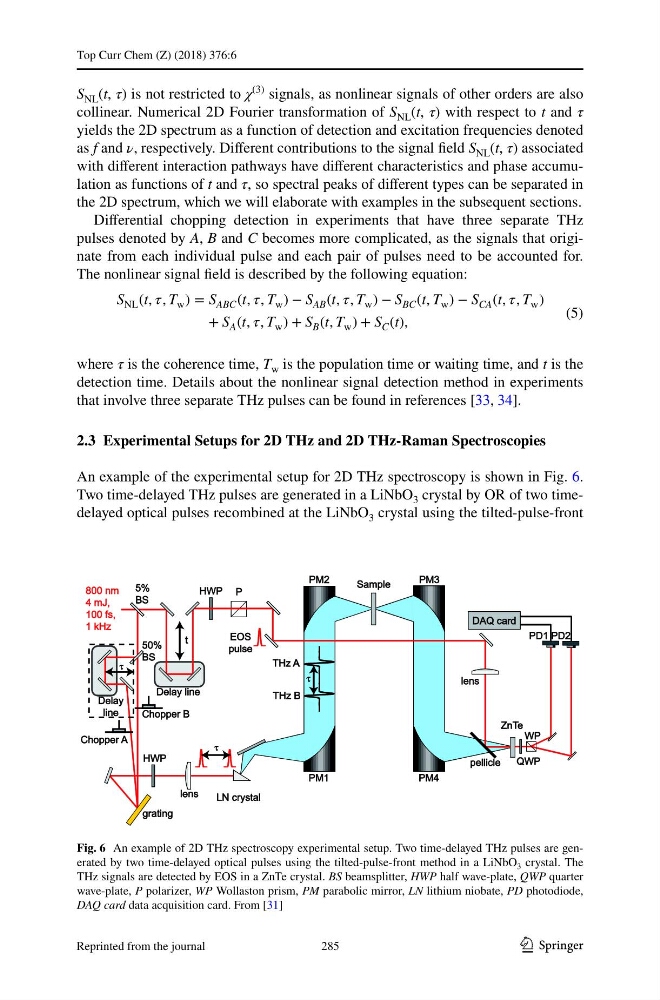
An example of the experimental setup for 2D THz spectroscopy is shown in Fig. 6.
Two time-delayed THz pulses are generated in a LiNbO 3 crystal by OR of two timedelayed optical pulses recombined at the LiNbO 3 crystal using the tilted-pulse-front
(5)
S NL (t, , T w ) = S ABC (t, , T w ) − S AB (t, , T w ) − S BC (t, T w ) − S CA (t, , T w )
+ S A (t, , T w ) + S B (t, T w ) + S C (t),
Fig. 6 An example of 2D THz spectroscopy experimental setup. Two time-delayed THz pulses are generated by two time-delayed optical pulses using the tilted-pulse-front method in a LiNbO 3 crystal. The
THz signals are detected by EOS in a ZnTe crystal. BS beamsplitter, HWP half wave-plate, QWP quarter
wave-plate, P polarizer, WP Wollaston prism, PM parabolic mirror, LN lithium niobate, PD photodiode,
DAQ card data acquisition card. From [31]
285
Reprinted from the journal
Top Curr Chem (Z) (2018) 376:6
S NL (t, τ) is not restricted to χ
(3)
signals, as nonlinear signals of other orders are also
collinear. Numerical 2D Fourier transformation of S NL (t, τ) with respect to t and τ
yields the 2D spectrum as a function of detection and excitation frequencies denoted
as f and ν, respectively. Different contributions to the signal field S NL (t, τ) associated
with different interaction pathways have different characteristics and phase accumulation as functions of t and τ, so spectral peaks of different types can be separated in
the 2D spectrum, which we will elaborate with examples in the subsequent sections.
Differential chopping detection in experiments that have three separate THz
pulses denoted by A, B and C becomes more complicated, as the signals that originate from each individual pulse and each pair of pulses need to be accounted for.
The nonlinear signal field is described by the following equation:
where τ is the coherence time, T w is the population time or waiting time, and t is the
detection time. Details about the nonlinear signal detection method in experiments
that involve three separate THz pulses can be found in references [33, 34].
2.3 Experimental Setups for 2D THz and 2D THz‑Raman Spectroscopies
An example of the experimental setup for 2D THz spectroscopy is shown in Fig. 6.
Two time-delayed THz pulses are generated in a LiNbO 3 crystal by OR of two timedelayed optical pulses recombined at the LiNbO 3 crystal using the tilted-pulse-front
(5)
S NL (t, , T w ) = S ABC (t, , T w ) − S AB (t, , T w ) − S BC (t, T w ) − S CA (t, , T w )
+ S A (t, , T w ) + S B (t, T w ) + S C (t),
Fig. 6 An example of 2D THz spectroscopy experimental setup. Two time-delayed THz pulses are generated by two time-delayed optical pulses using the tilted-pulse-front method in a LiNbO 3 crystal. The
THz signals are detected by EOS in a ZnTe crystal. BS beamsplitter, HWP half wave-plate, QWP quarter
wave-plate, P polarizer, WP Wollaston prism, PM parabolic mirror, LN lithium niobate, PD photodiode,
DAQ card data acquisition card. From [31]
285
Reprinted from the journal