

Top Curr Chem (Z) (2018) 376:6
1 3
OR with collinear phase matching [27, 34]. These three THz generation methods are
used in the works reviewed in this chapter. There are also other methods for strong
and broadband THz pulse generation using either fs lasers in tabletop setups [45, 46]
or relativistic electron bunches in accelerators [47, 48], which will not be discussed
here. We note that the THz electric field profile is determined from the optical pump
pulse intensity profile, so the THz fields used for 2D THz spectroscopy are inherently carrier-envelope phase-stable. This simplifies measurement of the full THz
field as described below.
2.1.2 THz Time‑Domain Detection by Electro‑Optic Sampling
THz pulses generated as described above typically have sub-ps durations and can be
sampled in the time domain using optical gate pulses of considerably shorter duration. For that purpose, a weak portion of the fs pulse used for THz generation is used
to detect the THz electric field profile in a nonlinear optical crystal such as ZnTe
and GaP via the electro-optic (EO) Pockels effect, i.e., electro-optic sampling (EOS)
[49, 50]. As the THz generation and detection both originate from the same laser
pulse, timing jitter between the gate and THz pulses is minimal. The same measurement method is used for the nonlinear THz signals in 2D THz spectroscopy measurements. Because the time-dependent THz electric field profile is measured in this
manner, there is no need for heterodyne detection of the signal as typically used in
2D IR and visible spectroscopies.
The geometry for EOS is shown schematically in Fig. 3. The THz pulse and optical gate pulse, both with linear polarization, are focused into the EO crystal. Without the presence of the THz electric field, the gate pulse does not experience any
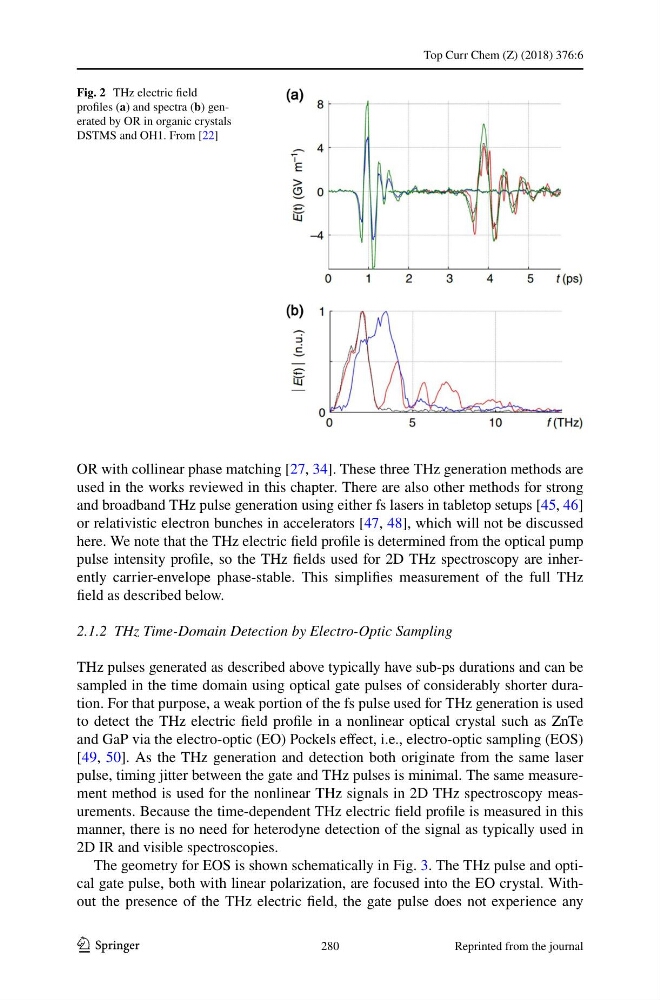
Fig. 2 THz electric field
profiles (a) and spectra (b) generated by OR in organic crystals
DSTMS and OH1. From [22]
280
Reprinted from the journal
1 3
OR with collinear phase matching [27, 34]. These three THz generation methods are
used in the works reviewed in this chapter. There are also other methods for strong
and broadband THz pulse generation using either fs lasers in tabletop setups [45, 46]
or relativistic electron bunches in accelerators [47, 48], which will not be discussed
here. We note that the THz electric field profile is determined from the optical pump
pulse intensity profile, so the THz fields used for 2D THz spectroscopy are inherently carrier-envelope phase-stable. This simplifies measurement of the full THz
field as described below.
2.1.2 THz Time‑Domain Detection by Electro‑Optic Sampling
THz pulses generated as described above typically have sub-ps durations and can be
sampled in the time domain using optical gate pulses of considerably shorter duration. For that purpose, a weak portion of the fs pulse used for THz generation is used
to detect the THz electric field profile in a nonlinear optical crystal such as ZnTe
and GaP via the electro-optic (EO) Pockels effect, i.e., electro-optic sampling (EOS)
[49, 50]. As the THz generation and detection both originate from the same laser
pulse, timing jitter between the gate and THz pulses is minimal. The same measurement method is used for the nonlinear THz signals in 2D THz spectroscopy measurements. Because the time-dependent THz electric field profile is measured in this
manner, there is no need for heterodyne detection of the signal as typically used in
2D IR and visible spectroscopies.
The geometry for EOS is shown schematically in Fig. 3. The THz pulse and optical gate pulse, both with linear polarization, are focused into the EO crystal. Without the presence of the THz electric field, the gate pulse does not experience any
Fig. 2 THz electric field
profiles (a) and spectra (b) generated by OR in organic crystals
DSTMS and OH1. From [22]
280
Reprinted from the journal