

1 3
Top Curr Chem (Z) (2018) 376:6
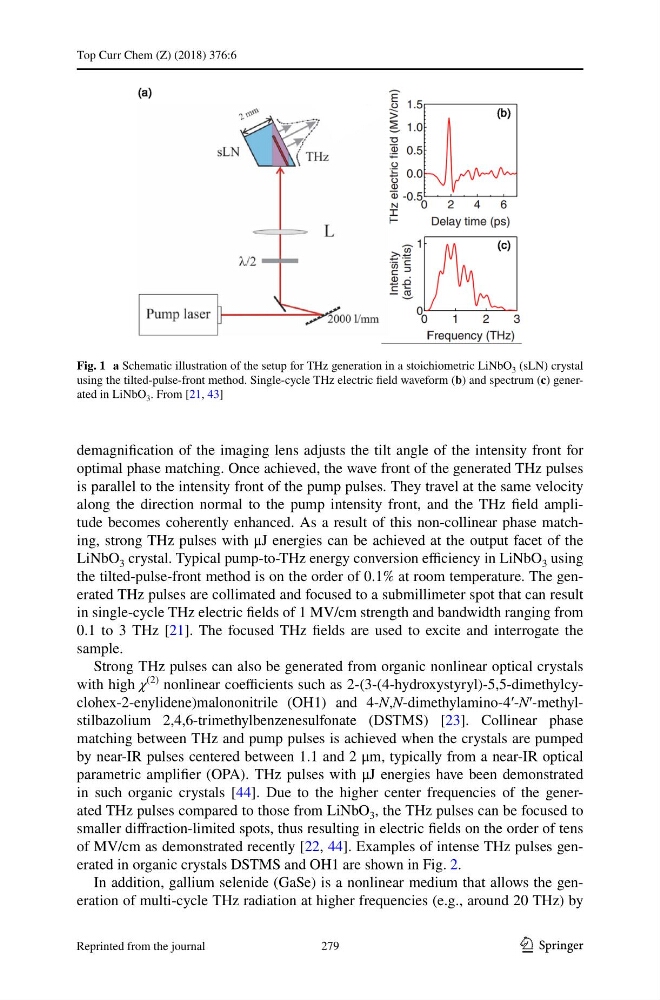
demagnification of the imaging lens adjusts the tilt angle of the intensity front for
optimal phase matching. Once achieved, the wave front of the generated THz pulses
is parallel to the intensity front of the pump pulses. They travel at the same velocity
along the direction normal to the pump intensity front, and the THz field amplitude becomes coherently enhanced. As a result of this non-collinear phase matching, strong THz pulses with μJ energies can be achieved at the output facet of the
LiNbO 3 crystal. Typical pump-to-THz energy conversion efficiency in LiNbO 3 using
the tilted-pulse-front method is on the order of 0.1% at room temperature. The generated THz pulses are collimated and focused to a submillimeter spot that can result
in single-cycle THz electric fields of 1 MV/cm strength and bandwidth ranging from
0.1 to 3 THz [21]. The focused THz fields are used to excite and interrogate the
sample.
Strong THz pulses can also be generated from organic nonlinear optical crystals
with high χ
(2)
nonlinear coefficients such as 2-(3-(4-hydroxystyryl)-5,5-dimethylcyclohex-2-enylidene)malononitrile (OH1) and 4-N,N-dimethylamino-4′-N′-methylstilbazolium 2,4,6-trimethylbenzenesulfonate (DSTMS) [23]. Collinear phase
matching between THz and pump pulses is achieved when the crystals are pumped
by near-IR pulses centered between 1.1 and 2 μm, typically from a near-IR optical
parametric amplifier (OPA). THz pulses with μJ energies have been demonstrated
in such organic crystals [44]. Due to the higher center frequencies of the generated THz pulses compared to those from LiNbO 3 , the THz pulses can be focused to
smaller diffraction-limited spots, thus resulting in electric fields on the order of tens
of MV/cm as demonstrated recently [22, 44]. Examples of intense THz pulses generated in organic crystals DSTMS and OH1 are shown in Fig. 2.
In addition, gallium selenide (GaSe) is a nonlinear medium that allows the generation of multi-cycle THz radiation at higher frequencies (e.g., around 20 THz) by
Fig. 1 a Schematic illustration of the setup for THz generation in a stoichiometric LiNbO 3 (sLN) crystal
using the tilted-pulse-front method. Single-cycle THz electric field waveform (b) and spectrum (c) generated in LiNbO 3 . From [21, 43]
279
Reprinted from the journal
Top Curr Chem (Z) (2018) 376:6
demagnification of the imaging lens adjusts the tilt angle of the intensity front for
optimal phase matching. Once achieved, the wave front of the generated THz pulses
is parallel to the intensity front of the pump pulses. They travel at the same velocity
along the direction normal to the pump intensity front, and the THz field amplitude becomes coherently enhanced. As a result of this non-collinear phase matching, strong THz pulses with μJ energies can be achieved at the output facet of the
LiNbO 3 crystal. Typical pump-to-THz energy conversion efficiency in LiNbO 3 using
the tilted-pulse-front method is on the order of 0.1% at room temperature. The generated THz pulses are collimated and focused to a submillimeter spot that can result
in single-cycle THz electric fields of 1 MV/cm strength and bandwidth ranging from
0.1 to 3 THz [21]. The focused THz fields are used to excite and interrogate the
sample.
Strong THz pulses can also be generated from organic nonlinear optical crystals
with high χ
(2)
nonlinear coefficients such as 2-(3-(4-hydroxystyryl)-5,5-dimethylcyclohex-2-enylidene)malononitrile (OH1) and 4-N,N-dimethylamino-4′-N′-methylstilbazolium 2,4,6-trimethylbenzenesulfonate (DSTMS) [23]. Collinear phase
matching between THz and pump pulses is achieved when the crystals are pumped
by near-IR pulses centered between 1.1 and 2 μm, typically from a near-IR optical
parametric amplifier (OPA). THz pulses with μJ energies have been demonstrated
in such organic crystals [44]. Due to the higher center frequencies of the generated THz pulses compared to those from LiNbO 3 , the THz pulses can be focused to
smaller diffraction-limited spots, thus resulting in electric fields on the order of tens
of MV/cm as demonstrated recently [22, 44]. Examples of intense THz pulses generated in organic crystals DSTMS and OH1 are shown in Fig. 2.
In addition, gallium selenide (GaSe) is a nonlinear medium that allows the generation of multi-cycle THz radiation at higher frequencies (e.g., around 20 THz) by
Fig. 1 a Schematic illustration of the setup for THz generation in a stoichiometric LiNbO 3 (sLN) crystal
using the tilted-pulse-front method. Single-cycle THz electric field waveform (b) and spectrum (c) generated in LiNbO 3 . From [21, 43]
279
Reprinted from the journal