

1 3
Topics in Current Chemistry (2018) 376:35
and will require in the future additional experimental and theoretical work to clarify
it. Nevertheless, the application to carotenoids illustrates the ability of multi-VCS
at revealing the signatures of vibrational dynamics involved in ultrafast, non-reactive, internal conversion. We will describe below another example of application of
multi-VCS to the investigation of photoreactive vibrational dynamics.
5.3 Photoisomerization of Stilbene and Derivates
Multidimensional VCS performs vibrational (Raman) spectroscopy of molecular
excited states, from the FC state to the photoproduct formation along the photoreaction pathway. Hence, it reports on the time evolution of the molecular structure,
which is particularly informative when monitoring photoreactions involving large
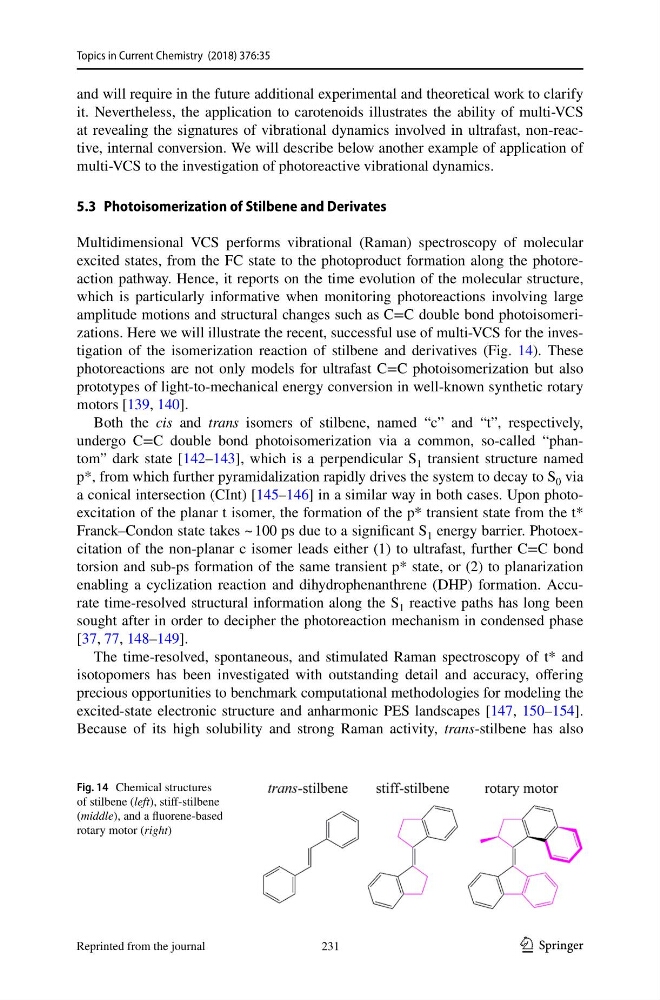
amplitude motions and structural changes such as C=C double bond photoisomerizations. Here we will illustrate the recent, successful use of multi-VCS for the investigation of the isomerization reaction of stilbene and derivatives (Fig. 14). These
photoreactions are not only models for ultrafast C=C photoisomerization but also
prototypes of light-to-mechanical energy conversion in well-known synthetic rotary
motors [139, 140].
Both the cis and trans isomers of stilbene, named “c” and “t”, respectively,
undergo C=C double bond photoisomerization via a common, so-called “phantom” dark state [142–143], which is a perpendicular S 1 transient structure named
p*, from which further pyramidalization rapidly drives the system to decay to S 0 via
a conical intersection (CInt) [145–146] in a similar way in both cases. Upon photoexcitation of the planar t isomer, the formation of the p* transient state from the t*
Franck–Condon state takes ~ 100 ps due to a significant S 1 energy barrier. Photoexcitation of the non-planar c isomer leads either (1) to ultrafast, further C=C bond
torsion and sub-ps formation of the same transient p* state, or (2) to planarization
enabling a cyclization reaction and dihydrophenanthrene (DHP) formation. Accurate time-resolved structural information along the S 1 reactive paths has long been
sought after in order to decipher the photoreaction mechanism in condensed phase
[37, 77, 148–149].
The time-resolved, spontaneous, and stimulated Raman spectroscopy of t* and
isotopomers has been investigated with outstanding detail and accuracy, offering
precious opportunities to benchmark computational methodologies for modeling the
excited-state electronic structure and anharmonic PES landscapes [147, 150–154].
Because of its high solubility and strong Raman activity, trans-stilbene has also
Fig. 14 Chemical structures
of stilbene (left), stiff-stilbene
(middle), and a fluorene-based
rotary motor (right)
231
Reprinted from the journal
Topics in Current Chemistry (2018) 376:35
and will require in the future additional experimental and theoretical work to clarify
it. Nevertheless, the application to carotenoids illustrates the ability of multi-VCS
at revealing the signatures of vibrational dynamics involved in ultrafast, non-reactive, internal conversion. We will describe below another example of application of
multi-VCS to the investigation of photoreactive vibrational dynamics.
5.3 Photoisomerization of Stilbene and Derivates
Multidimensional VCS performs vibrational (Raman) spectroscopy of molecular
excited states, from the FC state to the photoproduct formation along the photoreaction pathway. Hence, it reports on the time evolution of the molecular structure,
which is particularly informative when monitoring photoreactions involving large
amplitude motions and structural changes such as C=C double bond photoisomerizations. Here we will illustrate the recent, successful use of multi-VCS for the investigation of the isomerization reaction of stilbene and derivatives (Fig. 14). These
photoreactions are not only models for ultrafast C=C photoisomerization but also
prototypes of light-to-mechanical energy conversion in well-known synthetic rotary
motors [139, 140].
Both the cis and trans isomers of stilbene, named “c” and “t”, respectively,
undergo C=C double bond photoisomerization via a common, so-called “phantom” dark state [142–143], which is a perpendicular S 1 transient structure named
p*, from which further pyramidalization rapidly drives the system to decay to S 0 via
a conical intersection (CInt) [145–146] in a similar way in both cases. Upon photoexcitation of the planar t isomer, the formation of the p* transient state from the t*
Franck–Condon state takes ~ 100 ps due to a significant S 1 energy barrier. Photoexcitation of the non-planar c isomer leads either (1) to ultrafast, further C=C bond
torsion and sub-ps formation of the same transient p* state, or (2) to planarization
enabling a cyclization reaction and dihydrophenanthrene (DHP) formation. Accurate time-resolved structural information along the S 1 reactive paths has long been
sought after in order to decipher the photoreaction mechanism in condensed phase
[37, 77, 148–149].
The time-resolved, spontaneous, and stimulated Raman spectroscopy of t* and
isotopomers has been investigated with outstanding detail and accuracy, offering
precious opportunities to benchmark computational methodologies for modeling the
excited-state electronic structure and anharmonic PES landscapes [147, 150–154].
Because of its high solubility and strong Raman activity, trans-stilbene has also
Fig. 14 Chemical structures
of stilbene (left), stiff-stilbene
(middle), and a fluorene-based
rotary motor (right)
231
Reprinted from the journal