

Topics in Current Chemistry (2018) 376:35
1 3
been used to demonstrate the remarkable sensitivities of state-of-the-art multi-VCS
experimental setups producing very high quality spectra [46, 77], as illustrated in
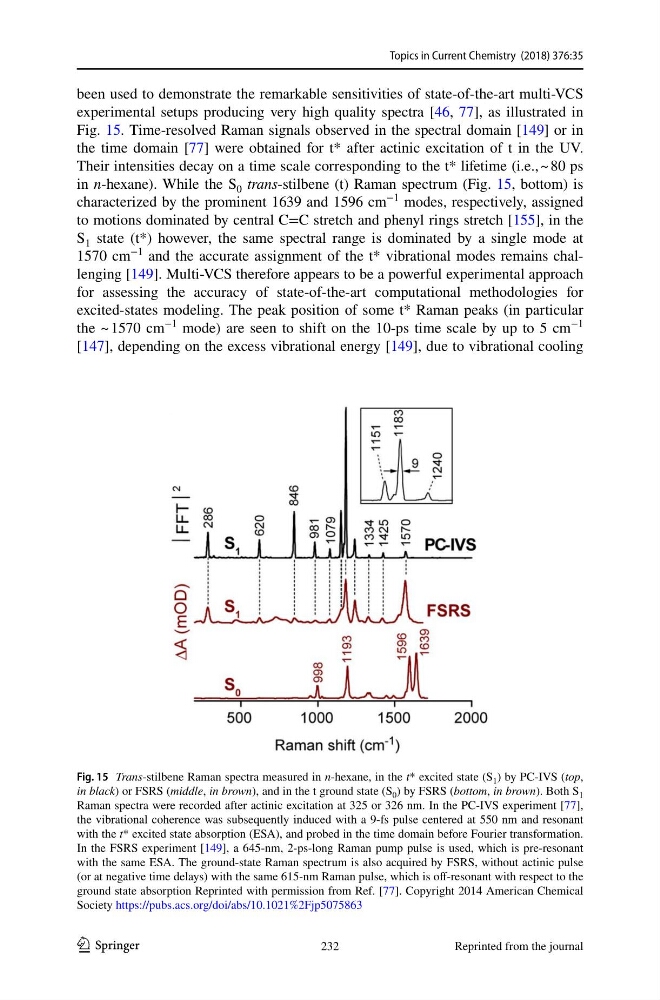
Fig. 15. Time-resolved Raman signals observed in the spectral domain [149] or in
the time domain [77] were obtained for t* after actinic excitation of t in the UV.
Their intensities decay on a time scale corresponding to the t* lifetime (i.e., ~ 80 ps
in n-hexane). While the S 0 trans-stilbene (t) Raman spectrum (Fig. 15, bottom) is
characterized by the prominent 1639 and 1596 cm
−1
modes, respectively, assigned
to motions dominated by central C=C stretch and phenyl rings stretch [155], in the
S 1 state (t*) however, the same spectral range is dominated by a single mode at
1570 cm
−1
and the accurate assignment of the t* vibrational modes remains challenging [149]. Multi-VCS therefore appears to be a powerful experimental approach
for assessing the accuracy of state-of-the-art computational methodologies for
excited-states modeling. The peak position of some t* Raman peaks (in particular
the ~ 1570 cm
−1
mode) are seen to shift on the 10-ps time scale by up to 5 cm
−1
[147], depending on the excess vibrational energy [149], due to vibrational cooling
Fig. 15 Trans-stilbene Raman spectra measured in n-hexane, in the t* excited state (S 1 ) by PC-IVS (top,
in black) or FSRS (middle, in brown), and in the t ground state (S 0 ) by FSRS (bottom, in brown). Both S 1
Raman spectra were recorded after actinic excitation at 325 or 326 nm. In the PC-IVS experiment [77],
the vibrational coherence was subsequently induced with a 9-fs pulse centered at 550 nm and resonant
with the t* excited state absorption (ESA), and probed in the time domain before Fourier transformation.
In the FSRS experiment [149], a 645-nm, 2-ps-long Raman pump pulse is used, which is pre-resonant
with the same ESA. The ground-state Raman spectrum is also acquired by FSRS, without actinic pulse
(or at negative time delays) with the same 615-nm Raman pulse, which is off-resonant with respect to the
ground state absorption Reprinted with permission from Ref. [77]. Copyright 2014 American Chemical
Society https ://pubs.acs.org/doi/abs/10.1021%2Fjp5 07586 3
232
Reprinted from the journal
1 3
been used to demonstrate the remarkable sensitivities of state-of-the-art multi-VCS
experimental setups producing very high quality spectra [46, 77], as illustrated in
Fig. 15. Time-resolved Raman signals observed in the spectral domain [149] or in
the time domain [77] were obtained for t* after actinic excitation of t in the UV.
Their intensities decay on a time scale corresponding to the t* lifetime (i.e., ~ 80 ps
in n-hexane). While the S 0 trans-stilbene (t) Raman spectrum (Fig. 15, bottom) is
characterized by the prominent 1639 and 1596 cm
−1
modes, respectively, assigned
to motions dominated by central C=C stretch and phenyl rings stretch [155], in the
S 1 state (t*) however, the same spectral range is dominated by a single mode at
1570 cm
−1
and the accurate assignment of the t* vibrational modes remains challenging [149]. Multi-VCS therefore appears to be a powerful experimental approach
for assessing the accuracy of state-of-the-art computational methodologies for
excited-states modeling. The peak position of some t* Raman peaks (in particular
the ~ 1570 cm
−1
mode) are seen to shift on the 10-ps time scale by up to 5 cm
−1
[147], depending on the excess vibrational energy [149], due to vibrational cooling
Fig. 15 Trans-stilbene Raman spectra measured in n-hexane, in the t* excited state (S 1 ) by PC-IVS (top,
in black) or FSRS (middle, in brown), and in the t ground state (S 0 ) by FSRS (bottom, in brown). Both S 1
Raman spectra were recorded after actinic excitation at 325 or 326 nm. In the PC-IVS experiment [77],
the vibrational coherence was subsequently induced with a 9-fs pulse centered at 550 nm and resonant
with the t* excited state absorption (ESA), and probed in the time domain before Fourier transformation.
In the FSRS experiment [149], a 645-nm, 2-ps-long Raman pump pulse is used, which is pre-resonant
with the same ESA. The ground-state Raman spectrum is also acquired by FSRS, without actinic pulse
(or at negative time delays) with the same 615-nm Raman pulse, which is off-resonant with respect to the
ground state absorption Reprinted with permission from Ref. [77]. Copyright 2014 American Chemical
Society https ://pubs.acs.org/doi/abs/10.1021%2Fjp5 07586 3
232
Reprinted from the journal