

Topics in Current Chemistry (2018) 376:35
1 3
C=C in the S 2 state at 1660 cm
−1
was also observed for another kind of carotenoid
(trans-apo-8′-carotenal) with FSRS [137]. It is important to note that, more recently,
Kennis et al. showed that the FSRS signal in all-trans-β-carotene measurements is
distorted by the transient absorption signal of the molecule and careful correction
must be performed to extract the correct Raman signal [55]. Non-optimal background subtraction may lead to false vibrational bands. For example, contributions
from the conventional transient absorption were taken into account, and the FSRS
was corrected, indicating that the spectra observed earlier for S 2 [138] were strongly
modulated by the S 2 transient absorption signal. A more careful study of the Raman
spectrum of the S 2 state with FSRS and of the S 0 Raman activity by non-resonant
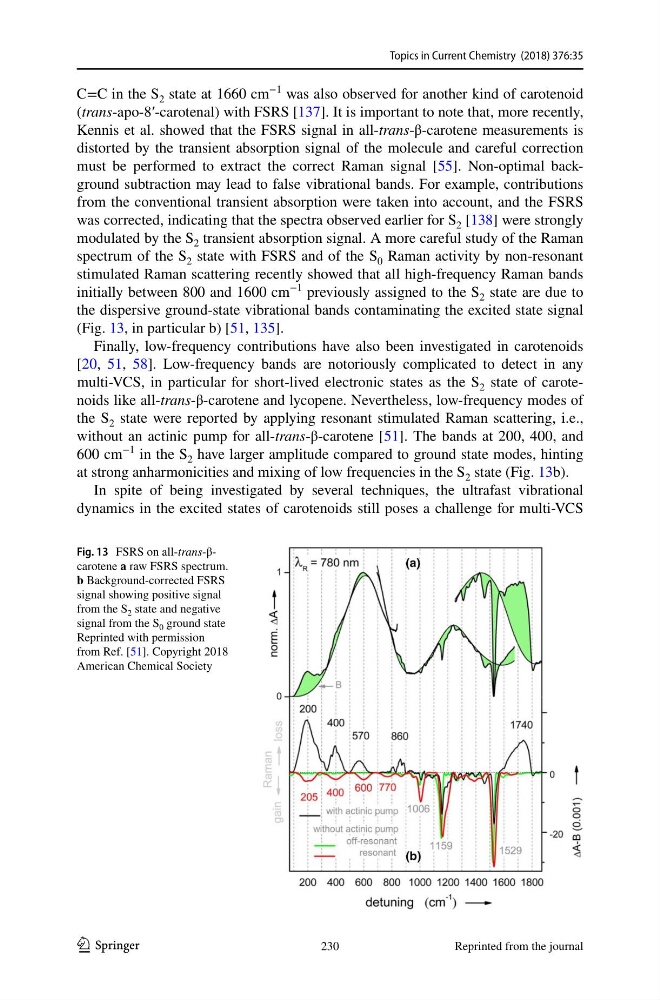
stimulated Raman scattering recently showed that all high-frequency Raman bands
initially between 800 and 1600 cm
−1
previously assigned to the S 2 state are due to
the dispersive ground-state vibrational bands contaminating the excited state signal
(Fig. 13, in particular b) [51, 135].
Finally, low-frequency contributions have also been investigated in carotenoids
[20, 51, 58]. Low-frequency bands are notoriously complicated to detect in any
multi-VCS, in particular for short-lived electronic states as the S 2 state of carotenoids like all-trans-β-carotene and lycopene. Nevertheless, low-frequency modes of
the S 2 state were reported by applying resonant stimulated Raman scattering, i.e.,
without an actinic pump for all-trans-β-carotene [51]. The bands at 200, 400, and
600 cm
−1
in the S 2 have larger amplitude compared to ground state modes, hinting
at strong anharmonicities and mixing of low frequencies in the S 2 state (Fig. 13b).
In spite of being investigated by several techniques, the ultrafast vibrational
dynamics in the excited states of carotenoids still poses a challenge for multi-VCS
Fig. 13 FSRS on all-trans-βcarotene a raw FSRS spectrum.
b Background-corrected FSRS
signal showing positive signal
from the S 2 state and negative
signal from the S 0 ground state
Reprinted with permission
from Ref. [51]. Copyright 2018
American Chemical Society
230
Reprinted from the journal
1 3
C=C in the S 2 state at 1660 cm
−1
was also observed for another kind of carotenoid
(trans-apo-8′-carotenal) with FSRS [137]. It is important to note that, more recently,
Kennis et al. showed that the FSRS signal in all-trans-β-carotene measurements is
distorted by the transient absorption signal of the molecule and careful correction
must be performed to extract the correct Raman signal [55]. Non-optimal background subtraction may lead to false vibrational bands. For example, contributions
from the conventional transient absorption were taken into account, and the FSRS
was corrected, indicating that the spectra observed earlier for S 2 [138] were strongly
modulated by the S 2 transient absorption signal. A more careful study of the Raman
spectrum of the S 2 state with FSRS and of the S 0 Raman activity by non-resonant
stimulated Raman scattering recently showed that all high-frequency Raman bands
initially between 800 and 1600 cm
−1
previously assigned to the S 2 state are due to
the dispersive ground-state vibrational bands contaminating the excited state signal
(Fig. 13, in particular b) [51, 135].
Finally, low-frequency contributions have also been investigated in carotenoids
[20, 51, 58]. Low-frequency bands are notoriously complicated to detect in any
multi-VCS, in particular for short-lived electronic states as the S 2 state of carotenoids like all-trans-β-carotene and lycopene. Nevertheless, low-frequency modes of
the S 2 state were reported by applying resonant stimulated Raman scattering, i.e.,
without an actinic pump for all-trans-β-carotene [51]. The bands at 200, 400, and
600 cm
−1
in the S 2 have larger amplitude compared to ground state modes, hinting
at strong anharmonicities and mixing of low frequencies in the S 2 state (Fig. 13b).
In spite of being investigated by several techniques, the ultrafast vibrational
dynamics in the excited states of carotenoids still poses a challenge for multi-VCS
Fig. 13 FSRS on all-trans-βcarotene a raw FSRS spectrum.
b Background-corrected FSRS
signal showing positive signal
from the S 2 state and negative
signal from the S 0 ground state
Reprinted with permission
from Ref. [51]. Copyright 2018
American Chemical Society
230
Reprinted from the journal