

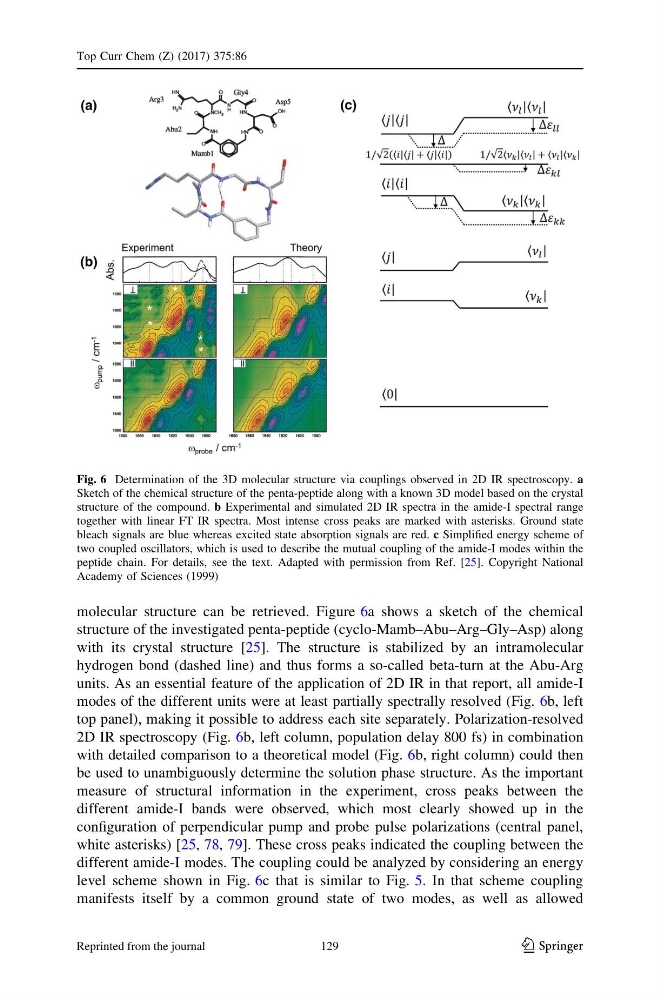
molecular structure can be retrieved. Figure 6a shows a sketch of the chemical
structure of the investigated penta-peptide (cyclo-Mamb–Abu–Arg–Gly–Asp) along
with its crystal structure [25]. The structure is stabilized by an intramolecular
hydrogen bond (dashed line) and thus forms a so-called beta-turn at the Abu-Arg
units. As an essential feature of the application of 2D IR in that report, all amide-I
modes of the different units were at least partially spectrally resolved (Fig. 6b, left
top panel), making it possible to address each site separately. Polarization-resolved
2D IR spectroscopy (Fig. 6b, left column, population delay 800 fs) in combination
with detailed comparison to a theoretical model (Fig. 6b, right column) could then
be used to unambiguously determine the solution phase structure. As the important
measure of structural information in the experiment, cross peaks between the
different amide-I bands were observed, which most clearly showed up in the
configuration of perpendicular pump and probe pulse polarizations (central panel,
white asterisks) [25, 78, 79]. These cross peaks indicated the coupling between the
different amide-I modes. The coupling could be analyzed by considering an energy
level scheme shown in Fig. 6c that is similar to Fig. 5. In that scheme coupling
manifests itself by a common ground state of two modes, as well as allowed
Fig. 6 Determination of the 3D molecular structure via couplings observed in 2D IR spectroscopy. a
Sketch of the chemical structure of the penta-peptide along with a known 3D model based on the crystal
structure of the compound. b Experimental and simulated 2D IR spectra in the amide-I spectral range
together with linear FT IR spectra. Most intense cross peaks are marked with asterisks. Ground state
bleach signals are blue whereas excited state absorption signals are red. c Simplified energy scheme of
two coupled oscillators, which is used to describe the mutual coupling of the amide-I modes within the
peptide chain. For details, see the text. Adapted with permission from Ref. [25]. Copyright National
Academy of Sciences (1999)
Top Curr Chem (Z) (2017) 375:86
123
129
Reprinted from the journal
structure of the investigated penta-peptide (cyclo-Mamb–Abu–Arg–Gly–Asp) along
with its crystal structure [25]. The structure is stabilized by an intramolecular
hydrogen bond (dashed line) and thus forms a so-called beta-turn at the Abu-Arg
units. As an essential feature of the application of 2D IR in that report, all amide-I
modes of the different units were at least partially spectrally resolved (Fig. 6b, left
top panel), making it possible to address each site separately. Polarization-resolved
2D IR spectroscopy (Fig. 6b, left column, population delay 800 fs) in combination
with detailed comparison to a theoretical model (Fig. 6b, right column) could then
be used to unambiguously determine the solution phase structure. As the important
measure of structural information in the experiment, cross peaks between the
different amide-I bands were observed, which most clearly showed up in the
configuration of perpendicular pump and probe pulse polarizations (central panel,
white asterisks) [25, 78, 79]. These cross peaks indicated the coupling between the
different amide-I modes. The coupling could be analyzed by considering an energy
level scheme shown in Fig. 6c that is similar to Fig. 5. In that scheme coupling
manifests itself by a common ground state of two modes, as well as allowed
Fig. 6 Determination of the 3D molecular structure via couplings observed in 2D IR spectroscopy. a
Sketch of the chemical structure of the penta-peptide along with a known 3D model based on the crystal
structure of the compound. b Experimental and simulated 2D IR spectra in the amide-I spectral range
together with linear FT IR spectra. Most intense cross peaks are marked with asterisks. Ground state
bleach signals are blue whereas excited state absorption signals are red. c Simplified energy scheme of
two coupled oscillators, which is used to describe the mutual coupling of the amide-I modes within the
peptide chain. For details, see the text. Adapted with permission from Ref. [25]. Copyright National
Academy of Sciences (1999)
Top Curr Chem (Z) (2017) 375:86
123
129
Reprinted from the journal