

Top Curr Chem (Z) (2018) 376:24
1 3
Lindblad equation and population transfer
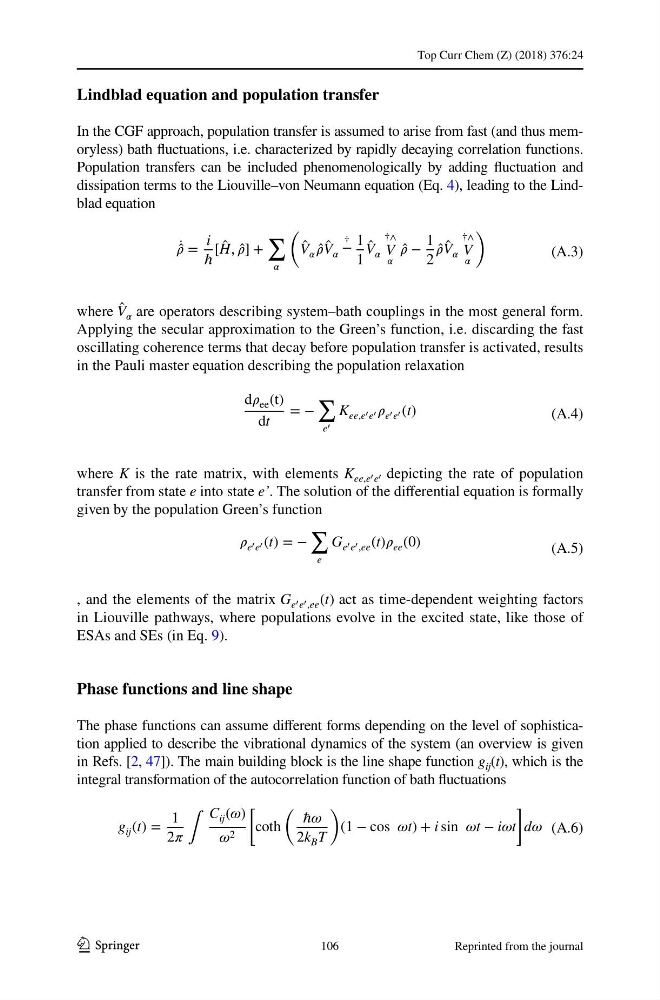
In the CGF approach, population transfer is assumed to arise from fast (and thus memoryless) bath fluctuations, i.e. characterized by rapidly decaying correlation functions.
Population transfers can be included phenomenologically by adding fluctuation and
dissipation terms to the Liouville–von Neumann equation (Eq. 4), leading to the Lindblad equation
where ̂
V í µí»¼ are operators describing system–bath couplings in the most general form.
Applying the secular approximation to the Green’s function, i.e. discarding the fast
oscillating coherence terms that decay before population transfer is activated, results
in the Pauli master equation describing the population relaxation
where K is the rate matrix, with elements K ee,e ′ e ′ depicting the rate of population
transfer from state e into state e’. The solution of the differential equation is formally
given by the population Green’s function
, and the elements of the matrix G e � e � ,ee (t) act as time-dependent weighting factors
in Liouville pathways, where populations evolve in the excited state, like those of
ESAs and SEs (in Eq. 9).
Phase functions and line shape
The phase functions can assume different forms depending on the level of sophistication applied to describe the vibrational dynamics of the system (an overview is given
in Refs. [2, 47]). The main building block is the line shape function g ij (t), which is the
integral transformation of the autocorrelation function of bath fluctuations
(A.3)
̇
̂
í µí¼ =
i
�
[ ̂
H, ̂
í µí¼] +
∑
í µí»¼
̂
V í µí»¼ ̂
í µí¼ ̂
V í µí»¼
†
− 1
1
̂
V í µí»¼
†∧
V
í µí»¼
̂
í µí¼ −
1
2
̂
í µí¼ ̂
V í µí»¼
†∧
V
í µí»¼
(A.4)
d ee (t)
dt
= −
∑
e �
K ee,e � e � e � e � (t)
(A.5)
e � e � (t) = −
∑
e
G e � e � ,ee (t) ee (0)
(A.6)
g ij (t) =
1
2 ∫
C ij ()
2
coth
ℏℏ
2k B T
(1 − cos t) + i sin t − it
d
106
Reprinted from the journal
1 3
Lindblad equation and population transfer
In the CGF approach, population transfer is assumed to arise from fast (and thus memoryless) bath fluctuations, i.e. characterized by rapidly decaying correlation functions.
Population transfers can be included phenomenologically by adding fluctuation and
dissipation terms to the Liouville–von Neumann equation (Eq. 4), leading to the Lindblad equation
where ̂
V í µí»¼ are operators describing system–bath couplings in the most general form.
Applying the secular approximation to the Green’s function, i.e. discarding the fast
oscillating coherence terms that decay before population transfer is activated, results
in the Pauli master equation describing the population relaxation
where K is the rate matrix, with elements K ee,e ′ e ′ depicting the rate of population
transfer from state e into state e’. The solution of the differential equation is formally
given by the population Green’s function
, and the elements of the matrix G e � e � ,ee (t) act as time-dependent weighting factors
in Liouville pathways, where populations evolve in the excited state, like those of
ESAs and SEs (in Eq. 9).
Phase functions and line shape
The phase functions can assume different forms depending on the level of sophistication applied to describe the vibrational dynamics of the system (an overview is given
in Refs. [2, 47]). The main building block is the line shape function g ij (t), which is the
integral transformation of the autocorrelation function of bath fluctuations
(A.3)
̇
̂
í µí¼ =
i
�
[ ̂
H, ̂
í µí¼] +
∑
í µí»¼
̂
V í µí»¼ ̂
í µí¼ ̂
V í µí»¼
†
− 1
1
̂
V í µí»¼
†∧
V
í µí»¼
̂
í µí¼ −
1
2
̂
í µí¼ ̂
V í µí»¼
†∧
V
í µí»¼
(A.4)
d ee (t)
dt
= −
∑
e �
K ee,e � e � e � e � (t)
(A.5)
e � e � (t) = −
∑
e
G e � e � ,ee (t) ee (0)
(A.6)
g ij (t) =
1
2 ∫
C ij ()
2
coth
ℏℏ
2k B T
(1 − cos t) + i sin t − it
d
106
Reprinted from the journal