

1 3
Top Curr Chem (Z) (2018) 376:24
in the theoretical treatment, it became possible, for the first time, to directly compare theoretical predictions with experimental data, available from broadband 2DES
spectra of the pyrene molecule, recorded along its excited-state relaxation process
[16] (Sect. 3.4).
A comparison of theoretical and experimental 2DUV spectra revealed that the
2D map of pyrene recorded at waiting times on a timescale that allows dissipation
of excess vibrational energy in the environment (i.e. when population is trapped in
an excited state) is dominated by the spectroscopic signatures of the excited-state
equilibrium geometry, as predicted by our computations. This outcome supports the
extension of 2DUV spectra simulation for resolving the spectroscopic fingerprints
of long-lived excited-state minima along the complex photoinduced decay pathways of DNA/RNA model systems. In particular, our predictions of state-specific
fingerprints of excited-state dynamics in solvated ApU dinucleoside monophosphate
exemplifies the potential impact of accurate simulations of 2DES spectra in revealing complex physicochemical properties of fundamental biological systems.
The accuracy of the theoretical treatments proposed here can be improved considerably on several fronts, from more efficient and reliable ab initio characterization of
excited-state manifolds, to inclusion of non-Gaussian bath fluctuations, to trajectorybased approaches for handling bath fluctuations and population transfers concurring
in the ultrafast timescale, just to mention a few developments that can be envisioned
in this field.
Acknowledegements Ivan Rivalta acknowledges support from the French Agence National de la
Recherche (FEMTO-2DNA, ANR-15-CE29-0010). Javier Segarra-Marti thanks Dr. Lara MartínezFernández for useful discussions. Marco Garavelli acknowledges support from the European Research
Council STRATUS Advanced Grant (ERC-2011-AdG No. 291198). Shaul Mukamel gratefully acknowledges the support of the National Science Foundation (Grant CHE-1361516) and the Chemical Sciences,
Geosciences, and Biosciences Division, Office of Basic Energy Sciences, Office of Science, U.S. Department of Energy.
Appendix: Retarded Green’s function and third‑order density matrix
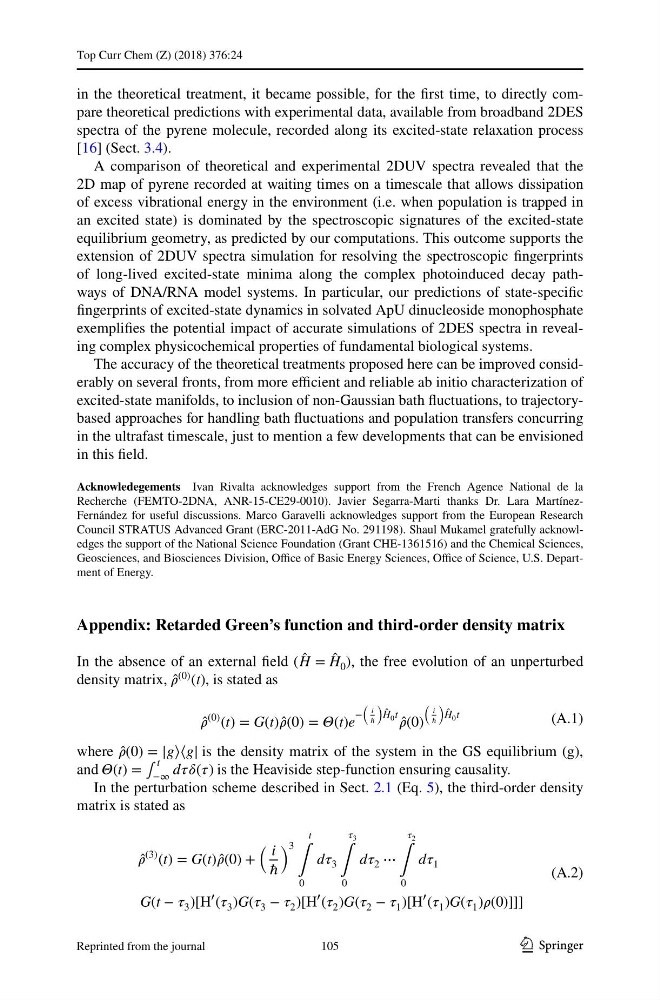
In the absence of an external field ( ̂
H = ̂
H 0 ), the free evolution of an unperturbed
density matrix, ̂
í µí¼
(0) (t) , is stated as
where ̂
í µí¼(0) = �g⟩⟨g� is the density matrix of the system in the GS equilibrium (g),
and (t) = ∫
t
−∞
d() is the Heaviside step-function ensuring causality.
In the perturbation scheme described in Sect. 2.1 (Eq. 5), the third-order density
matrix is stated as
(A.1)
̂
í µí¼
(0) (t) = G(t) ̂
í µí¼(0) = í µí»©(t)e
−
i
�
̂
H 0 t ̂
í µí¼(0)
i
�
̂
H 0 t
(A.2)
̂
í µí¼
(3) (t) = G(t) ̂
í µí¼(0) +
i
�
3
t
∫
0
dí µí¼ 3
í µí¼ 3
∫
0
dí µí¼ 2 ⋯
í µí¼ 2
∫
0
dí µí¼ 1
G(t − í µí¼ 3 )[H
� (í µí¼ 3 )G(í µí¼ 3 − í µí¼ 2 )[H
� (í µí¼ 2 )G(í µí¼ 2 − í µí¼ 1 )[H
� (í µí¼ 1 )G(í µí¼ 1 )í µí¼(0)]]]
105
Reprinted from the journal
Top Curr Chem (Z) (2018) 376:24
in the theoretical treatment, it became possible, for the first time, to directly compare theoretical predictions with experimental data, available from broadband 2DES
spectra of the pyrene molecule, recorded along its excited-state relaxation process
[16] (Sect. 3.4).
A comparison of theoretical and experimental 2DUV spectra revealed that the
2D map of pyrene recorded at waiting times on a timescale that allows dissipation
of excess vibrational energy in the environment (i.e. when population is trapped in
an excited state) is dominated by the spectroscopic signatures of the excited-state
equilibrium geometry, as predicted by our computations. This outcome supports the
extension of 2DUV spectra simulation for resolving the spectroscopic fingerprints
of long-lived excited-state minima along the complex photoinduced decay pathways of DNA/RNA model systems. In particular, our predictions of state-specific
fingerprints of excited-state dynamics in solvated ApU dinucleoside monophosphate
exemplifies the potential impact of accurate simulations of 2DES spectra in revealing complex physicochemical properties of fundamental biological systems.
The accuracy of the theoretical treatments proposed here can be improved considerably on several fronts, from more efficient and reliable ab initio characterization of
excited-state manifolds, to inclusion of non-Gaussian bath fluctuations, to trajectorybased approaches for handling bath fluctuations and population transfers concurring
in the ultrafast timescale, just to mention a few developments that can be envisioned
in this field.
Acknowledegements Ivan Rivalta acknowledges support from the French Agence National de la
Recherche (FEMTO-2DNA, ANR-15-CE29-0010). Javier Segarra-Marti thanks Dr. Lara MartínezFernández for useful discussions. Marco Garavelli acknowledges support from the European Research
Council STRATUS Advanced Grant (ERC-2011-AdG No. 291198). Shaul Mukamel gratefully acknowledges the support of the National Science Foundation (Grant CHE-1361516) and the Chemical Sciences,
Geosciences, and Biosciences Division, Office of Basic Energy Sciences, Office of Science, U.S. Department of Energy.
Appendix: Retarded Green’s function and third‑order density matrix
In the absence of an external field ( ̂
H = ̂
H 0 ), the free evolution of an unperturbed
density matrix, ̂
í µí¼
(0) (t) , is stated as
where ̂
í µí¼(0) = �g⟩⟨g� is the density matrix of the system in the GS equilibrium (g),
and (t) = ∫
t
−∞
d() is the Heaviside step-function ensuring causality.
In the perturbation scheme described in Sect. 2.1 (Eq. 5), the third-order density
matrix is stated as
(A.1)
̂
í µí¼
(0) (t) = G(t) ̂
í µí¼(0) = í µí»©(t)e
−
i
�
̂
H 0 t ̂
í µí¼(0)
i
�
̂
H 0 t
(A.2)
̂
í µí¼
(3) (t) = G(t) ̂
í µí¼(0) +
i
�
3
t
∫
0
dí µí¼ 3
í µí¼ 3
∫
0
dí µí¼ 2 ⋯
í µí¼ 2
∫
0
dí µí¼ 1
G(t − í µí¼ 3 )[H
� (í µí¼ 3 )G(í µí¼ 3 − í µí¼ 2 )[H
� (í µí¼ 2 )G(í µí¼ 2 − í µí¼ 1 )[H
� (í µí¼ 1 )G(í µí¼ 1 )í µí¼(0)]]]
105
Reprinted from the journal