

5.3 Microflow Sonoreactors in Chemical Synthesis
79
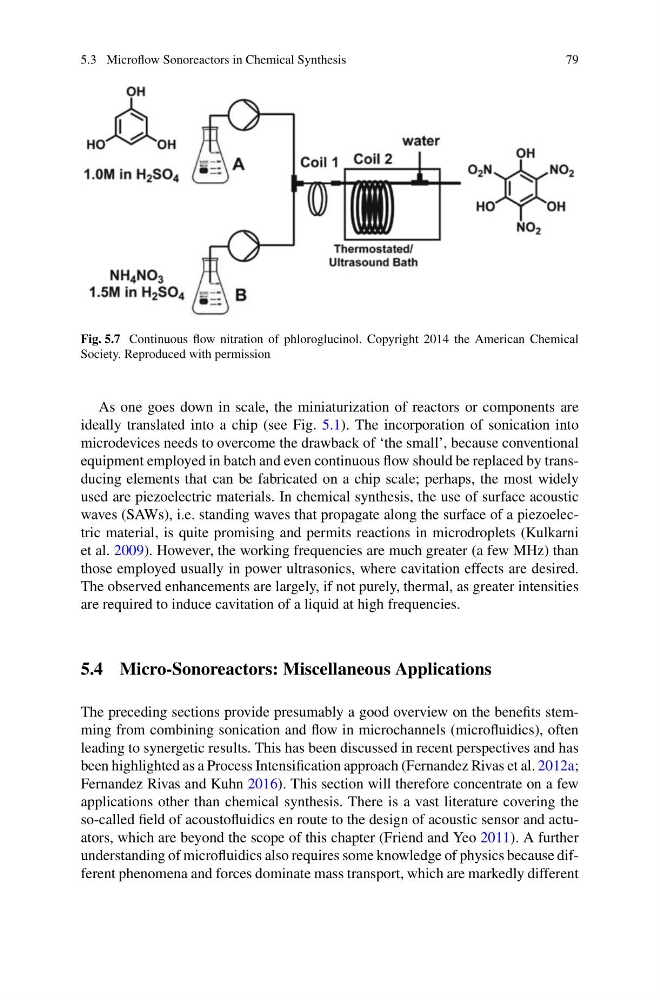
Fig. 5.7 Continuous flow nitration of phloroglucinol. Copyright 2014 the American Chemical
Society. Reproduced with permission
As one goes down in scale, the miniaturization of reactors or components are
ideally translated into a chip (see Fig. 5.1). The incorporation of sonication into
microdevices needs to overcome the drawback of ‘the small’, because conventional
equipment employed in batch and even continuous flow should be replaced by transducing elements that can be fabricated on a chip scale; perhaps, the most widely
used are piezoelectric materials. In chemical synthesis, the use of surface acoustic
waves (SAWs), i.e. standing waves that propagate along the surface of a piezoelectric material, is quite promising and permits reactions in microdroplets (Kulkarni
et al. 2009). However, the working frequencies are much greater (a few MHz) than
those employed usually in power ultrasonics, where cavitation effects are desired.
The observed enhancements are largely, if not purely, thermal, as greater intensities
are required to induce cavitation of a liquid at high frequencies.
5.4 Micro-Sonoreactors: Miscellaneous Applications
The preceding sections provide presumably a good overview on the benefits stemming from combining sonication and flow in microchannels (microfluidics), often
leading to synergetic results. This has been discussed in recent perspectives and has
been highlighted as a Process Intensification approach (Fernandez Rivas et al. 2012a;
Fernandez Rivas and Kuhn 2016). This section will therefore concentrate on a few
applications other than chemical synthesis. There is a vast literature covering the
so-called field of acoustofluidics en route to the design of acoustic sensor and actuators, which are beyond the scope of this chapter (Friend and Yeo 2011). A further
understanding of microfluidics also requires some knowledge of physics because different phenomena and forces dominate mass transport, which are markedly different
79
Fig. 5.7 Continuous flow nitration of phloroglucinol. Copyright 2014 the American Chemical
Society. Reproduced with permission
As one goes down in scale, the miniaturization of reactors or components are
ideally translated into a chip (see Fig. 5.1). The incorporation of sonication into
microdevices needs to overcome the drawback of ‘the small’, because conventional
equipment employed in batch and even continuous flow should be replaced by transducing elements that can be fabricated on a chip scale; perhaps, the most widely
used are piezoelectric materials. In chemical synthesis, the use of surface acoustic
waves (SAWs), i.e. standing waves that propagate along the surface of a piezoelectric material, is quite promising and permits reactions in microdroplets (Kulkarni
et al. 2009). However, the working frequencies are much greater (a few MHz) than
those employed usually in power ultrasonics, where cavitation effects are desired.
The observed enhancements are largely, if not purely, thermal, as greater intensities
are required to induce cavitation of a liquid at high frequencies.
5.4 Micro-Sonoreactors: Miscellaneous Applications
The preceding sections provide presumably a good overview on the benefits stemming from combining sonication and flow in microchannels (microfluidics), often
leading to synergetic results. This has been discussed in recent perspectives and has
been highlighted as a Process Intensification approach (Fernandez Rivas et al. 2012a;
Fernandez Rivas and Kuhn 2016). This section will therefore concentrate on a few
applications other than chemical synthesis. There is a vast literature covering the
so-called field of acoustofluidics en route to the design of acoustic sensor and actuators, which are beyond the scope of this chapter (Friend and Yeo 2011). A further
understanding of microfluidics also requires some knowledge of physics because different phenomena and forces dominate mass transport, which are markedly different