

78
5 Gone with the Flow: Miniaturization and Safer Chemistry
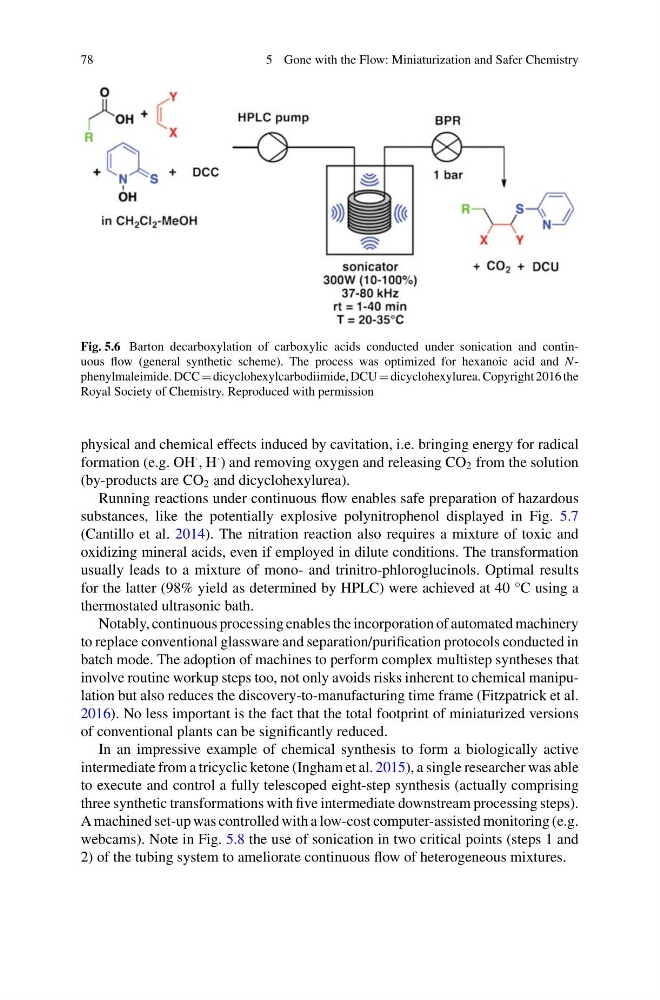
Fig. 5.6 Barton decarboxylation of carboxylic acids conducted under sonication and continuous flow (general synthetic scheme). The process was optimized for hexanoic acid and Nphenylmaleimide. DCC dicyclohexylcarbodiimide, DCU dicyclohexylurea. Copyright 2016 the
Royal Society of Chemistry. Reproduced with permission
physical and chemical effects induced by cavitation, i.e. bringing energy for radical
formation (e.g. OH
· , H
· ) and removing oxygen and releasing CO 2 from the solution
(by-products are CO 2 and dicyclohexylurea).
Running reactions under continuous flow enables safe preparation of hazardous
substances, like the potentially explosive polynitrophenol displayed in Fig. 5.7
(Cantillo et al. 2014). The nitration reaction also requires a mixture of toxic and
oxidizing mineral acids, even if employed in dilute conditions. The transformation
usually leads to a mixture of mono- and trinitro-phloroglucinols. Optimal results
for the latter (98% yield as determined by HPLC) were achieved at 40 °C using a
thermostated ultrasonic bath.
Notably, continuous processing enables the incorporation of automated machinery
to replace conventional glassware and separation/purification protocols conducted in
batch mode. The adoption of machines to perform complex multistep syntheses that
involve routine workup steps too, not only avoids risks inherent to chemical manipulation but also reduces the discovery-to-manufacturing time frame (Fitzpatrick et al.
2016). No less important is the fact that the total footprint of miniaturized versions
of conventional plants can be significantly reduced.
In an impressive example of chemical synthesis to form a biologically active
intermediate from a tricyclic ketone (Ingham et al. 2015), a single researcher was able
to execute and control a fully telescoped eight-step synthesis (actually comprising
three synthetic transformations with five intermediate downstream processing steps).
A machined set-up was controlled with a low-cost computer-assisted monitoring (e.g.
webcams). Note in Fig. 5.8 the use of sonication in two critical points (steps 1 and
2) of the tubing system to ameliorate continuous flow of heterogeneous mixtures.
5 Gone with the Flow: Miniaturization and Safer Chemistry
Fig. 5.6 Barton decarboxylation of carboxylic acids conducted under sonication and continuous flow (general synthetic scheme). The process was optimized for hexanoic acid and Nphenylmaleimide. DCC dicyclohexylcarbodiimide, DCU dicyclohexylurea. Copyright 2016 the
Royal Society of Chemistry. Reproduced with permission
physical and chemical effects induced by cavitation, i.e. bringing energy for radical
formation (e.g. OH
· , H
· ) and removing oxygen and releasing CO 2 from the solution
(by-products are CO 2 and dicyclohexylurea).
Running reactions under continuous flow enables safe preparation of hazardous
substances, like the potentially explosive polynitrophenol displayed in Fig. 5.7
(Cantillo et al. 2014). The nitration reaction also requires a mixture of toxic and
oxidizing mineral acids, even if employed in dilute conditions. The transformation
usually leads to a mixture of mono- and trinitro-phloroglucinols. Optimal results
for the latter (98% yield as determined by HPLC) were achieved at 40 °C using a
thermostated ultrasonic bath.
Notably, continuous processing enables the incorporation of automated machinery
to replace conventional glassware and separation/purification protocols conducted in
batch mode. The adoption of machines to perform complex multistep syntheses that
involve routine workup steps too, not only avoids risks inherent to chemical manipulation but also reduces the discovery-to-manufacturing time frame (Fitzpatrick et al.
2016). No less important is the fact that the total footprint of miniaturized versions
of conventional plants can be significantly reduced.
In an impressive example of chemical synthesis to form a biologically active
intermediate from a tricyclic ketone (Ingham et al. 2015), a single researcher was able
to execute and control a fully telescoped eight-step synthesis (actually comprising
three synthetic transformations with five intermediate downstream processing steps).
A machined set-up was controlled with a low-cost computer-assisted monitoring (e.g.
webcams). Note in Fig. 5.8 the use of sonication in two critical points (steps 1 and
2) of the tubing system to ameliorate continuous flow of heterogeneous mixtures.