

5.3 Microflow Sonoreactors in Chemical Synthesis
77
5.3 Microflow Sonoreactors in Chemical Synthesis
As noted in the preceding section, early studies combining sonication and any type
of continuous flow were focused essentially on solving a major technical trouble:
clogging. Other pluses that cavitation might induce in the reaction mixture have
been often overlooked. For example, given the omnipresence of ultrasonic baths in
most chemical labs for cleaning activities, scientist see sonication as a non-invasive
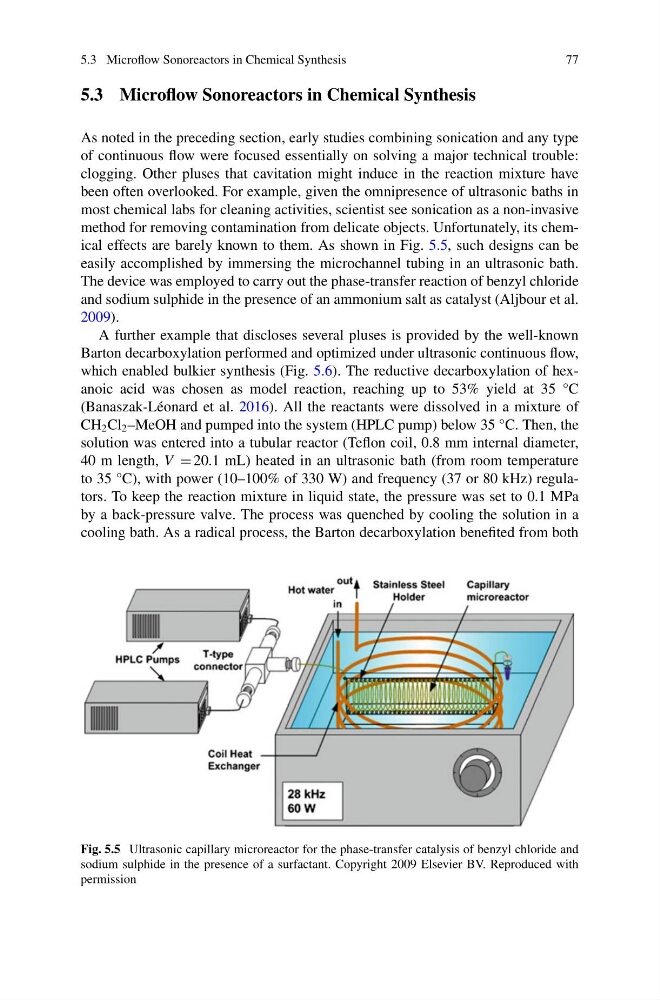
method for removing contamination from delicate objects. Unfortunately, its chemical effects are barely known to them. As shown in Fig. 5.5, such designs can be
easily accomplished by immersing the microchannel tubing in an ultrasonic bath.
The device was employed to carry out the phase-transfer reaction of benzyl chloride
and sodium sulphide in the presence of an ammonium salt as catalyst (Aljbour et al.
2009).
A further example that discloses several pluses is provided by the well-known
Barton decarboxylation performed and optimized under ultrasonic continuous flow,
which enabled bulkier synthesis (Fig. 5.6). The reductive decarboxylation of hexanoic acid was chosen as model reaction, reaching up to 53% yield at 35 °C
(Banaszak-Léonard et al. 2016). All the reactants were dissolved in a mixture of
CH 2 Cl 2 –MeOH and pumped into the system (HPLC pump) below 35 °C. Then, the
solution was entered into a tubular reactor (Teflon coil, 0.8 mm internal diameter,
40 m length, V 20.1 mL) heated in an ultrasonic bath (from room temperature
to 35 °C), with power (10–100% of 330 W) and frequency (37 or 80 kHz) regulators. To keep the reaction mixture in liquid state, the pressure was set to 0.1 MPa
by a back-pressure valve. The process was quenched by cooling the solution in a
cooling bath. As a radical process, the Barton decarboxylation benefited from both
Fig. 5.5 Ultrasonic capillary microreactor for the phase-transfer catalysis of benzyl chloride and
sodium sulphide in the presence of a surfactant. Copyright 2009 Elsevier BV. Reproduced with
permission
77
5.3 Microflow Sonoreactors in Chemical Synthesis
As noted in the preceding section, early studies combining sonication and any type
of continuous flow were focused essentially on solving a major technical trouble:
clogging. Other pluses that cavitation might induce in the reaction mixture have
been often overlooked. For example, given the omnipresence of ultrasonic baths in
most chemical labs for cleaning activities, scientist see sonication as a non-invasive
method for removing contamination from delicate objects. Unfortunately, its chemical effects are barely known to them. As shown in Fig. 5.5, such designs can be
easily accomplished by immersing the microchannel tubing in an ultrasonic bath.
The device was employed to carry out the phase-transfer reaction of benzyl chloride
and sodium sulphide in the presence of an ammonium salt as catalyst (Aljbour et al.
2009).
A further example that discloses several pluses is provided by the well-known
Barton decarboxylation performed and optimized under ultrasonic continuous flow,
which enabled bulkier synthesis (Fig. 5.6). The reductive decarboxylation of hexanoic acid was chosen as model reaction, reaching up to 53% yield at 35 °C
(Banaszak-Léonard et al. 2016). All the reactants were dissolved in a mixture of
CH 2 Cl 2 –MeOH and pumped into the system (HPLC pump) below 35 °C. Then, the
solution was entered into a tubular reactor (Teflon coil, 0.8 mm internal diameter,
40 m length, V 20.1 mL) heated in an ultrasonic bath (from room temperature
to 35 °C), with power (10–100% of 330 W) and frequency (37 or 80 kHz) regulators. To keep the reaction mixture in liquid state, the pressure was set to 0.1 MPa
by a back-pressure valve. The process was quenched by cooling the solution in a
cooling bath. As a radical process, the Barton decarboxylation benefited from both
Fig. 5.5 Ultrasonic capillary microreactor for the phase-transfer catalysis of benzyl chloride and
sodium sulphide in the presence of a surfactant. Copyright 2009 Elsevier BV. Reproduced with
permission