

76
5 Gone with the Flow: Miniaturization and Safer Chemistry
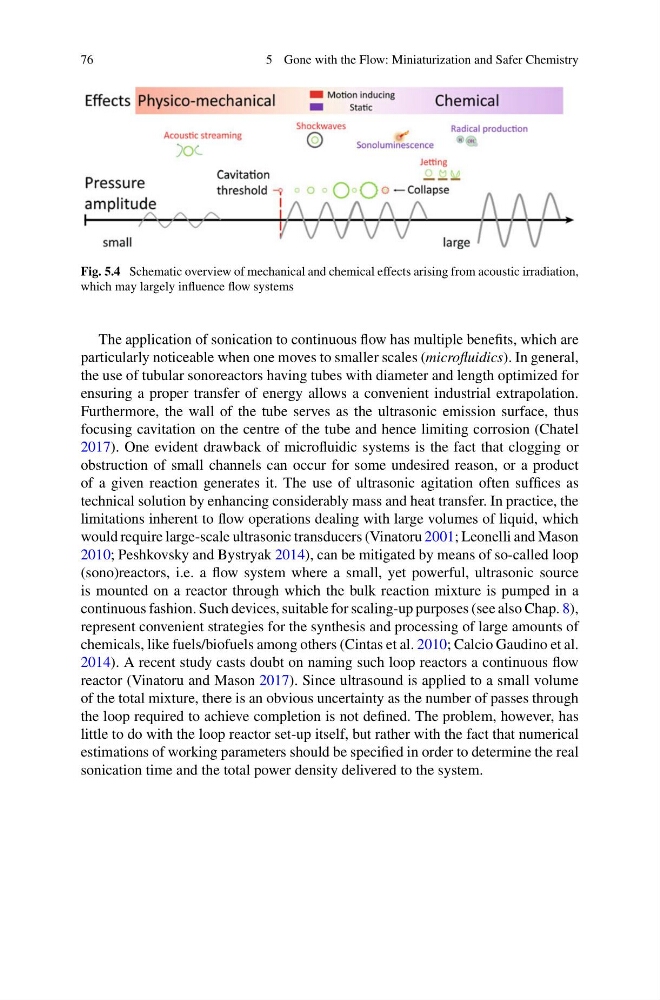
Fig. 5.4 Schematic overview of mechanical and chemical effects arising from acoustic irradiation,
which may largely influence flow systems
The application of sonication to continuous flow has multiple benefits, which are
particularly noticeable when one moves to smaller scales (microfluidics). In general,
the use of tubular sonoreactors having tubes with diameter and length optimized for
ensuring a proper transfer of energy allows a convenient industrial extrapolation.
Furthermore, the wall of the tube serves as the ultrasonic emission surface, thus
focusing cavitation on the centre of the tube and hence limiting corrosion (Chatel
2017). One evident drawback of microfluidic systems is the fact that clogging or
obstruction of small channels can occur for some undesired reason, or a product
of a given reaction generates it. The use of ultrasonic agitation often suffices as
technical solution by enhancing considerably mass and heat transfer. In practice, the
limitations inherent to flow operations dealing with large volumes of liquid, which
would require large-scale ultrasonic transducers (Vinatoru 2001; Leonelli and Mason
2010; Peshkovsky and Bystryak 2014), can be mitigated by means of so-called loop
(sono)reactors, i.e. a flow system where a small, yet powerful, ultrasonic source
is mounted on a reactor through which the bulk reaction mixture is pumped in a
continuous fashion. Such devices, suitable for scaling-up purposes (see also Chap. 8),
represent convenient strategies for the synthesis and processing of large amounts of
chemicals, like fuels/biofuels among others (Cintas et al. 2010; Calcio Gaudino et al.
2014). A recent study casts doubt on naming such loop reactors a continuous flow
reactor (Vinatoru and Mason 2017). Since ultrasound is applied to a small volume
of the total mixture, there is an obvious uncertainty as the number of passes through
the loop required to achieve completion is not defined. The problem, however, has
little to do with the loop reactor set-up itself, but rather with the fact that numerical
estimations of working parameters should be specified in order to determine the real
sonication time and the total power density delivered to the system.
5 Gone with the Flow: Miniaturization and Safer Chemistry
Fig. 5.4 Schematic overview of mechanical and chemical effects arising from acoustic irradiation,
which may largely influence flow systems
The application of sonication to continuous flow has multiple benefits, which are
particularly noticeable when one moves to smaller scales (microfluidics). In general,
the use of tubular sonoreactors having tubes with diameter and length optimized for
ensuring a proper transfer of energy allows a convenient industrial extrapolation.
Furthermore, the wall of the tube serves as the ultrasonic emission surface, thus
focusing cavitation on the centre of the tube and hence limiting corrosion (Chatel
2017). One evident drawback of microfluidic systems is the fact that clogging or
obstruction of small channels can occur for some undesired reason, or a product
of a given reaction generates it. The use of ultrasonic agitation often suffices as
technical solution by enhancing considerably mass and heat transfer. In practice, the
limitations inherent to flow operations dealing with large volumes of liquid, which
would require large-scale ultrasonic transducers (Vinatoru 2001; Leonelli and Mason
2010; Peshkovsky and Bystryak 2014), can be mitigated by means of so-called loop
(sono)reactors, i.e. a flow system where a small, yet powerful, ultrasonic source
is mounted on a reactor through which the bulk reaction mixture is pumped in a
continuous fashion. Such devices, suitable for scaling-up purposes (see also Chap. 8),
represent convenient strategies for the synthesis and processing of large amounts of
chemicals, like fuels/biofuels among others (Cintas et al. 2010; Calcio Gaudino et al.
2014). A recent study casts doubt on naming such loop reactors a continuous flow
reactor (Vinatoru and Mason 2017). Since ultrasound is applied to a small volume
of the total mixture, there is an obvious uncertainty as the number of passes through
the loop required to achieve completion is not defined. The problem, however, has
little to do with the loop reactor set-up itself, but rather with the fact that numerical
estimations of working parameters should be specified in order to determine the real
sonication time and the total power density delivered to the system.