

5.2 Miniaturized Continuous Flow Systems: Some Remarks
75
with the conventional batch process that makes ciprofloxacin in more than 100 h to
achieve a similar throughput.
Practitioners moving from batch to flow systems face invariably the challenges
of miniaturization as flow reactors are usually smaller than flasks, even if a given
product can ultimately be obtained in significant amount or concentration after several
cycles. Another well-known challenge is mixing, for which non-dimensional analysis
can assist, based on the Reynolds, Peclet and Dämkholer numbers, among others
(Günther and Jensen 2006; Nagy et al. 2012). Perhaps, a curious exception can
be seen in the case of segmented liquid–liquid and gas–liquid flows, which provide
enhanced mixing, when liquid slugs or microdroplets are obtained without any special
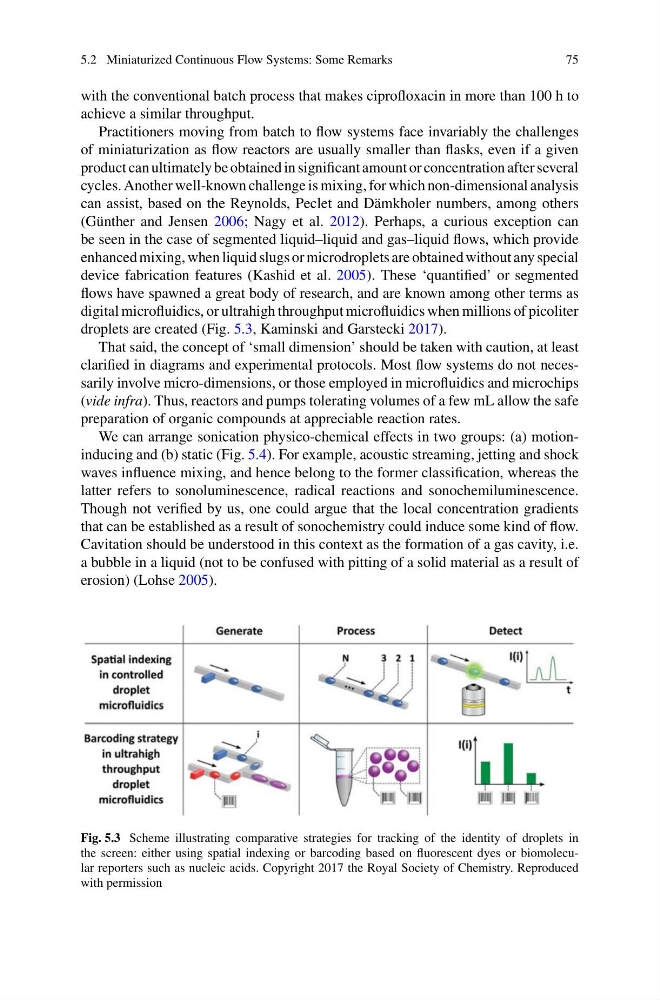
device fabrication features (Kashid et al. 2005). These ‘quantified’ or segmented
flows have spawned a great body of research, and are known among other terms as
digital microfluidics, or ultrahigh throughput microfluidics when millions of picoliter
droplets are created (Fig. 5.3, Kaminski and Garstecki 2017).
That said, the concept of ‘small dimension’ should be taken with caution, at least
clarified in diagrams and experimental protocols. Most flow systems do not necessarily involve micro-dimensions, or those employed in microfluidics and microchips
(vide infra). Thus, reactors and pumps tolerating volumes of a few mL allow the safe
preparation of organic compounds at appreciable reaction rates.
We can arrange sonication physico-chemical effects in two groups: (a) motioninducing and (b) static (Fig. 5.4). For example, acoustic streaming, jetting and shock
waves influence mixing, and hence belong to the former classification, whereas the
latter refers to sonoluminescence, radical reactions and sonochemiluminescence.
Though not verified by us, one could argue that the local concentration gradients
that can be established as a result of sonochemistry could induce some kind of flow.
Cavitation should be understood in this context as the formation of a gas cavity, i.e.
a bubble in a liquid (not to be confused with pitting of a solid material as a result of
erosion) (Lohse 2005).
Fig. 5.3 Scheme illustrating comparative strategies for tracking of the identity of droplets in
the screen: either using spatial indexing or barcoding based on fluorescent dyes or biomolecular reporters such as nucleic acids. Copyright 2017 the Royal Society of Chemistry. Reproduced
with permission
75
with the conventional batch process that makes ciprofloxacin in more than 100 h to
achieve a similar throughput.
Practitioners moving from batch to flow systems face invariably the challenges
of miniaturization as flow reactors are usually smaller than flasks, even if a given
product can ultimately be obtained in significant amount or concentration after several
cycles. Another well-known challenge is mixing, for which non-dimensional analysis
can assist, based on the Reynolds, Peclet and Dämkholer numbers, among others
(Günther and Jensen 2006; Nagy et al. 2012). Perhaps, a curious exception can
be seen in the case of segmented liquid–liquid and gas–liquid flows, which provide
enhanced mixing, when liquid slugs or microdroplets are obtained without any special
device fabrication features (Kashid et al. 2005). These ‘quantified’ or segmented
flows have spawned a great body of research, and are known among other terms as
digital microfluidics, or ultrahigh throughput microfluidics when millions of picoliter
droplets are created (Fig. 5.3, Kaminski and Garstecki 2017).
That said, the concept of ‘small dimension’ should be taken with caution, at least
clarified in diagrams and experimental protocols. Most flow systems do not necessarily involve micro-dimensions, or those employed in microfluidics and microchips
(vide infra). Thus, reactors and pumps tolerating volumes of a few mL allow the safe
preparation of organic compounds at appreciable reaction rates.
We can arrange sonication physico-chemical effects in two groups: (a) motioninducing and (b) static (Fig. 5.4). For example, acoustic streaming, jetting and shock
waves influence mixing, and hence belong to the former classification, whereas the
latter refers to sonoluminescence, radical reactions and sonochemiluminescence.
Though not verified by us, one could argue that the local concentration gradients
that can be established as a result of sonochemistry could induce some kind of flow.
Cavitation should be understood in this context as the formation of a gas cavity, i.e.
a bubble in a liquid (not to be confused with pitting of a solid material as a result of
erosion) (Lohse 2005).
Fig. 5.3 Scheme illustrating comparative strategies for tracking of the identity of droplets in
the screen: either using spatial indexing or barcoding based on fluorescent dyes or biomolecular reporters such as nucleic acids. Copyright 2017 the Royal Society of Chemistry. Reproduced
with permission