

66
4 Effective Biomass Valorization Procedures Using Ultrasound …
O
O
HO
OH
O
OH
O
HO
OH
O
OH
n
)))
BMimCl
O
O
RO
OR
O
OR
O
RO
OR
O
OR
n
R = H or
OH
O
O
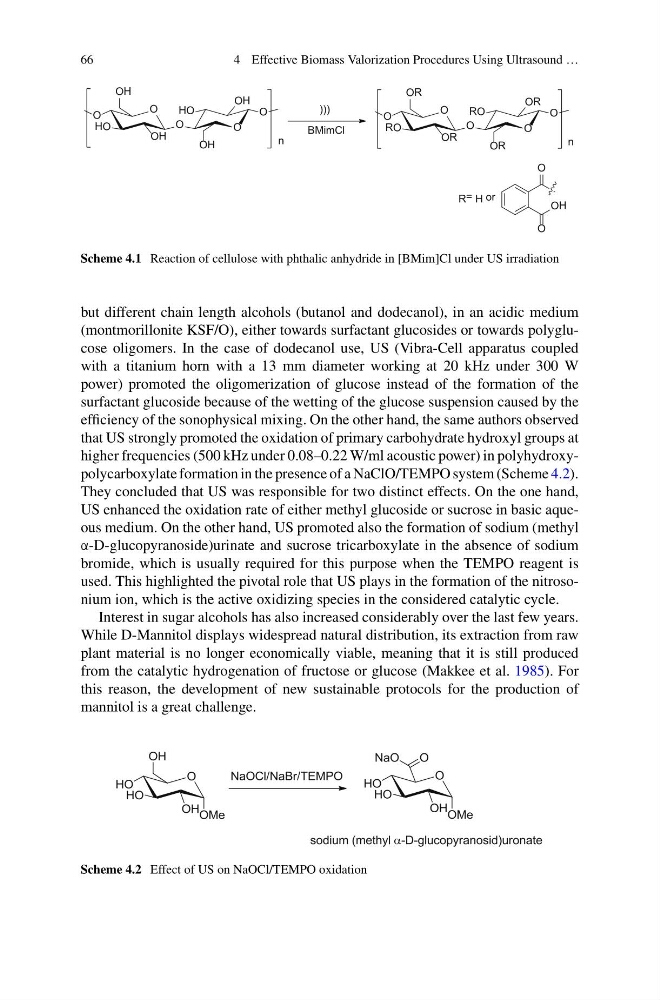
Scheme 4.1 Reaction of cellulose with phthalic anhydride in [BMim]Cl under US irradiation
but different chain length alcohols (butanol and dodecanol), in an acidic medium
(montmorillonite KSF/O), either towards surfactant glucosides or towards polyglucose oligomers. In the case of dodecanol use, US (Vibra-Cell apparatus coupled
with a titanium horn with a 13 mm diameter working at 20 kHz under 300 W
power) promoted the oligomerization of glucose instead of the formation of the
surfactant glucoside because of the wetting of the glucose suspension caused by the
efficiency of the sonophysical mixing. On the other hand, the same authors observed
that US strongly promoted the oxidation of primary carbohydrate hydroxyl groups at
higher frequencies (500 kHz under 0.08–0.22 W/ml acoustic power) in polyhydroxypolycarboxylate formation in the presence of a NaClO/TEMPO system (Scheme 4.2).
They concluded that US was responsible for two distinct effects. On the one hand,
US enhanced the oxidation rate of either methyl glucoside or sucrose in basic aqueous medium. On the other hand, US promoted also the formation of sodium (methyl
α-D-glucopyranoside)urinate and sucrose tricarboxylate in the absence of sodium
bromide, which is usually required for this purpose when the TEMPO reagent is
used. This highlighted the pivotal role that US plays in the formation of the nitrosonium ion, which is the active oxidizing species in the considered catalytic cycle.
Interest in sugar alcohols has also increased considerably over the last few years.
While D-Mannitol displays widespread natural distribution, its extraction from raw
plant material is no longer economically viable, meaning that it is still produced
from the catalytic hydrogenation of fructose or glucose (Makkee et al. 1985). For
this reason, the development of new sustainable protocols for the production of
mannitol is a great challenge.
Scheme 4.2 Effect of US on NaOCl/TEMPO oxidation
4 Effective Biomass Valorization Procedures Using Ultrasound …
O
O
HO
OH
O
OH
O
HO
OH
O
OH
n
)))
BMimCl
O
O
RO
OR
O
OR
O
RO
OR
O
OR
n
R = H or
OH
O
O
Scheme 4.1 Reaction of cellulose with phthalic anhydride in [BMim]Cl under US irradiation
but different chain length alcohols (butanol and dodecanol), in an acidic medium
(montmorillonite KSF/O), either towards surfactant glucosides or towards polyglucose oligomers. In the case of dodecanol use, US (Vibra-Cell apparatus coupled
with a titanium horn with a 13 mm diameter working at 20 kHz under 300 W
power) promoted the oligomerization of glucose instead of the formation of the
surfactant glucoside because of the wetting of the glucose suspension caused by the
efficiency of the sonophysical mixing. On the other hand, the same authors observed
that US strongly promoted the oxidation of primary carbohydrate hydroxyl groups at
higher frequencies (500 kHz under 0.08–0.22 W/ml acoustic power) in polyhydroxypolycarboxylate formation in the presence of a NaClO/TEMPO system (Scheme 4.2).
They concluded that US was responsible for two distinct effects. On the one hand,
US enhanced the oxidation rate of either methyl glucoside or sucrose in basic aqueous medium. On the other hand, US promoted also the formation of sodium (methyl
α-D-glucopyranoside)urinate and sucrose tricarboxylate in the absence of sodium
bromide, which is usually required for this purpose when the TEMPO reagent is
used. This highlighted the pivotal role that US plays in the formation of the nitrosonium ion, which is the active oxidizing species in the considered catalytic cycle.
Interest in sugar alcohols has also increased considerably over the last few years.
While D-Mannitol displays widespread natural distribution, its extraction from raw
plant material is no longer economically viable, meaning that it is still produced
from the catalytic hydrogenation of fructose or glucose (Makkee et al. 1985). For
this reason, the development of new sustainable protocols for the production of
mannitol is a great challenge.
Scheme 4.2 Effect of US on NaOCl/TEMPO oxidation