

4.4 Ultrasound-Assisted Conversion of Biomass into Platform Molecules
67
In this context, Toukoniitty et al. (2005) have investigated the effect of US on
D-fructose hydrogenation to D-Mannitol over three different heterogeneous catalysts: Cu/SiO 2 , Cu/ZnO/Al 2 O 3 and Raney-Ni. The hydrogenation reactions were
performed at 110 °C under 50 bar of hydrogen in a high-pressure autoclave equipped
with an ultrasonic horn-type irradiation system working at 20 kHz and 50 W. The
sonication significantly enhanced the reaction rate over Cu/SiO 2 , although Raney-Ni
remained the most active catalyst. The influence of pressure and temperature on the
reaction over the Raney-Ni type catalyst was studied under sonication as well. Higher
H 2 pressures (30–50 bar) and temperatures (90 and 110 °C) only brought moderate enhancements to reaction rates whereas variations in nominal ultrasonic power
input (from 0 to 50 W) significantly affected catalyst activity. Moreover, catalyst
deactivation was significantly hampered by the acoustic irradiation, as compared to
experiments run under silent conditions.
Finally, lignin has recently been considered as a possible starting material for
new nanostructured products that are suitable for textile fibre treatments or for use as
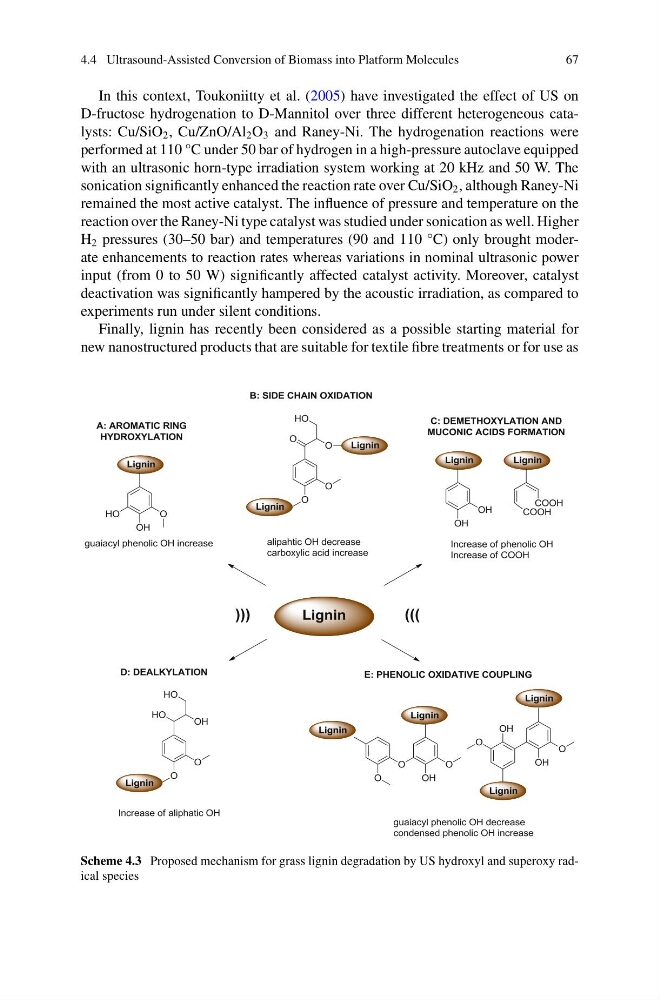
Scheme 4.3 Proposed mechanism for grass lignin degradation by US hydroxyl and superoxy radical species
67
In this context, Toukoniitty et al. (2005) have investigated the effect of US on
D-fructose hydrogenation to D-Mannitol over three different heterogeneous catalysts: Cu/SiO 2 , Cu/ZnO/Al 2 O 3 and Raney-Ni. The hydrogenation reactions were
performed at 110 °C under 50 bar of hydrogen in a high-pressure autoclave equipped
with an ultrasonic horn-type irradiation system working at 20 kHz and 50 W. The
sonication significantly enhanced the reaction rate over Cu/SiO 2 , although Raney-Ni
remained the most active catalyst. The influence of pressure and temperature on the
reaction over the Raney-Ni type catalyst was studied under sonication as well. Higher
H 2 pressures (30–50 bar) and temperatures (90 and 110 °C) only brought moderate enhancements to reaction rates whereas variations in nominal ultrasonic power
input (from 0 to 50 W) significantly affected catalyst activity. Moreover, catalyst
deactivation was significantly hampered by the acoustic irradiation, as compared to
experiments run under silent conditions.
Finally, lignin has recently been considered as a possible starting material for
new nanostructured products that are suitable for textile fibre treatments or for use as
Scheme 4.3 Proposed mechanism for grass lignin degradation by US hydroxyl and superoxy radical species