

4.4 Ultrasound-Assisted Conversion of Biomass into Platform Molecules
65
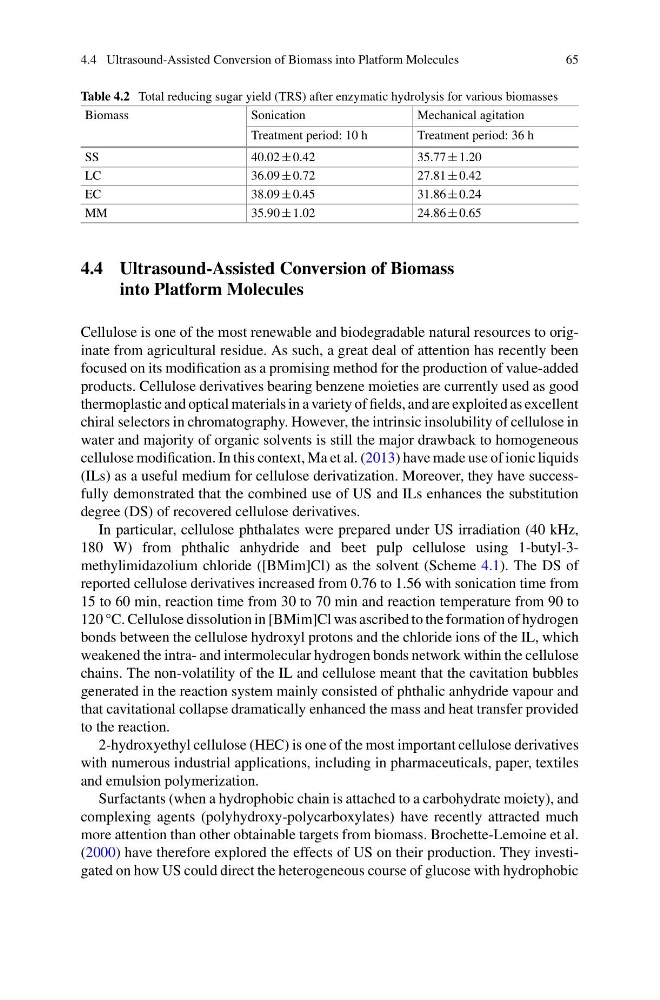
Table 4.2 Total reducing sugar yield (TRS) after enzymatic hydrolysis for various biomasses
Biomass
Sonication
Mechanical agitation
Treatment period: 10 h
Treatment period: 36 h
SS
40.02 ± 0.42
35.77 ± 1.20
LC
36.09 ± 0.72
27.81 ± 0.42
EC
38.09 ± 0.45
31.86 ± 0.24
MM
35.90 ± 1.02
24.86 ± 0.65
4.4 Ultrasound-Assisted Conversion of Biomass
into Platform Molecules
Cellulose is one of the most renewable and biodegradable natural resources to originate from agricultural residue. As such, a great deal of attention has recently been
focused on its modification as a promising method for the production of value-added
products. Cellulose derivatives bearing benzene moieties are currently used as good
thermoplastic and optical materials in a variety of fields, and are exploited as excellent
chiral selectors in chromatography. However, the intrinsic insolubility of cellulose in
water and majority of organic solvents is still the major drawback to homogeneous
cellulose modification. In this context, Ma et al. (2013) have made use of ionic liquids
(ILs) as a useful medium for cellulose derivatization. Moreover, they have successfully demonstrated that the combined use of US and ILs enhances the substitution
degree (DS) of recovered cellulose derivatives.
In particular, cellulose phthalates were prepared under US irradiation (40 kHz,
180 W) from phthalic anhydride and beet pulp cellulose using 1-butyl-3methylimidazolium chloride ([BMim]Cl) as the solvent (Scheme 4.1). The DS of
reported cellulose derivatives increased from 0.76 to 1.56 with sonication time from
15 to 60 min, reaction time from 30 to 70 min and reaction temperature from 90 to
120 °C. Cellulose dissolution in [BMim]Cl was ascribed to the formation of hydrogen
bonds between the cellulose hydroxyl protons and the chloride ions of the IL, which
weakened the intra- and intermolecular hydrogen bonds network within the cellulose
chains. The non-volatility of the IL and cellulose meant that the cavitation bubbles
generated in the reaction system mainly consisted of phthalic anhydride vapour and
that cavitational collapse dramatically enhanced the mass and heat transfer provided
to the reaction.
2-hydroxyethyl cellulose (HEC) is one of the most important cellulose derivatives
with numerous industrial applications, including in pharmaceuticals, paper, textiles
and emulsion polymerization.
Surfactants (when a hydrophobic chain is attached to a carbohydrate moiety), and
complexing agents (polyhydroxy-polycarboxylates) have recently attracted much
more attention than other obtainable targets from biomass. Brochette-Lemoine et al.
(2000) have therefore explored the effects of US on their production. They investigated on how US could direct the heterogeneous course of glucose with hydrophobic
65
Table 4.2 Total reducing sugar yield (TRS) after enzymatic hydrolysis for various biomasses
Biomass
Sonication
Mechanical agitation
Treatment period: 10 h
Treatment period: 36 h
SS
40.02 ± 0.42
35.77 ± 1.20
LC
36.09 ± 0.72
27.81 ± 0.42
EC
38.09 ± 0.45
31.86 ± 0.24
MM
35.90 ± 1.02
24.86 ± 0.65
4.4 Ultrasound-Assisted Conversion of Biomass
into Platform Molecules
Cellulose is one of the most renewable and biodegradable natural resources to originate from agricultural residue. As such, a great deal of attention has recently been
focused on its modification as a promising method for the production of value-added
products. Cellulose derivatives bearing benzene moieties are currently used as good
thermoplastic and optical materials in a variety of fields, and are exploited as excellent
chiral selectors in chromatography. However, the intrinsic insolubility of cellulose in
water and majority of organic solvents is still the major drawback to homogeneous
cellulose modification. In this context, Ma et al. (2013) have made use of ionic liquids
(ILs) as a useful medium for cellulose derivatization. Moreover, they have successfully demonstrated that the combined use of US and ILs enhances the substitution
degree (DS) of recovered cellulose derivatives.
In particular, cellulose phthalates were prepared under US irradiation (40 kHz,
180 W) from phthalic anhydride and beet pulp cellulose using 1-butyl-3methylimidazolium chloride ([BMim]Cl) as the solvent (Scheme 4.1). The DS of
reported cellulose derivatives increased from 0.76 to 1.56 with sonication time from
15 to 60 min, reaction time from 30 to 70 min and reaction temperature from 90 to
120 °C. Cellulose dissolution in [BMim]Cl was ascribed to the formation of hydrogen
bonds between the cellulose hydroxyl protons and the chloride ions of the IL, which
weakened the intra- and intermolecular hydrogen bonds network within the cellulose
chains. The non-volatility of the IL and cellulose meant that the cavitation bubbles
generated in the reaction system mainly consisted of phthalic anhydride vapour and
that cavitational collapse dramatically enhanced the mass and heat transfer provided
to the reaction.
2-hydroxyethyl cellulose (HEC) is one of the most important cellulose derivatives
with numerous industrial applications, including in pharmaceuticals, paper, textiles
and emulsion polymerization.
Surfactants (when a hydrophobic chain is attached to a carbohydrate moiety), and
complexing agents (polyhydroxy-polycarboxylates) have recently attracted much
more attention than other obtainable targets from biomass. Brochette-Lemoine et al.
(2000) have therefore explored the effects of US on their production. They investigated on how US could direct the heterogeneous course of glucose with hydrophobic