

64
4 Effective Biomass Valorization Procedures Using Ultrasound …
action’. This would facilitate the development of effective processes in the field of
sono-biotechnology.
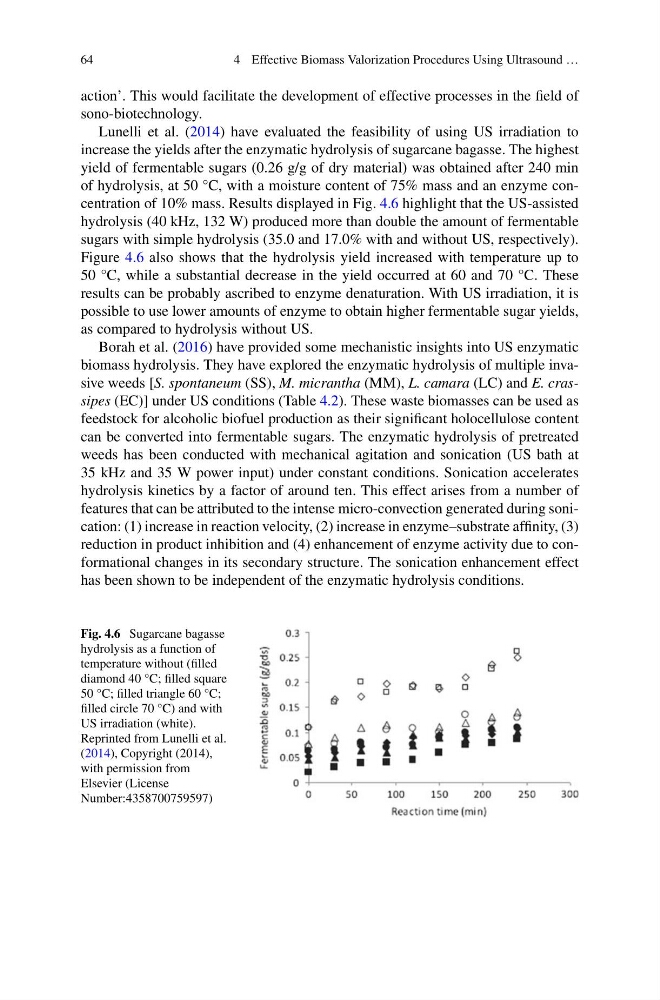
Lunelli et al. (2014) have evaluated the feasibility of using US irradiation to
increase the yields after the enzymatic hydrolysis of sugarcane bagasse. The highest
yield of fermentable sugars (0.26 g/g of dry material) was obtained after 240 min
of hydrolysis, at 50 °C, with a moisture content of 75% mass and an enzyme concentration of 10% mass. Results displayed in Fig. 4.6 highlight that the US-assisted
hydrolysis (40 kHz, 132 W) produced more than double the amount of fermentable
sugars with simple hydrolysis (35.0 and 17.0% with and without US, respectively).
Figure 4.6 also shows that the hydrolysis yield increased with temperature up to
50 °C, while a substantial decrease in the yield occurred at 60 and 70 °C. These
results can be probably ascribed to enzyme denaturation. With US irradiation, it is
possible to use lower amounts of enzyme to obtain higher fermentable sugar yields,
as compared to hydrolysis without US.
Borah et al. (2016) have provided some mechanistic insights into US enzymatic
biomass hydrolysis. They have explored the enzymatic hydrolysis of multiple invasive weeds [S. spontaneum (SS), M. micrantha (MM), L. camara (LC) and E. crassipes (EC)] under US conditions (Table 4.2). These waste biomasses can be used as
feedstock for alcoholic biofuel production as their significant holocellulose content
can be converted into fermentable sugars. The enzymatic hydrolysis of pretreated
weeds has been conducted with mechanical agitation and sonication (US bath at
35 kHz and 35 W power input) under constant conditions. Sonication accelerates
hydrolysis kinetics by a factor of around ten. This effect arises from a number of
features that can be attributed to the intense micro-convection generated during sonication: (1) increase in reaction velocity, (2) increase in enzyme–substrate affinity, (3)
reduction in product inhibition and (4) enhancement of enzyme activity due to conformational changes in its secondary structure. The sonication enhancement effect
has been shown to be independent of the enzymatic hydrolysis conditions.
Fig. 4.6 Sugarcane bagasse
hydrolysis as a function of
temperature without (filled
diamond 40 °C; filled square
50 °C; filled triangle 60 °C;
filled circle 70 °C) and with
US irradiation (white).
Reprinted from Lunelli et al.
(2014), Copyright (2014),
with permission from
Elsevier (License
Number:4358700759597)
4 Effective Biomass Valorization Procedures Using Ultrasound …
action’. This would facilitate the development of effective processes in the field of
sono-biotechnology.
Lunelli et al. (2014) have evaluated the feasibility of using US irradiation to
increase the yields after the enzymatic hydrolysis of sugarcane bagasse. The highest
yield of fermentable sugars (0.26 g/g of dry material) was obtained after 240 min
of hydrolysis, at 50 °C, with a moisture content of 75% mass and an enzyme concentration of 10% mass. Results displayed in Fig. 4.6 highlight that the US-assisted
hydrolysis (40 kHz, 132 W) produced more than double the amount of fermentable
sugars with simple hydrolysis (35.0 and 17.0% with and without US, respectively).
Figure 4.6 also shows that the hydrolysis yield increased with temperature up to
50 °C, while a substantial decrease in the yield occurred at 60 and 70 °C. These
results can be probably ascribed to enzyme denaturation. With US irradiation, it is
possible to use lower amounts of enzyme to obtain higher fermentable sugar yields,
as compared to hydrolysis without US.
Borah et al. (2016) have provided some mechanistic insights into US enzymatic
biomass hydrolysis. They have explored the enzymatic hydrolysis of multiple invasive weeds [S. spontaneum (SS), M. micrantha (MM), L. camara (LC) and E. crassipes (EC)] under US conditions (Table 4.2). These waste biomasses can be used as
feedstock for alcoholic biofuel production as their significant holocellulose content
can be converted into fermentable sugars. The enzymatic hydrolysis of pretreated
weeds has been conducted with mechanical agitation and sonication (US bath at
35 kHz and 35 W power input) under constant conditions. Sonication accelerates
hydrolysis kinetics by a factor of around ten. This effect arises from a number of
features that can be attributed to the intense micro-convection generated during sonication: (1) increase in reaction velocity, (2) increase in enzyme–substrate affinity, (3)
reduction in product inhibition and (4) enhancement of enzyme activity due to conformational changes in its secondary structure. The sonication enhancement effect
has been shown to be independent of the enzymatic hydrolysis conditions.
Fig. 4.6 Sugarcane bagasse
hydrolysis as a function of
temperature without (filled
diamond 40 °C; filled square
50 °C; filled triangle 60 °C;
filled circle 70 °C) and with
US irradiation (white).
Reprinted from Lunelli et al.
(2014), Copyright (2014),
with permission from
Elsevier (License
Number:4358700759597)