

4.2 Biomass Pretreatment
63
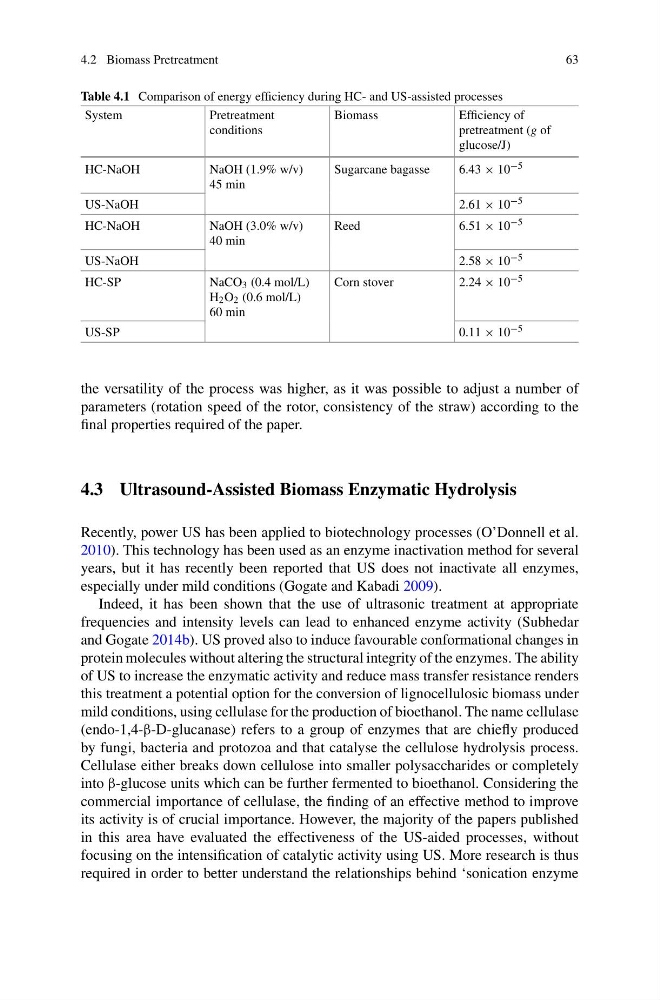
Table 4.1 Comparison of energy efficiency during HC- and US-assisted processes
System
Pretreatment
conditions
Biomass
Efficiency of
pretreatment (g of
glucose/J)
HC-NaOH
NaOH (1.9% w/v)
45 min
Sugarcane bagasse
6.43 × 10 −5
US-NaOH
2.61 × 10 −5
HC-NaOH
NaOH (3.0% w/v)
40 min
Reed
6.51 × 10 −5
US-NaOH
2.58 × 10 −5
HC-SP
NaCO 3 (0.4 mol/L)
H 2 O 2 (0.6 mol/L)
60 min
Corn stover
2.24 × 10 −5
US-SP
0.11 × 10 −5
the versatility of the process was higher, as it was possible to adjust a number of
parameters (rotation speed of the rotor, consistency of the straw) according to the
final properties required of the paper.
4.3 Ultrasound-Assisted Biomass Enzymatic Hydrolysis
Recently, power US has been applied to biotechnology processes (O’Donnell et al.
2010). This technology has been used as an enzyme inactivation method for several
years, but it has recently been reported that US does not inactivate all enzymes,
especially under mild conditions (Gogate and Kabadi 2009).
Indeed, it has been shown that the use of ultrasonic treatment at appropriate
frequencies and intensity levels can lead to enhanced enzyme activity (Subhedar
and Gogate 2014b). US proved also to induce favourable conformational changes in
protein molecules without altering the structural integrity of the enzymes. The ability
of US to increase the enzymatic activity and reduce mass transfer resistance renders
this treatment a potential option for the conversion of lignocellulosic biomass under
mild conditions, using cellulase for the production of bioethanol. The name cellulase
(endo-1,4-β-D-glucanase) refers to a group of enzymes that are chiefly produced
by fungi, bacteria and protozoa and that catalyse the cellulose hydrolysis process.
Cellulase either breaks down cellulose into smaller polysaccharides or completely
into β-glucose units which can be further fermented to bioethanol. Considering the
commercial importance of cellulase, the finding of an effective method to improve
its activity is of crucial importance. However, the majority of the papers published
in this area have evaluated the effectiveness of the US-aided processes, without
focusing on the intensification of catalytic activity using US. More research is thus
required in order to better understand the relationships behind ‘sonication enzyme
63
Table 4.1 Comparison of energy efficiency during HC- and US-assisted processes
System
Pretreatment
conditions
Biomass
Efficiency of
pretreatment (g of
glucose/J)
HC-NaOH
NaOH (1.9% w/v)
45 min
Sugarcane bagasse
6.43 × 10 −5
US-NaOH
2.61 × 10 −5
HC-NaOH
NaOH (3.0% w/v)
40 min
Reed
6.51 × 10 −5
US-NaOH
2.58 × 10 −5
HC-SP
NaCO 3 (0.4 mol/L)
H 2 O 2 (0.6 mol/L)
60 min
Corn stover
2.24 × 10 −5
US-SP
0.11 × 10 −5
the versatility of the process was higher, as it was possible to adjust a number of
parameters (rotation speed of the rotor, consistency of the straw) according to the
final properties required of the paper.
4.3 Ultrasound-Assisted Biomass Enzymatic Hydrolysis
Recently, power US has been applied to biotechnology processes (O’Donnell et al.
2010). This technology has been used as an enzyme inactivation method for several
years, but it has recently been reported that US does not inactivate all enzymes,
especially under mild conditions (Gogate and Kabadi 2009).
Indeed, it has been shown that the use of ultrasonic treatment at appropriate
frequencies and intensity levels can lead to enhanced enzyme activity (Subhedar
and Gogate 2014b). US proved also to induce favourable conformational changes in
protein molecules without altering the structural integrity of the enzymes. The ability
of US to increase the enzymatic activity and reduce mass transfer resistance renders
this treatment a potential option for the conversion of lignocellulosic biomass under
mild conditions, using cellulase for the production of bioethanol. The name cellulase
(endo-1,4-β-D-glucanase) refers to a group of enzymes that are chiefly produced
by fungi, bacteria and protozoa and that catalyse the cellulose hydrolysis process.
Cellulase either breaks down cellulose into smaller polysaccharides or completely
into β-glucose units which can be further fermented to bioethanol. Considering the
commercial importance of cellulase, the finding of an effective method to improve
its activity is of crucial importance. However, the majority of the papers published
in this area have evaluated the effectiveness of the US-aided processes, without
focusing on the intensification of catalytic activity using US. More research is thus
required in order to better understand the relationships behind ‘sonication enzyme