

58
4 Effective Biomass Valorization Procedures Using Ultrasound …
for 45 min, affording a maximum xylose yield of 58% after the hydrolytic tests,
while untreated biomass afforded only 22% of xylose. This noticeable difference
reveals that directly exposing OPEFB fibres to ultrasonication power at a variety of
amplitudes has a marked effect on the efficiency of low-temperature acid hydrolysis.
This was mainly due to the removal of silica bodies from the surface of the OPEFB
fibres prior to acid hydrolysis.
In order to increase the enzymatic digestibility of rice straw (RS), Xiong et al.
(2017) have recently reported the use of US-assisted pretreatment in the presence of
Fenton’s reagent and a horn-type US device working at 22 kHz and 200–600 W. They
confirmed that the US-assisted Fenton process facilitated the reliable and effective
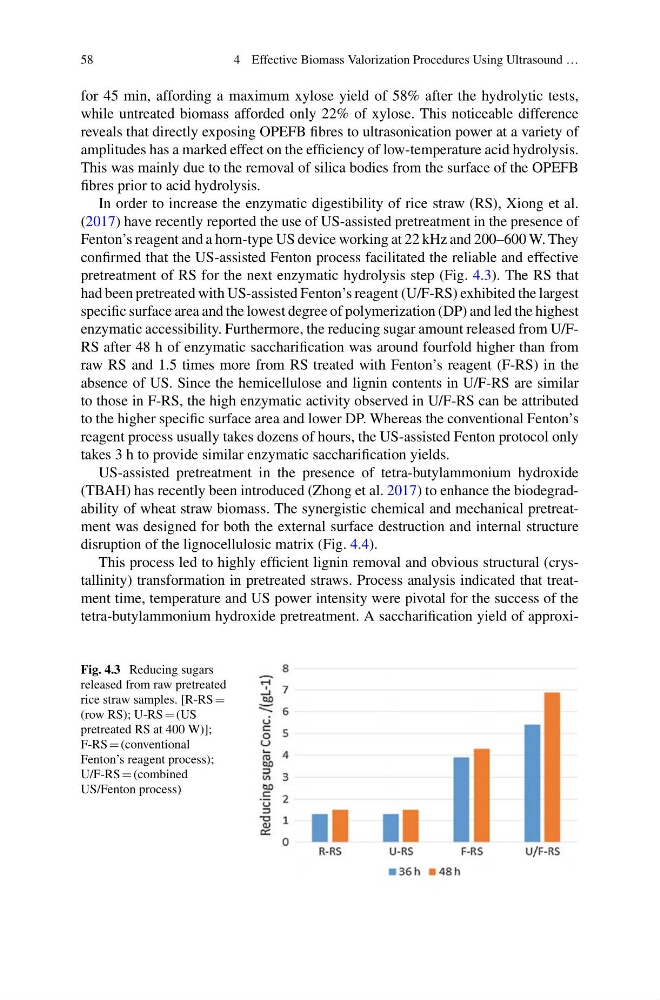
pretreatment of RS for the next enzymatic hydrolysis step (Fig. 4.3). The RS that
had been pretreated with US-assisted Fenton’s reagent (U/F-RS) exhibited the largest
specific surface area and the lowest degree of polymerization (DP) and led the highest
enzymatic accessibility. Furthermore, the reducing sugar amount released from U/FRS after 48 h of enzymatic saccharification was around fourfold higher than from
raw RS and 1.5 times more from RS treated with Fenton’s reagent (F-RS) in the
absence of US. Since the hemicellulose and lignin contents in U/F-RS are similar
to those in F-RS, the high enzymatic activity observed in U/F-RS can be attributed
to the higher specific surface area and lower DP. Whereas the conventional Fenton’s
reagent process usually takes dozens of hours, the US-assisted Fenton protocol only
takes 3 h to provide similar enzymatic saccharification yields.
US-assisted pretreatment in the presence of tetra-butylammonium hydroxide
(TBAH) has recently been introduced (Zhong et al. 2017) to enhance the biodegradability of wheat straw biomass. The synergistic chemical and mechanical pretreatment was designed for both the external surface destruction and internal structure
disruption of the lignocellulosic matrix (Fig. 4.4).
This process led to highly efficient lignin removal and obvious structural (crystallinity) transformation in pretreated straws. Process analysis indicated that treatment time, temperature and US power intensity were pivotal for the success of the
tetra-butylammonium hydroxide pretreatment. A saccharification yield of approxiFig. 4.3 Reducing sugars
released from raw pretreated
rice straw samples. [R-RS
(row RS); U-RS (US
pretreated RS at 400 W)];
F-RS (conventional
Fenton’s reagent process);
U/F-RS (combined
US/Fenton process)
4 Effective Biomass Valorization Procedures Using Ultrasound …
for 45 min, affording a maximum xylose yield of 58% after the hydrolytic tests,
while untreated biomass afforded only 22% of xylose. This noticeable difference
reveals that directly exposing OPEFB fibres to ultrasonication power at a variety of
amplitudes has a marked effect on the efficiency of low-temperature acid hydrolysis.
This was mainly due to the removal of silica bodies from the surface of the OPEFB
fibres prior to acid hydrolysis.
In order to increase the enzymatic digestibility of rice straw (RS), Xiong et al.
(2017) have recently reported the use of US-assisted pretreatment in the presence of
Fenton’s reagent and a horn-type US device working at 22 kHz and 200–600 W. They
confirmed that the US-assisted Fenton process facilitated the reliable and effective
pretreatment of RS for the next enzymatic hydrolysis step (Fig. 4.3). The RS that
had been pretreated with US-assisted Fenton’s reagent (U/F-RS) exhibited the largest
specific surface area and the lowest degree of polymerization (DP) and led the highest
enzymatic accessibility. Furthermore, the reducing sugar amount released from U/FRS after 48 h of enzymatic saccharification was around fourfold higher than from
raw RS and 1.5 times more from RS treated with Fenton’s reagent (F-RS) in the
absence of US. Since the hemicellulose and lignin contents in U/F-RS are similar
to those in F-RS, the high enzymatic activity observed in U/F-RS can be attributed
to the higher specific surface area and lower DP. Whereas the conventional Fenton’s
reagent process usually takes dozens of hours, the US-assisted Fenton protocol only
takes 3 h to provide similar enzymatic saccharification yields.
US-assisted pretreatment in the presence of tetra-butylammonium hydroxide
(TBAH) has recently been introduced (Zhong et al. 2017) to enhance the biodegradability of wheat straw biomass. The synergistic chemical and mechanical pretreatment was designed for both the external surface destruction and internal structure
disruption of the lignocellulosic matrix (Fig. 4.4).
This process led to highly efficient lignin removal and obvious structural (crystallinity) transformation in pretreated straws. Process analysis indicated that treatment time, temperature and US power intensity were pivotal for the success of the
tetra-butylammonium hydroxide pretreatment. A saccharification yield of approxiFig. 4.3 Reducing sugars
released from raw pretreated
rice straw samples. [R-RS
(row RS); U-RS (US
pretreated RS at 400 W)];
F-RS (conventional
Fenton’s reagent process);
U/F-RS (combined
US/Fenton process)