

4.2 Biomass Pretreatment
59
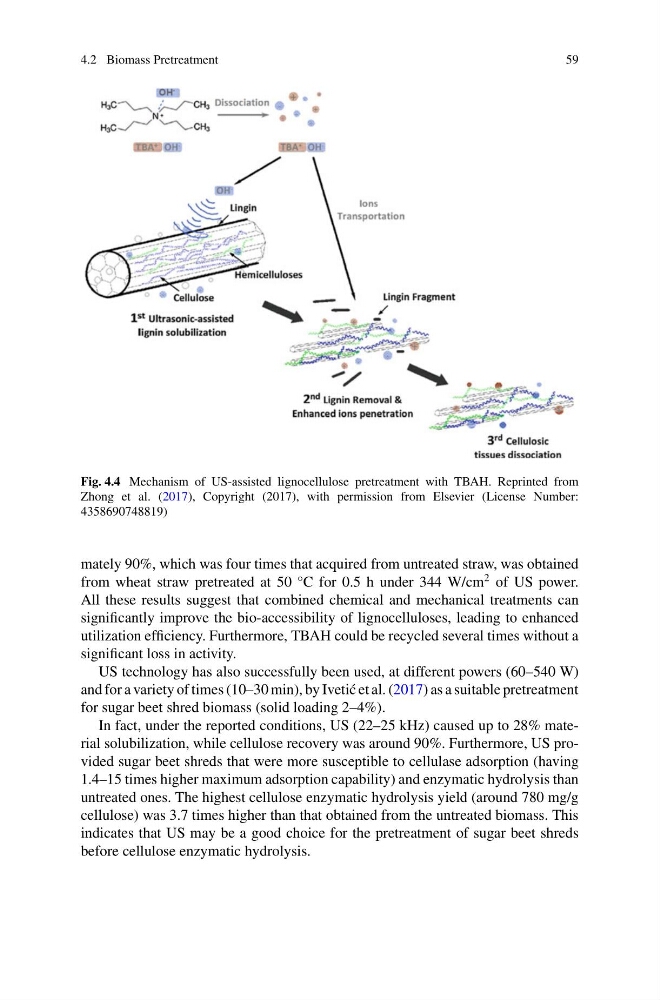
Fig. 4.4 Mechanism of US-assisted lignocellulose pretreatment with TBAH. Reprinted from
Zhong et al. (2017), Copyright (2017), with permission from Elsevier (License Number:
4358690748819)
mately 90%, which was four times that acquired from untreated straw, was obtained
from wheat straw pretreated at 50 °C for 0.5 h under 344 W/cm
2 of US power.
All these results suggest that combined chemical and mechanical treatments can
significantly improve the bio-accessibility of lignocelluloses, leading to enhanced
utilization efficiency. Furthermore, TBAH could be recycled several times without a
significant loss in activity.
US technology has also successfully been used, at different powers (60–540 W)
and for a variety of times (10–30 min), by Iveti´ c et al. (2017) as a suitable pretreatment
for sugar beet shred biomass (solid loading 2–4%).
In fact, under the reported conditions, US (22–25 kHz) caused up to 28% material solubilization, while cellulose recovery was around 90%. Furthermore, US provided sugar beet shreds that were more susceptible to cellulase adsorption (having
1.4–15 times higher maximum adsorption capability) and enzymatic hydrolysis than
untreated ones. The highest cellulose enzymatic hydrolysis yield (around 780 mg/g
cellulose) was 3.7 times higher than that obtained from the untreated biomass. This
indicates that US may be a good choice for the pretreatment of sugar beet shreds
before cellulose enzymatic hydrolysis.
59
Fig. 4.4 Mechanism of US-assisted lignocellulose pretreatment with TBAH. Reprinted from
Zhong et al. (2017), Copyright (2017), with permission from Elsevier (License Number:
4358690748819)
mately 90%, which was four times that acquired from untreated straw, was obtained
from wheat straw pretreated at 50 °C for 0.5 h under 344 W/cm
2 of US power.
All these results suggest that combined chemical and mechanical treatments can
significantly improve the bio-accessibility of lignocelluloses, leading to enhanced
utilization efficiency. Furthermore, TBAH could be recycled several times without a
significant loss in activity.
US technology has also successfully been used, at different powers (60–540 W)
and for a variety of times (10–30 min), by Iveti´ c et al. (2017) as a suitable pretreatment
for sugar beet shred biomass (solid loading 2–4%).
In fact, under the reported conditions, US (22–25 kHz) caused up to 28% material solubilization, while cellulose recovery was around 90%. Furthermore, US provided sugar beet shreds that were more susceptible to cellulase adsorption (having
1.4–15 times higher maximum adsorption capability) and enzymatic hydrolysis than
untreated ones. The highest cellulose enzymatic hydrolysis yield (around 780 mg/g
cellulose) was 3.7 times higher than that obtained from the untreated biomass. This
indicates that US may be a good choice for the pretreatment of sugar beet shreds
before cellulose enzymatic hydrolysis.