

4.2 Biomass Pretreatment
57
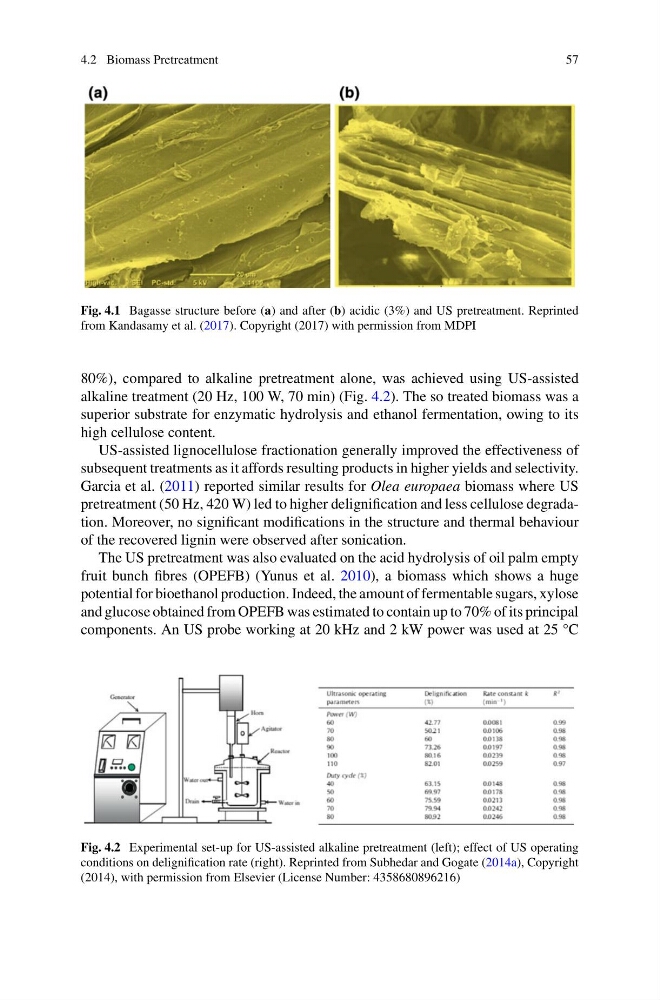
Fig. 4.1 Bagasse structure before (a) and after (b) acidic (3%) and US pretreatment. Reprinted
from Kandasamy et al. (2017). Copyright (2017) with permission from MDPI
80%), compared to alkaline pretreatment alone, was achieved using US-assisted
alkaline treatment (20 Hz, 100 W, 70 min) (Fig. 4.2). The so treated biomass was a
superior substrate for enzymatic hydrolysis and ethanol fermentation, owing to its
high cellulose content.
US-assisted lignocellulose fractionation generally improved the effectiveness of
subsequent treatments as it affords resulting products in higher yields and selectivity.
Garcia et al. (2011) reported similar results for Olea europaea biomass where US
pretreatment (50 Hz, 420 W) led to higher delignification and less cellulose degradation. Moreover, no significant modifications in the structure and thermal behaviour
of the recovered lignin were observed after sonication.
The US pretreatment was also evaluated on the acid hydrolysis of oil palm empty
fruit bunch fibres (OPEFB) (Yunus et al. 2010), a biomass which shows a huge
potential for bioethanol production. Indeed, the amount of fermentable sugars, xylose
and glucose obtained from OPEFB was estimated to contain up to 70% of its principal
components. An US probe working at 20 kHz and 2 kW power was used at 25 °C
Fig. 4.2 Experimental set-up for US-assisted alkaline pretreatment (left); effect of US operating
conditions on delignification rate (right). Reprinted from Subhedar and Gogate (2014a), Copyright
(2014), with permission from Elsevier (License Number: 4358680896216)
57
Fig. 4.1 Bagasse structure before (a) and after (b) acidic (3%) and US pretreatment. Reprinted
from Kandasamy et al. (2017). Copyright (2017) with permission from MDPI
80%), compared to alkaline pretreatment alone, was achieved using US-assisted
alkaline treatment (20 Hz, 100 W, 70 min) (Fig. 4.2). The so treated biomass was a
superior substrate for enzymatic hydrolysis and ethanol fermentation, owing to its
high cellulose content.
US-assisted lignocellulose fractionation generally improved the effectiveness of
subsequent treatments as it affords resulting products in higher yields and selectivity.
Garcia et al. (2011) reported similar results for Olea europaea biomass where US
pretreatment (50 Hz, 420 W) led to higher delignification and less cellulose degradation. Moreover, no significant modifications in the structure and thermal behaviour
of the recovered lignin were observed after sonication.
The US pretreatment was also evaluated on the acid hydrolysis of oil palm empty
fruit bunch fibres (OPEFB) (Yunus et al. 2010), a biomass which shows a huge
potential for bioethanol production. Indeed, the amount of fermentable sugars, xylose
and glucose obtained from OPEFB was estimated to contain up to 70% of its principal
components. An US probe working at 20 kHz and 2 kW power was used at 25 °C
Fig. 4.2 Experimental set-up for US-assisted alkaline pretreatment (left); effect of US operating
conditions on delignification rate (right). Reprinted from Subhedar and Gogate (2014a), Copyright
(2014), with permission from Elsevier (License Number: 4358680896216)