

44
3 Sonication in Neoteric Solvents. A Further Look …
literature in many domains, it is a safe bet that this gives a glimpse of a bright future
for this coupled technology.
3.2.2 Ionic Liquids (ILs)
Ionic liquids are organic salts made of poorly coordinated cations/anions combinations ensuring a law lattice energy enabling a liquid state at room temperature
or at least below 100 °C. The cationic part must be of organic nature whereas the
anion can be or organic or inorganic origin. At least one of the constituting moieties
of this ionic pair must present delocalized charge(s) to prevent the formation of a
stable crystal lattice. Organic cations are usually large ones and are derived from
molecules bearing a heteroatom with an available lone pair such as nitrogen, sulphur
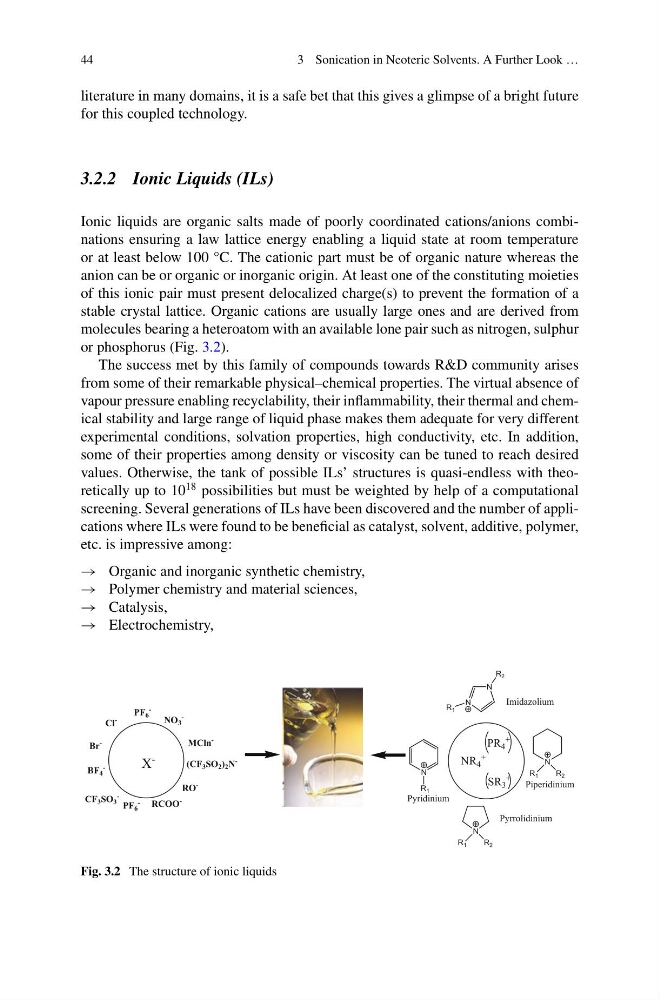
or phosphorus (Fig. 3.2).
The success met by this family of compounds towards R&D community arises
from some of their remarkable physical–chemical properties. The virtual absence of
vapour pressure enabling recyclability, their inflammability, their thermal and chemical stability and large range of liquid phase makes them adequate for very different
experimental conditions, solvation properties, high conductivity, etc. In addition,
some of their properties among density or viscosity can be tuned to reach desired
values. Otherwise, the tank of possible ILs’ structures is quasi-endless with theoretically up to 10
18 possibilities but must be weighted by help of a computational
screening. Several generations of ILs have been discovered and the number of applications where ILs were found to be beneficial as catalyst, solvent, additive, polymer,
etc. is impressive among:
→ Organic and inorganic synthetic chemistry,
→ Polymer chemistry and material sciences,
→ Catalysis,
→ Electrochemistry,
PR 4
+
SR 3
+
NR 4
+
X
-
PF 6
-
Cl
-
Br
-
BF 4
-
CF 3 SO 3
-
PF 6
-
RCOO
-
(CF 3 SO 2 ) 2 N
-
MCln
-
NO 3
-
RO
-
N
R 1
N
N
R 2
R 1
N
R 1
R 2
N
R 1
R 2
Pyridinium
Imidazolium
Piperidinium
Pyrrolidinium
Fig. 3.2 The structure of ionic liquids
3 Sonication in Neoteric Solvents. A Further Look …
literature in many domains, it is a safe bet that this gives a glimpse of a bright future
for this coupled technology.
3.2.2 Ionic Liquids (ILs)
Ionic liquids are organic salts made of poorly coordinated cations/anions combinations ensuring a law lattice energy enabling a liquid state at room temperature
or at least below 100 °C. The cationic part must be of organic nature whereas the
anion can be or organic or inorganic origin. At least one of the constituting moieties
of this ionic pair must present delocalized charge(s) to prevent the formation of a
stable crystal lattice. Organic cations are usually large ones and are derived from
molecules bearing a heteroatom with an available lone pair such as nitrogen, sulphur
or phosphorus (Fig. 3.2).
The success met by this family of compounds towards R&D community arises
from some of their remarkable physical–chemical properties. The virtual absence of
vapour pressure enabling recyclability, their inflammability, their thermal and chemical stability and large range of liquid phase makes them adequate for very different
experimental conditions, solvation properties, high conductivity, etc. In addition,
some of their properties among density or viscosity can be tuned to reach desired
values. Otherwise, the tank of possible ILs’ structures is quasi-endless with theoretically up to 10
18 possibilities but must be weighted by help of a computational
screening. Several generations of ILs have been discovered and the number of applications where ILs were found to be beneficial as catalyst, solvent, additive, polymer,
etc. is impressive among:
→ Organic and inorganic synthetic chemistry,
→ Polymer chemistry and material sciences,
→ Catalysis,
→ Electrochemistry,
PR 4
+
SR 3
+
NR 4
+
X
-
PF 6
-
Cl
-
Br
-
BF 4
-
CF 3 SO 3
-
PF 6
-
RCOO
-
(CF 3 SO 2 ) 2 N
-
MCln
-
NO 3
-
RO
-
N
R 1
N
N
R 2
R 1
N
R 1
R 2
N
R 1
R 2
Pyridinium
Imidazolium
Piperidinium
Pyrrolidinium
Fig. 3.2 The structure of ionic liquids