

3.2 The Three Most Promising Classes of Neoteric Solvents
45
→ Energy storage and conversion,
→ Extraction, segregation and separation processes, and
→ Biomass valorization and biotechnologies.
This is testified by the current high rate of publication lasting for more than
10 years. However, enthusiasm seems to attenuate with time notably as an increasing
number of studies on these moieties reported that they were not totally inert under several explored reaction conditions. In addition, ILs compounds show major drawbacks
such as non-negligible toxicity, high cost and a poor biodegradability. An alternative
approach was to develop ILs based on bio-based components enabling biodegradability properties and low toxicity. Numerous ILs based on amino acids, carboxylic
acids, quaternary ammonium, phosphonium, etc. have recently emerged. As a striking
example, cholinium-based ionic liquids combined with amino acid anions ([Ch][AA]
ILs) have been reported to have very promising properties (Dominguez de Maria
2013) including adequate toxicity and biodegradability for large-scale implementation (Petkovic et al. 2010), reviving the initial craze of this family of compounds.
3.2.3 Deep Eutectic Solvents (DES)
DES, also named as NADES for natural deep eutectic solvents, are among the latest
breakthroughs in the world of green solvents. Whereas ILs are considered as ionic
compounds, DES can be said to be ionic mixtures obtained from the mixing of two or
more cheaper and non-toxic molecular components, i.e. an HBA (for hydrogen bond
acceptor) and an HBD (hydrogen bond donor). Both components do dynamically
exchange a hydrogen bond leading to a eutectic combination (Smith et al. 2014). In
many reports, DES are typically prepared from choline chloride as HBA with diverse
HBD such as urea, carboxylic acids or polyols although several sub-classes of DES
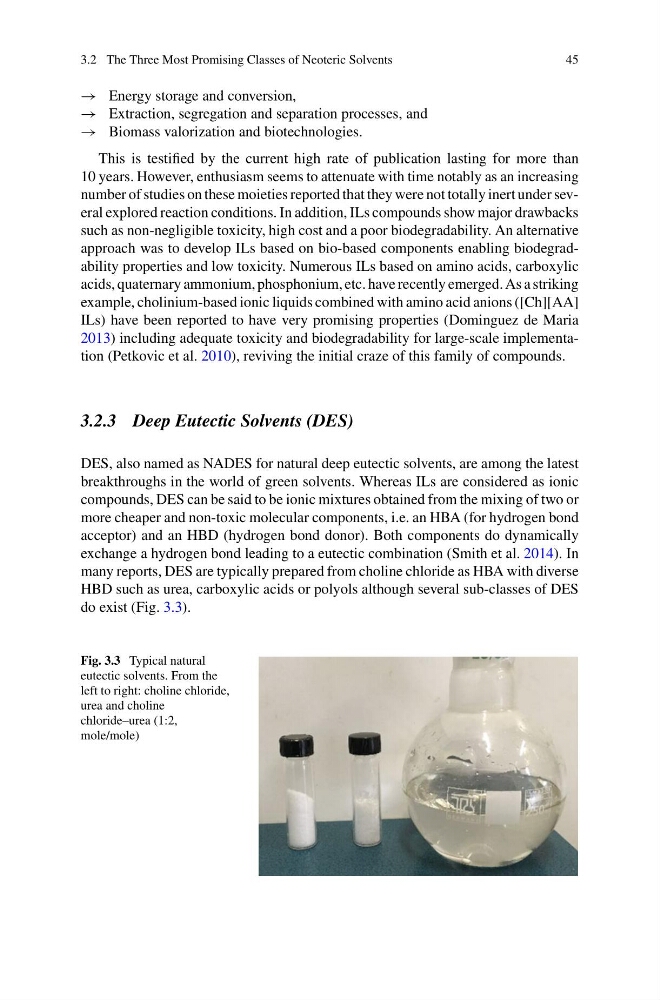
do exist (Fig. 3.3).
Fig. 3.3 Typical natural
eutectic solvents. From the
left to right: choline chloride,
urea and choline
chloride–urea (1:2,
mole/mole)
45
→ Energy storage and conversion,
→ Extraction, segregation and separation processes, and
→ Biomass valorization and biotechnologies.
This is testified by the current high rate of publication lasting for more than
10 years. However, enthusiasm seems to attenuate with time notably as an increasing
number of studies on these moieties reported that they were not totally inert under several explored reaction conditions. In addition, ILs compounds show major drawbacks
such as non-negligible toxicity, high cost and a poor biodegradability. An alternative
approach was to develop ILs based on bio-based components enabling biodegradability properties and low toxicity. Numerous ILs based on amino acids, carboxylic
acids, quaternary ammonium, phosphonium, etc. have recently emerged. As a striking
example, cholinium-based ionic liquids combined with amino acid anions ([Ch][AA]
ILs) have been reported to have very promising properties (Dominguez de Maria
2013) including adequate toxicity and biodegradability for large-scale implementation (Petkovic et al. 2010), reviving the initial craze of this family of compounds.
3.2.3 Deep Eutectic Solvents (DES)
DES, also named as NADES for natural deep eutectic solvents, are among the latest
breakthroughs in the world of green solvents. Whereas ILs are considered as ionic
compounds, DES can be said to be ionic mixtures obtained from the mixing of two or
more cheaper and non-toxic molecular components, i.e. an HBA (for hydrogen bond
acceptor) and an HBD (hydrogen bond donor). Both components do dynamically
exchange a hydrogen bond leading to a eutectic combination (Smith et al. 2014). In
many reports, DES are typically prepared from choline chloride as HBA with diverse
HBD such as urea, carboxylic acids or polyols although several sub-classes of DES
do exist (Fig. 3.3).
Fig. 3.3 Typical natural
eutectic solvents. From the
left to right: choline chloride,
urea and choline
chloride–urea (1:2,
mole/mole)