

3.2 The Three Most Promising Classes of Neoteric Solvents
43
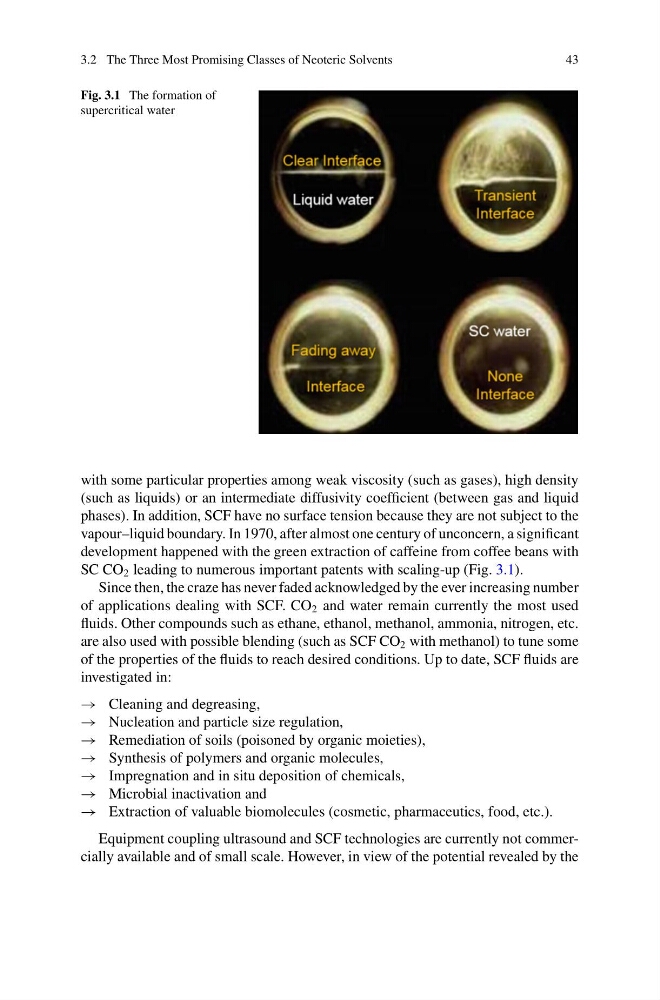
Fig. 3.1 The formation of
supercritical water
with some particular properties among weak viscosity (such as gases), high density
(such as liquids) or an intermediate diffusivity coefficient (between gas and liquid
phases). In addition, SCF have no surface tension because they are not subject to the
vapour–liquid boundary. In 1970, after almost one century of unconcern, a significant
development happened with the green extraction of caffeine from coffee beans with
SC CO 2 leading to numerous important patents with scaling-up (Fig. 3.1).
Since then, the craze has never faded acknowledged by the ever increasing number
of applications dealing with SCF. CO 2 and water remain currently the most used
fluids. Other compounds such as ethane, ethanol, methanol, ammonia, nitrogen, etc.
are also used with possible blending (such as SCF CO 2 with methanol) to tune some
of the properties of the fluids to reach desired conditions. Up to date, SCF fluids are
investigated in:
→ Cleaning and degreasing,
→ Nucleation and particle size regulation,
→ Remediation of soils (poisoned by organic moieties),
→ Synthesis of polymers and organic molecules,
→ Impregnation and in situ deposition of chemicals,
→ Microbial inactivation and
→ Extraction of valuable biomolecules (cosmetic, pharmaceutics, food, etc.).
Equipment coupling ultrasound and SCF technologies are currently not commercially available and of small scale. However, in view of the potential revealed by the
43
Fig. 3.1 The formation of
supercritical water
with some particular properties among weak viscosity (such as gases), high density
(such as liquids) or an intermediate diffusivity coefficient (between gas and liquid
phases). In addition, SCF have no surface tension because they are not subject to the
vapour–liquid boundary. In 1970, after almost one century of unconcern, a significant
development happened with the green extraction of caffeine from coffee beans with
SC CO 2 leading to numerous important patents with scaling-up (Fig. 3.1).
Since then, the craze has never faded acknowledged by the ever increasing number
of applications dealing with SCF. CO 2 and water remain currently the most used
fluids. Other compounds such as ethane, ethanol, methanol, ammonia, nitrogen, etc.
are also used with possible blending (such as SCF CO 2 with methanol) to tune some
of the properties of the fluids to reach desired conditions. Up to date, SCF fluids are
investigated in:
→ Cleaning and degreasing,
→ Nucleation and particle size regulation,
→ Remediation of soils (poisoned by organic moieties),
→ Synthesis of polymers and organic molecules,
→ Impregnation and in situ deposition of chemicals,
→ Microbial inactivation and
→ Extraction of valuable biomolecules (cosmetic, pharmaceutics, food, etc.).
Equipment coupling ultrasound and SCF technologies are currently not commercially available and of small scale. However, in view of the potential revealed by the