

2.4 Sonochemical Approaches in Organic Synthesis
31
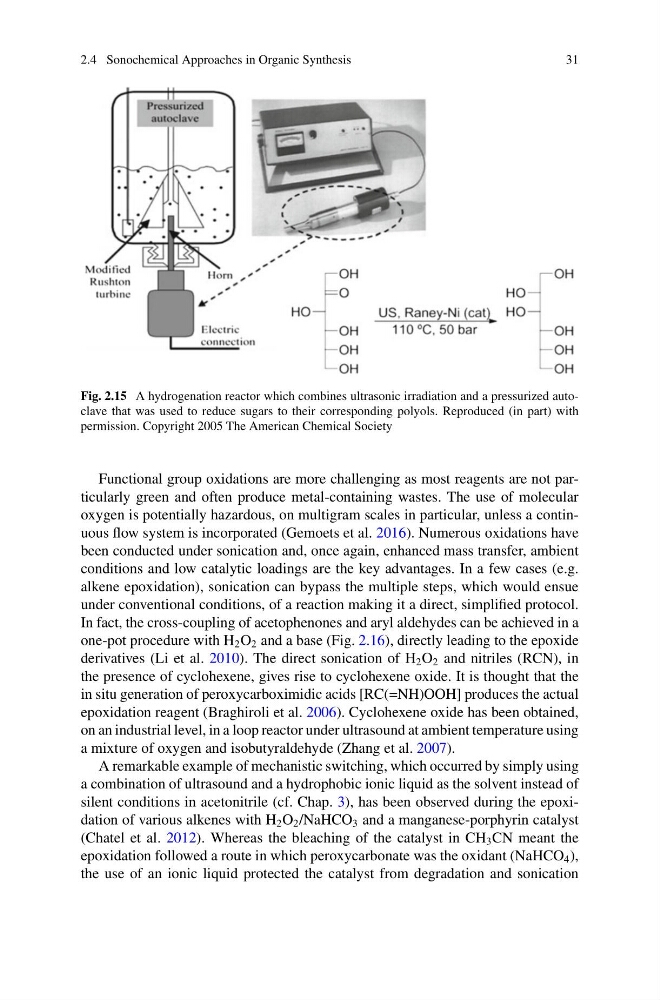
Fig. 2.15 A hydrogenation reactor which combines ultrasonic irradiation and a pressurized autoclave that was used to reduce sugars to their corresponding polyols. Reproduced (in part) with
permission. Copyright 2005 The American Chemical Society
Functional group oxidations are more challenging as most reagents are not particularly green and often produce metal-containing wastes. The use of molecular
oxygen is potentially hazardous, on multigram scales in particular, unless a continuous flow system is incorporated (Gemoets et al. 2016). Numerous oxidations have
been conducted under sonication and, once again, enhanced mass transfer, ambient
conditions and low catalytic loadings are the key advantages. In a few cases (e.g.
alkene epoxidation), sonication can bypass the multiple steps, which would ensue
under conventional conditions, of a reaction making it a direct, simplified protocol.
In fact, the cross-coupling of acetophenones and aryl aldehydes can be achieved in a
one-pot procedure with H 2 O 2 and a base (Fig. 2.16), directly leading to the epoxide
derivatives (Li et al. 2010). The direct sonication of H 2 O 2 and nitriles (RCN), in
the presence of cyclohexene, gives rise to cyclohexene oxide. It is thought that the
in situ generation of peroxycarboximidic acids [RC(=NH)OOH] produces the actual
epoxidation reagent (Braghiroli et al. 2006). Cyclohexene oxide has been obtained,
on an industrial level, in a loop reactor under ultrasound at ambient temperature using
a mixture of oxygen and isobutyraldehyde (Zhang et al. 2007).
A remarkable example of mechanistic switching, which occurred by simply using
a combination of ultrasound and a hydrophobic ionic liquid as the solvent instead of
silent conditions in acetonitrile (cf. Chap. 3), has been observed during the epoxidation of various alkenes with H 2 O 2 /NaHCO 3 and a manganese-porphyrin catalyst
(Chatel et al. 2012). Whereas the bleaching of the catalyst in CH 3 CN meant the
epoxidation followed a route in which peroxycarbonate was the oxidant (NaHCO 4 ),
the use of an ionic liquid protected the catalyst from degradation and sonication
31
Fig. 2.15 A hydrogenation reactor which combines ultrasonic irradiation and a pressurized autoclave that was used to reduce sugars to their corresponding polyols. Reproduced (in part) with
permission. Copyright 2005 The American Chemical Society
Functional group oxidations are more challenging as most reagents are not particularly green and often produce metal-containing wastes. The use of molecular
oxygen is potentially hazardous, on multigram scales in particular, unless a continuous flow system is incorporated (Gemoets et al. 2016). Numerous oxidations have
been conducted under sonication and, once again, enhanced mass transfer, ambient
conditions and low catalytic loadings are the key advantages. In a few cases (e.g.
alkene epoxidation), sonication can bypass the multiple steps, which would ensue
under conventional conditions, of a reaction making it a direct, simplified protocol.
In fact, the cross-coupling of acetophenones and aryl aldehydes can be achieved in a
one-pot procedure with H 2 O 2 and a base (Fig. 2.16), directly leading to the epoxide
derivatives (Li et al. 2010). The direct sonication of H 2 O 2 and nitriles (RCN), in
the presence of cyclohexene, gives rise to cyclohexene oxide. It is thought that the
in situ generation of peroxycarboximidic acids [RC(=NH)OOH] produces the actual
epoxidation reagent (Braghiroli et al. 2006). Cyclohexene oxide has been obtained,
on an industrial level, in a loop reactor under ultrasound at ambient temperature using
a mixture of oxygen and isobutyraldehyde (Zhang et al. 2007).
A remarkable example of mechanistic switching, which occurred by simply using
a combination of ultrasound and a hydrophobic ionic liquid as the solvent instead of
silent conditions in acetonitrile (cf. Chap. 3), has been observed during the epoxidation of various alkenes with H 2 O 2 /NaHCO 3 and a manganese-porphyrin catalyst
(Chatel et al. 2012). Whereas the bleaching of the catalyst in CH 3 CN meant the
epoxidation followed a route in which peroxycarbonate was the oxidant (NaHCO 4 ),
the use of an ionic liquid protected the catalyst from degradation and sonication