

2.4 Sonochemical Approaches in Organic Synthesis
29
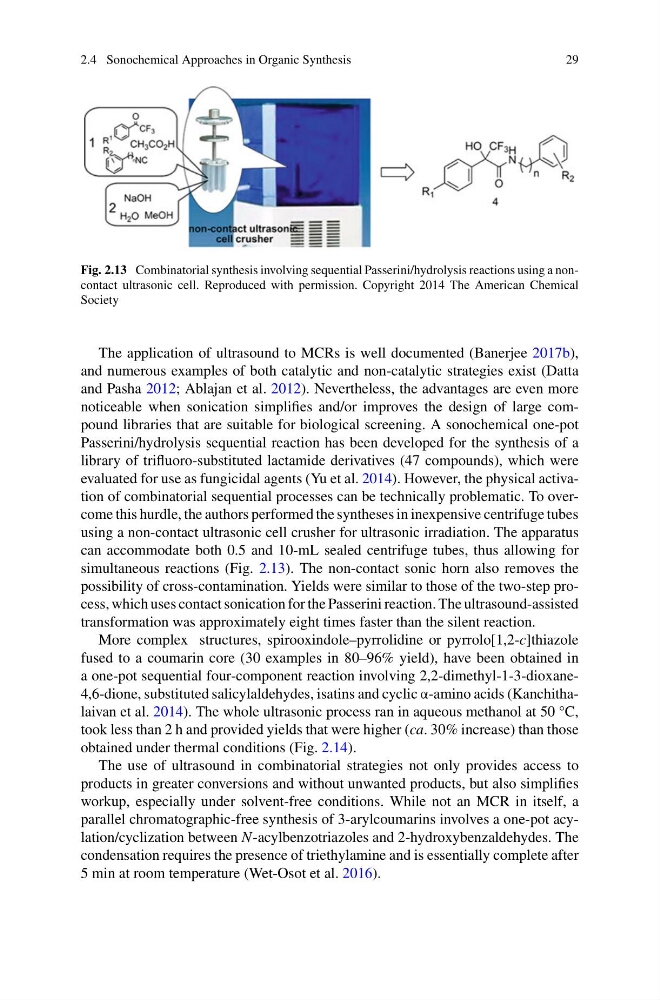
Fig. 2.13 Combinatorial synthesis involving sequential Passerini/hydrolysis reactions using a noncontact ultrasonic cell. Reproduced with permission. Copyright 2014 The American Chemical
Society
The application of ultrasound to MCRs is well documented (Banerjee 2017b),
and numerous examples of both catalytic and non-catalytic strategies exist (Datta
and Pasha 2012; Ablajan et al. 2012). Nevertheless, the advantages are even more
noticeable when sonication simplifies and/or improves the design of large compound libraries that are suitable for biological screening. A sonochemical one-pot
Passerini/hydrolysis sequential reaction has been developed for the synthesis of a
library of trifluoro-substituted lactamide derivatives (47 compounds), which were
evaluated for use as fungicidal agents (Yu et al. 2014). However, the physical activation of combinatorial sequential processes can be technically problematic. To overcome this hurdle, the authors performed the syntheses in inexpensive centrifuge tubes
using a non-contact ultrasonic cell crusher for ultrasonic irradiation. The apparatus
can accommodate both 0.5 and 10-mL sealed centrifuge tubes, thus allowing for
simultaneous reactions (Fig. 2.13). The non-contact sonic horn also removes the
possibility of cross-contamination. Yields were similar to those of the two-step process, which uses contact sonication for the Passerini reaction. The ultrasound-assisted
transformation was approximately eight times faster than the silent reaction.
More complex structures, spirooxindole–pyrrolidine or pyrrolo[1,2-c]thiazole
fused to a coumarin core (30 examples in 80–96% yield), have been obtained in
a one-pot sequential four-component reaction involving 2,2-dimethyl-1-3-dioxane4,6-dione, substituted salicylaldehydes, isatins and cyclic α-amino acids (Kanchithalaivan et al. 2014). The whole ultrasonic process ran in aqueous methanol at 50 °C,
took less than 2 h and provided yields that were higher (ca. 30% increase) than those
obtained under thermal conditions (Fig. 2.14).
The use of ultrasound in combinatorial strategies not only provides access to
products in greater conversions and without unwanted products, but also simplifies
workup, especially under solvent-free conditions. While not an MCR in itself, a
parallel chromatographic-free synthesis of 3-arylcoumarins involves a one-pot acylation/cyclization between N-acylbenzotriazoles and 2-hydroxybenzaldehydes. The
condensation requires the presence of triethylamine and is essentially complete after
5 min at room temperature (Wet-Osot et al. 2016).
29
Fig. 2.13 Combinatorial synthesis involving sequential Passerini/hydrolysis reactions using a noncontact ultrasonic cell. Reproduced with permission. Copyright 2014 The American Chemical
Society
The application of ultrasound to MCRs is well documented (Banerjee 2017b),
and numerous examples of both catalytic and non-catalytic strategies exist (Datta
and Pasha 2012; Ablajan et al. 2012). Nevertheless, the advantages are even more
noticeable when sonication simplifies and/or improves the design of large compound libraries that are suitable for biological screening. A sonochemical one-pot
Passerini/hydrolysis sequential reaction has been developed for the synthesis of a
library of trifluoro-substituted lactamide derivatives (47 compounds), which were
evaluated for use as fungicidal agents (Yu et al. 2014). However, the physical activation of combinatorial sequential processes can be technically problematic. To overcome this hurdle, the authors performed the syntheses in inexpensive centrifuge tubes
using a non-contact ultrasonic cell crusher for ultrasonic irradiation. The apparatus
can accommodate both 0.5 and 10-mL sealed centrifuge tubes, thus allowing for
simultaneous reactions (Fig. 2.13). The non-contact sonic horn also removes the
possibility of cross-contamination. Yields were similar to those of the two-step process, which uses contact sonication for the Passerini reaction. The ultrasound-assisted
transformation was approximately eight times faster than the silent reaction.
More complex structures, spirooxindole–pyrrolidine or pyrrolo[1,2-c]thiazole
fused to a coumarin core (30 examples in 80–96% yield), have been obtained in
a one-pot sequential four-component reaction involving 2,2-dimethyl-1-3-dioxane4,6-dione, substituted salicylaldehydes, isatins and cyclic α-amino acids (Kanchithalaivan et al. 2014). The whole ultrasonic process ran in aqueous methanol at 50 °C,
took less than 2 h and provided yields that were higher (ca. 30% increase) than those
obtained under thermal conditions (Fig. 2.14).
The use of ultrasound in combinatorial strategies not only provides access to
products in greater conversions and without unwanted products, but also simplifies
workup, especially under solvent-free conditions. While not an MCR in itself, a
parallel chromatographic-free synthesis of 3-arylcoumarins involves a one-pot acylation/cyclization between N-acylbenzotriazoles and 2-hydroxybenzaldehydes. The
condensation requires the presence of triethylamine and is essentially complete after
5 min at room temperature (Wet-Osot et al. 2016).