

28
2 Efficient Organic Synthesis: What Ultrasound Makes Easier
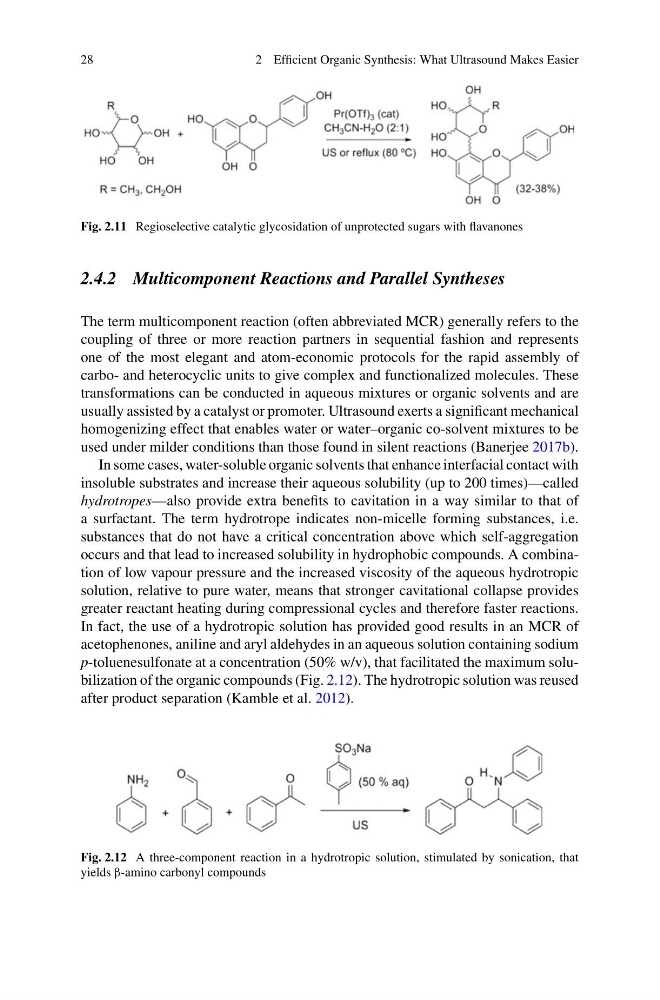
Fig. 2.11 Regioselective catalytic glycosidation of unprotected sugars with flavanones
2.4.2 Multicomponent Reactions and Parallel Syntheses
The term multicomponent reaction (often abbreviated MCR) generally refers to the
coupling of three or more reaction partners in sequential fashion and represents
one of the most elegant and atom-economic protocols for the rapid assembly of
carbo- and heterocyclic units to give complex and functionalized molecules. These
transformations can be conducted in aqueous mixtures or organic solvents and are
usually assisted by a catalyst or promoter. Ultrasound exerts a significant mechanical
homogenizing effect that enables water or water–organic co-solvent mixtures to be
used under milder conditions than those found in silent reactions (Banerjee 2017b).
In some cases, water-soluble organic solvents that enhance interfacial contact with
insoluble substrates and increase their aqueous solubility (up to 200 times)—called
hydrotropes—also provide extra benefits to cavitation in a way similar to that of
a surfactant. The term hydrotrope indicates non-micelle forming substances, i.e.
substances that do not have a critical concentration above which self-aggregation
occurs and that lead to increased solubility in hydrophobic compounds. A combination of low vapour pressure and the increased viscosity of the aqueous hydrotropic
solution, relative to pure water, means that stronger cavitational collapse provides
greater reactant heating during compressional cycles and therefore faster reactions.
In fact, the use of a hydrotropic solution has provided good results in an MCR of
acetophenones, aniline and aryl aldehydes in an aqueous solution containing sodium
p-toluenesulfonate at a concentration (50% w/v), that facilitated the maximum solubilization of the organic compounds (Fig. 2.12). The hydrotropic solution was reused
after product separation (Kamble et al. 2012).
Fig. 2.12 A three-component reaction in a hydrotropic solution, stimulated by sonication, that
yields β-amino carbonyl compounds
2 Efficient Organic Synthesis: What Ultrasound Makes Easier
Fig. 2.11 Regioselective catalytic glycosidation of unprotected sugars with flavanones
2.4.2 Multicomponent Reactions and Parallel Syntheses
The term multicomponent reaction (often abbreviated MCR) generally refers to the
coupling of three or more reaction partners in sequential fashion and represents
one of the most elegant and atom-economic protocols for the rapid assembly of
carbo- and heterocyclic units to give complex and functionalized molecules. These
transformations can be conducted in aqueous mixtures or organic solvents and are
usually assisted by a catalyst or promoter. Ultrasound exerts a significant mechanical
homogenizing effect that enables water or water–organic co-solvent mixtures to be
used under milder conditions than those found in silent reactions (Banerjee 2017b).
In some cases, water-soluble organic solvents that enhance interfacial contact with
insoluble substrates and increase their aqueous solubility (up to 200 times)—called
hydrotropes—also provide extra benefits to cavitation in a way similar to that of
a surfactant. The term hydrotrope indicates non-micelle forming substances, i.e.
substances that do not have a critical concentration above which self-aggregation
occurs and that lead to increased solubility in hydrophobic compounds. A combination of low vapour pressure and the increased viscosity of the aqueous hydrotropic
solution, relative to pure water, means that stronger cavitational collapse provides
greater reactant heating during compressional cycles and therefore faster reactions.
In fact, the use of a hydrotropic solution has provided good results in an MCR of
acetophenones, aniline and aryl aldehydes in an aqueous solution containing sodium
p-toluenesulfonate at a concentration (50% w/v), that facilitated the maximum solubilization of the organic compounds (Fig. 2.12). The hydrotropic solution was reused
after product separation (Kamble et al. 2012).
Fig. 2.12 A three-component reaction in a hydrotropic solution, stimulated by sonication, that
yields β-amino carbonyl compounds