

2.4 Sonochemical Approaches in Organic Synthesis
27
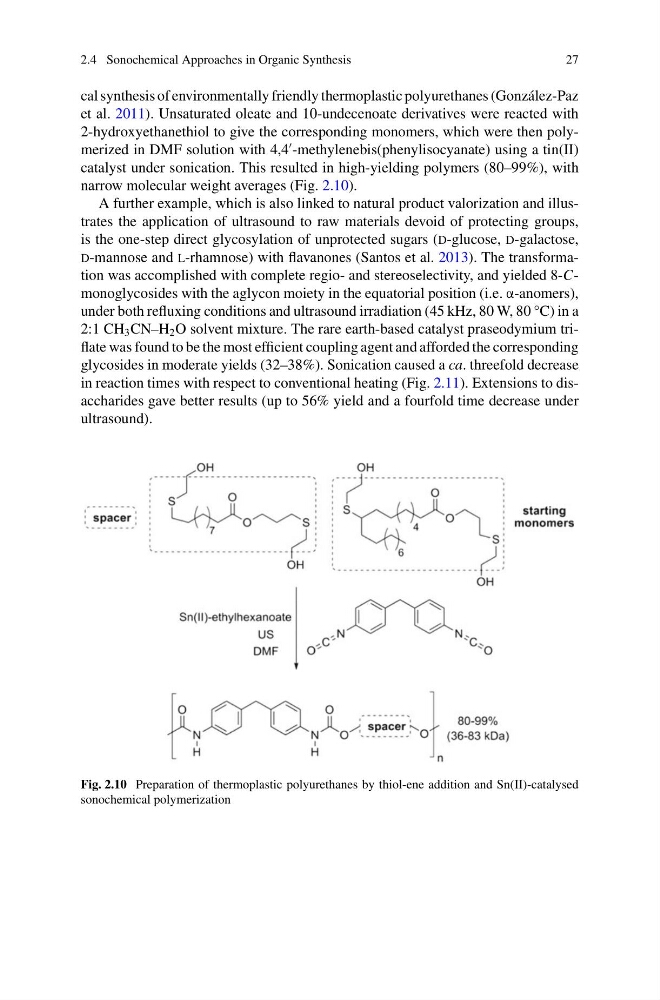
cal synthesis of environmentally friendly thermoplastic polyurethanes (González-Paz
et al. 2011). Unsaturated oleate and 10-undecenoate derivatives were reacted with
2-hydroxyethanethiol to give the corresponding monomers, which were then polymerized in DMF solution with 4,4
-methylenebis(phenylisocyanate) using a tin(II)
catalyst under sonication. This resulted in high-yielding polymers (80–99%), with
narrow molecular weight averages (Fig. 2.10).
A further example, which is also linked to natural product valorization and illustrates the application of ultrasound to raw materials devoid of protecting groups,
is the one-step direct glycosylation of unprotected sugars (d-glucose, d-galactose,
d-mannose and l-rhamnose) with flavanones (Santos et al. 2013). The transformation was accomplished with complete regio- and stereoselectivity, and yielded 8-Cmonoglycosides with the aglycon moiety in the equatorial position (i.e. α-anomers),
under both refluxing conditions and ultrasound irradiation (45 kHz, 80 W, 80 °C) in a
2:1 CH 3 CN–H 2 O solvent mixture. The rare earth-based catalyst praseodymium triflate was found to be the most efficient coupling agent and afforded the corresponding
glycosides in moderate yields (32–38%). Sonication caused a ca. threefold decrease
in reaction times with respect to conventional heating (Fig. 2.11). Extensions to disaccharides gave better results (up to 56% yield and a fourfold time decrease under
ultrasound).
Fig. 2.10 Preparation of thermoplastic polyurethanes by thiol-ene addition and Sn(II)-catalysed
sonochemical polymerization
27
cal synthesis of environmentally friendly thermoplastic polyurethanes (González-Paz
et al. 2011). Unsaturated oleate and 10-undecenoate derivatives were reacted with
2-hydroxyethanethiol to give the corresponding monomers, which were then polymerized in DMF solution with 4,4
-methylenebis(phenylisocyanate) using a tin(II)
catalyst under sonication. This resulted in high-yielding polymers (80–99%), with
narrow molecular weight averages (Fig. 2.10).
A further example, which is also linked to natural product valorization and illustrates the application of ultrasound to raw materials devoid of protecting groups,
is the one-step direct glycosylation of unprotected sugars (d-glucose, d-galactose,
d-mannose and l-rhamnose) with flavanones (Santos et al. 2013). The transformation was accomplished with complete regio- and stereoselectivity, and yielded 8-Cmonoglycosides with the aglycon moiety in the equatorial position (i.e. α-anomers),
under both refluxing conditions and ultrasound irradiation (45 kHz, 80 W, 80 °C) in a
2:1 CH 3 CN–H 2 O solvent mixture. The rare earth-based catalyst praseodymium triflate was found to be the most efficient coupling agent and afforded the corresponding
glycosides in moderate yields (32–38%). Sonication caused a ca. threefold decrease
in reaction times with respect to conventional heating (Fig. 2.11). Extensions to disaccharides gave better results (up to 56% yield and a fourfold time decrease under
ultrasound).
Fig. 2.10 Preparation of thermoplastic polyurethanes by thiol-ene addition and Sn(II)-catalysed
sonochemical polymerization