

26
2 Efficient Organic Synthesis: What Ultrasound Makes Easier
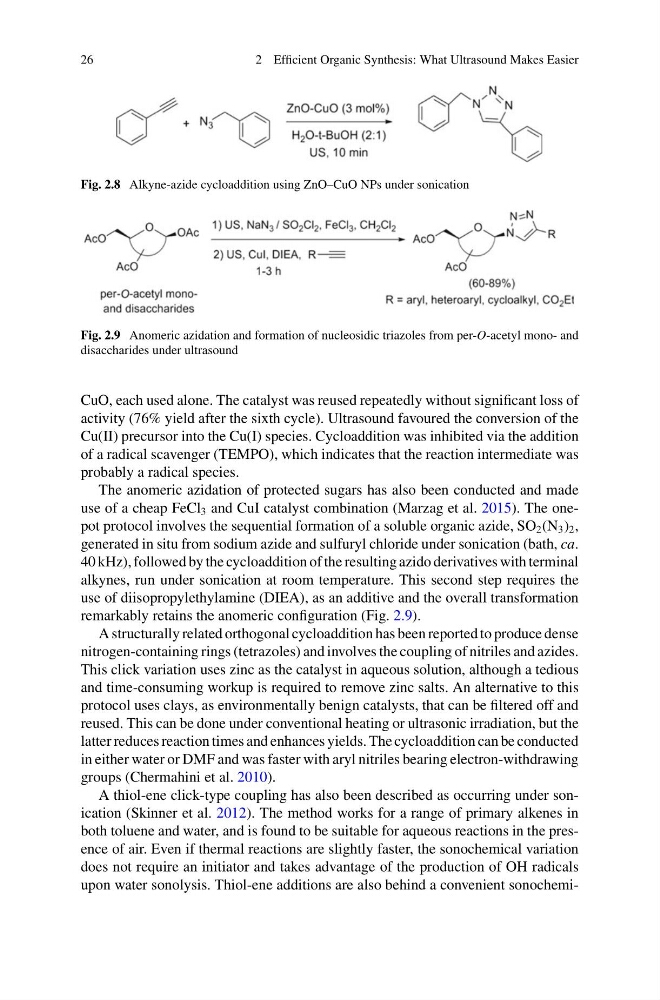
Fig. 2.8 Alkyne-azide cycloaddition using ZnO–CuO NPs under sonication
Fig. 2.9 Anomeric azidation and formation of nucleosidic triazoles from per-O-acetyl mono- and
disaccharides under ultrasound
CuO, each used alone. The catalyst was reused repeatedly without significant loss of
activity (76% yield after the sixth cycle). Ultrasound favoured the conversion of the
Cu(II) precursor into the Cu(I) species. Cycloaddition was inhibited via the addition
of a radical scavenger (TEMPO), which indicates that the reaction intermediate was
probably a radical species.
The anomeric azidation of protected sugars has also been conducted and made
use of a cheap FeCl 3 and CuI catalyst combination (Marzag et al. 2015). The onepot protocol involves the sequential formation of a soluble organic azide, SO 2 (N 3 ) 2 ,
generated in situ from sodium azide and sulfuryl chloride under sonication (bath, ca.
40 kHz), followed by the cycloaddition of the resulting azido derivatives with terminal
alkynes, run under sonication at room temperature. This second step requires the
use of diisopropylethylamine (DIEA), as an additive and the overall transformation
remarkably retains the anomeric configuration (Fig. 2.9).
A structurally related orthogonal cycloaddition has been reported to produce dense
nitrogen-containing rings (tetrazoles) and involves the coupling of nitriles and azides.
This click variation uses zinc as the catalyst in aqueous solution, although a tedious
and time-consuming workup is required to remove zinc salts. An alternative to this
protocol uses clays, as environmentally benign catalysts, that can be filtered off and
reused. This can be done under conventional heating or ultrasonic irradiation, but the
latter reduces reaction times and enhances yields. The cycloaddition can be conducted
in either water or DMF and was faster with aryl nitriles bearing electron-withdrawing
groups (Chermahini et al. 2010).
A thiol-ene click-type coupling has also been described as occurring under sonication (Skinner et al. 2012). The method works for a range of primary alkenes in
both toluene and water, and is found to be suitable for aqueous reactions in the presence of air. Even if thermal reactions are slightly faster, the sonochemical variation
does not require an initiator and takes advantage of the production of OH radicals
upon water sonolysis. Thiol-ene additions are also behind a convenient sonochemi-
2 Efficient Organic Synthesis: What Ultrasound Makes Easier
Fig. 2.8 Alkyne-azide cycloaddition using ZnO–CuO NPs under sonication
Fig. 2.9 Anomeric azidation and formation of nucleosidic triazoles from per-O-acetyl mono- and
disaccharides under ultrasound
CuO, each used alone. The catalyst was reused repeatedly without significant loss of
activity (76% yield after the sixth cycle). Ultrasound favoured the conversion of the
Cu(II) precursor into the Cu(I) species. Cycloaddition was inhibited via the addition
of a radical scavenger (TEMPO), which indicates that the reaction intermediate was
probably a radical species.
The anomeric azidation of protected sugars has also been conducted and made
use of a cheap FeCl 3 and CuI catalyst combination (Marzag et al. 2015). The onepot protocol involves the sequential formation of a soluble organic azide, SO 2 (N 3 ) 2 ,
generated in situ from sodium azide and sulfuryl chloride under sonication (bath, ca.
40 kHz), followed by the cycloaddition of the resulting azido derivatives with terminal
alkynes, run under sonication at room temperature. This second step requires the
use of diisopropylethylamine (DIEA), as an additive and the overall transformation
remarkably retains the anomeric configuration (Fig. 2.9).
A structurally related orthogonal cycloaddition has been reported to produce dense
nitrogen-containing rings (tetrazoles) and involves the coupling of nitriles and azides.
This click variation uses zinc as the catalyst in aqueous solution, although a tedious
and time-consuming workup is required to remove zinc salts. An alternative to this
protocol uses clays, as environmentally benign catalysts, that can be filtered off and
reused. This can be done under conventional heating or ultrasonic irradiation, but the
latter reduces reaction times and enhances yields. The cycloaddition can be conducted
in either water or DMF and was faster with aryl nitriles bearing electron-withdrawing
groups (Chermahini et al. 2010).
A thiol-ene click-type coupling has also been described as occurring under sonication (Skinner et al. 2012). The method works for a range of primary alkenes in
both toluene and water, and is found to be suitable for aqueous reactions in the presence of air. Even if thermal reactions are slightly faster, the sonochemical variation
does not require an initiator and takes advantage of the production of OH radicals
upon water sonolysis. Thiol-ene additions are also behind a convenient sonochemi-