

24
2 Efficient Organic Synthesis: What Ultrasound Makes Easier
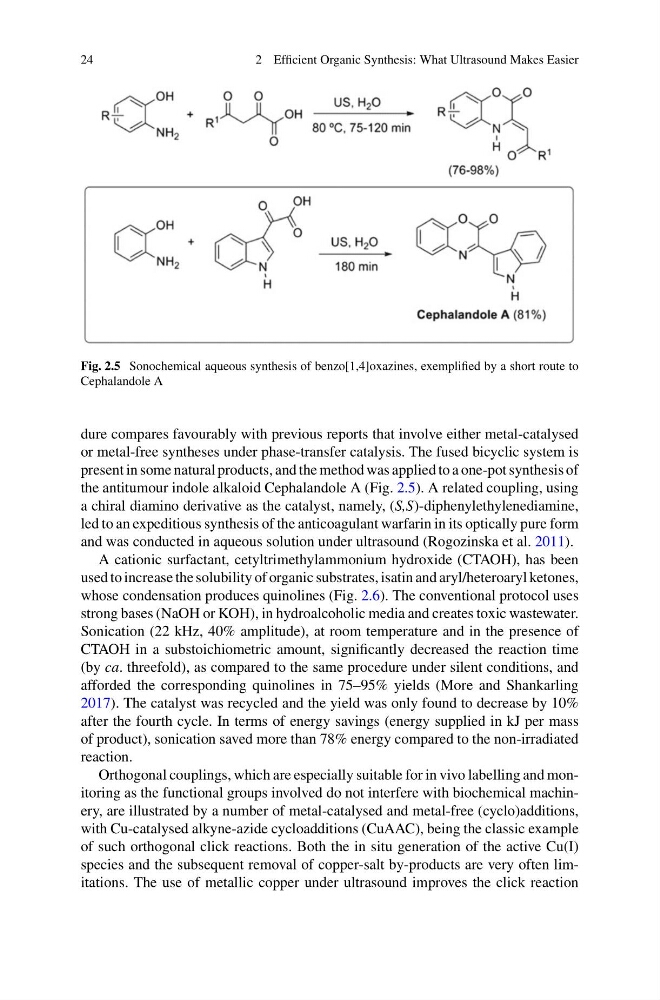
Fig. 2.5 Sonochemical aqueous synthesis of benzo[1,4]oxazines, exemplified by a short route to
Cephalandole A
dure compares favourably with previous reports that involve either metal-catalysed
or metal-free syntheses under phase-transfer catalysis. The fused bicyclic system is
present in some natural products, and the method was applied to a one-pot synthesis of
the antitumour indole alkaloid Cephalandole A (Fig. 2.5). A related coupling, using
a chiral diamino derivative as the catalyst, namely, (S,S)-diphenylethylenediamine,
led to an expeditious synthesis of the anticoagulant warfarin in its optically pure form
and was conducted in aqueous solution under ultrasound (Rogozinska et al. 2011).
A cationic surfactant, cetyltrimethylammonium hydroxide (CTAOH), has been
used to increase the solubility of organic substrates, isatin and aryl/heteroaryl ketones,
whose condensation produces quinolines (Fig. 2.6). The conventional protocol uses
strong bases (NaOH or KOH), in hydroalcoholic media and creates toxic wastewater.
Sonication (22 kHz, 40% amplitude), at room temperature and in the presence of
CTAOH in a substoichiometric amount, significantly decreased the reaction time
(by ca. threefold), as compared to the same procedure under silent conditions, and
afforded the corresponding quinolines in 75–95% yields (More and Shankarling
2017). The catalyst was recycled and the yield was only found to decrease by 10%
after the fourth cycle. In terms of energy savings (energy supplied in kJ per mass
of product), sonication saved more than 78% energy compared to the non-irradiated
reaction.
Orthogonal couplings, which are especially suitable for in vivo labelling and monitoring as the functional groups involved do not interfere with biochemical machinery, are illustrated by a number of metal-catalysed and metal-free (cyclo)additions,
with Cu-catalysed alkyne-azide cycloadditions (CuAAC), being the classic example
of such orthogonal click reactions. Both the in situ generation of the active Cu(I)
species and the subsequent removal of copper-salt by-products are very often limitations. The use of metallic copper under ultrasound improves the click reaction
2 Efficient Organic Synthesis: What Ultrasound Makes Easier
Fig. 2.5 Sonochemical aqueous synthesis of benzo[1,4]oxazines, exemplified by a short route to
Cephalandole A
dure compares favourably with previous reports that involve either metal-catalysed
or metal-free syntheses under phase-transfer catalysis. The fused bicyclic system is
present in some natural products, and the method was applied to a one-pot synthesis of
the antitumour indole alkaloid Cephalandole A (Fig. 2.5). A related coupling, using
a chiral diamino derivative as the catalyst, namely, (S,S)-diphenylethylenediamine,
led to an expeditious synthesis of the anticoagulant warfarin in its optically pure form
and was conducted in aqueous solution under ultrasound (Rogozinska et al. 2011).
A cationic surfactant, cetyltrimethylammonium hydroxide (CTAOH), has been
used to increase the solubility of organic substrates, isatin and aryl/heteroaryl ketones,
whose condensation produces quinolines (Fig. 2.6). The conventional protocol uses
strong bases (NaOH or KOH), in hydroalcoholic media and creates toxic wastewater.
Sonication (22 kHz, 40% amplitude), at room temperature and in the presence of
CTAOH in a substoichiometric amount, significantly decreased the reaction time
(by ca. threefold), as compared to the same procedure under silent conditions, and
afforded the corresponding quinolines in 75–95% yields (More and Shankarling
2017). The catalyst was recycled and the yield was only found to decrease by 10%
after the fourth cycle. In terms of energy savings (energy supplied in kJ per mass
of product), sonication saved more than 78% energy compared to the non-irradiated
reaction.
Orthogonal couplings, which are especially suitable for in vivo labelling and monitoring as the functional groups involved do not interfere with biochemical machinery, are illustrated by a number of metal-catalysed and metal-free (cyclo)additions,
with Cu-catalysed alkyne-azide cycloadditions (CuAAC), being the classic example
of such orthogonal click reactions. Both the in situ generation of the active Cu(I)
species and the subsequent removal of copper-salt by-products are very often limitations. The use of metallic copper under ultrasound improves the click reaction