

621
The U.S. Mine Safety and Health Administration (MSHA) issued guidance (MSHA, 2013)
for certified mine examiners to test for methane with handheld detectors “within 5 feet of the
face and at least 12 inches from the roof, face, ribs, and floor.” Reasons for these distances
are not specified but one can assume that the 12-inch (0.3m) standoff relates to the dilution
depicted in Figure 1 while the 5-foot (1.5 m) standoff from the face is designed to keep the
examiner from traveling beyond the last row of roof support.
In the United States the limit for methane detected is 1.0%. At this level, all “electrically
powered equipment in the face shall be de-energized and other mechanized equipment shall
be shut off ” (30 CFR §75.323). This applies regardless whether the methane is detected using
a handheld or machine-mounted sensor. MSHA may permit up to 1.5% CH 4 in the longwall
face, provided that certain enhanced methane monitoring provisions are met. In this case,
the shearer will alarm and must be de-energized at this level and corrections made to reduce
CH 4 below 1.5%. Automatic power shutdown must occur at 2% CH 4 (see U.S. regulation
30 CFR §75.323 and §27.24). In most cases, machine-mounted sensors are directly linked to
de-energize the equipment automatically. If 1.5% or more methane is detected in a working
place, all persons must be removed from the affected area except those required to restore
ventilation. U.S. law also permits up to 1.5% or even up to 2.0% in specific return air courses.
These methane limits are common to many countries. Most countries require mine-wide
atmospheric monitoring systems, but such systems are not currently mandated in U.S. coal
mines. In any case, all methane and atmospheric monitoring systems rely on point-type detectors placed at strategic locations to test both the fresh air and the exhaust airways.
2 METHANE DISTRIBUTION IN THE LONGWALL FACE
Researchers at the Colorado School of Mines (CSM), with funding from CDC NIOSH, have
conducted extensive work with computational fluid dynamics (CFD) studying airflow distribution, leakages between the face and the gob, and methane distribution patterns. From a
CFD modeling perspective, a longwall face ventilation is quite complex. Shearer and face conveyor are moving obstructions, and the shield support, hydraulic hoses, cables etc. are difficult
to model in sufficient detail. Therefore, in another project funded by NIOSH, CSM researchers are constructing a 1:40 scaled longwall model for physical airflow and explosion testing.
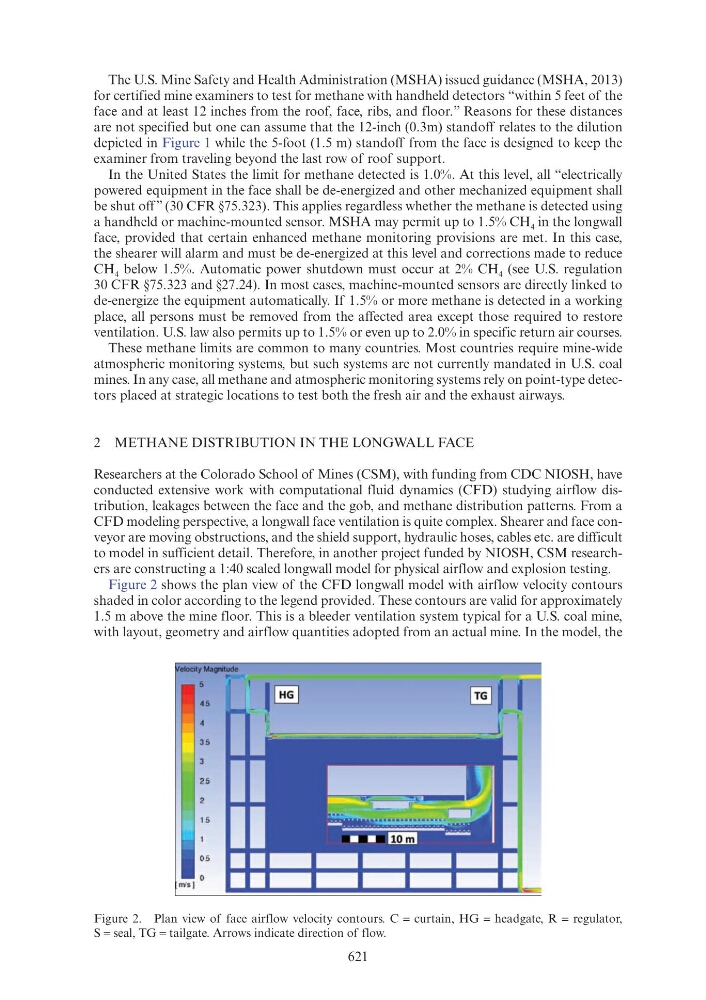
Figure 2 shows the plan view of the CFD longwall model with airflow velocity contours
shaded in color according to the legend provided. These contours are valid for approximately
1.5 m above the mine floor. This is a bleeder ventilation system typical for a U.S. coal mine,
with layout, geometry and airflow quantities adopted from an actual mine. In the model, the
Figure 2. Plan view of face airflow velocity contours. C = curtain, HG = headgate, R = regulator,
S = seal, TG = tailgate. Arrows indicate direction of flow.