

Mining Goes Digital – Mueller et al. (Eds)
© 2019 Taylor & Francis Group, London, ISBN 978-0-367-33604-2
620
Proximity detection of explosive methane clouds in longwall mines
J.F. Brune, H.S. Düzgün, G.E. Bogin Jr., A. Juganda, C. Strebinger,
T. Nguyen, E. Isleyen & C. Demirkanr
Colorado School of Mines, Golden CO, USA
ABSTRACT: Methane detection in underground coal and other gassy mines traditionally
done with point-type sensors or by certified examiners using handheld meters. To provide a
sufficient margin of safety, machine-mounted point sensors shut down equipment at methane concentrations of 1 or 1.5%, yet many mine fires and explosions have shown that point
sensors may not be capable of detecting explosive methane clouds. The 2010 explosion at the
Upper Big Branch mine in West Virginia, USA, is one such example that killed 29 miners.
Researchers are using multi-point methane readings, CFD, and 3-D modeling to produce the
real-time methane distribution cloud and visualization through virtual and augmented reality
(VR and AR). Knowing the position of the shearer, shields and other ignition sources creates a proximity detection model for the methane cloud that will automatically shut off the
shearer or other equipment before an explosion can happen.
1 INTRODUCTION
The 2010 methane and coal dust explosion at the Upper Big Branch Mine in West Virginia,
United States, killed 29 miners. Investigators (Page, 2011) found that worn cutter bits on the
drums of the longwall shearer likely ignited a cloud of flammable methane-air mixture that
had migrated into the face area from the gob fringe behind the shields. As Brune and Sapko
(2012) demonstrated, it is easily possible that flammable or explosive mixtures form near the
cutter bits that remain undetected by the methane sensors mounted on the shearer body, the
headgate and tailgate drives. This calls into question the validity of point-type methane readings that have long been used worldwide to protect miners from methane explosions, as this
was likely a contributing cause of the Upper Big Branch explosion.
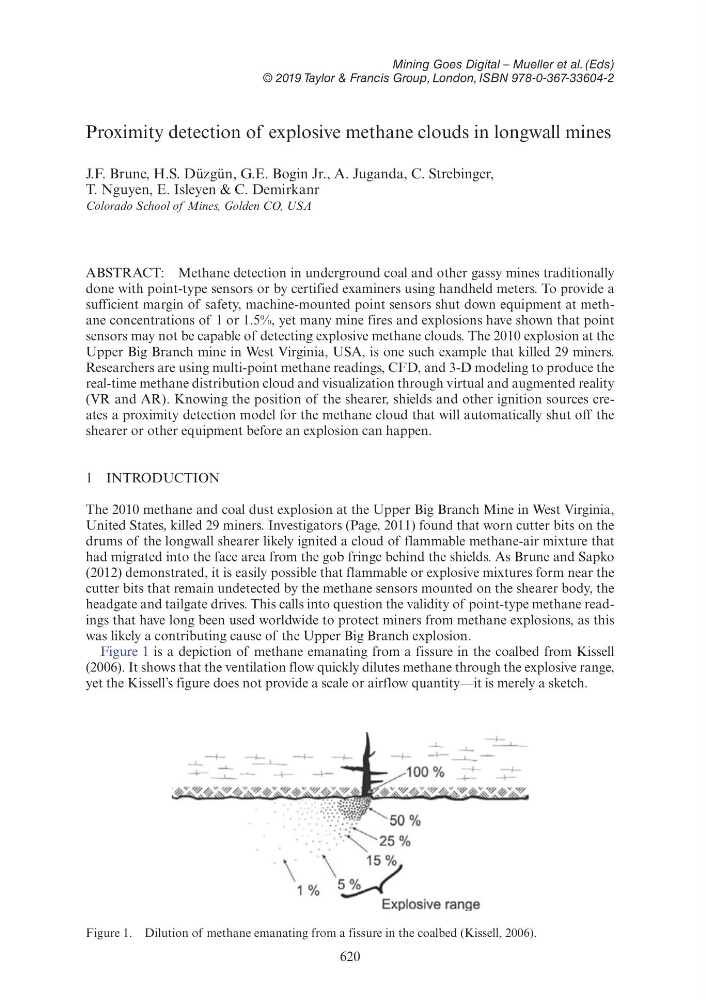
Figure 1 is a depiction of methane emanating from a fissure in the coalbed from Kissell
(2006). It shows that the ventilation flow quickly dilutes methane through the explosive range,
yet the Kissell’s figure does not provide a scale or airflow quantity—it is merely a sketch.
Figure 1. Dilution of methane emanating from a fissure in the coalbed (Kissell, 2006).
1%
25%
- -· 15 >
~
Explosive range