

598
2.1 Sensor node
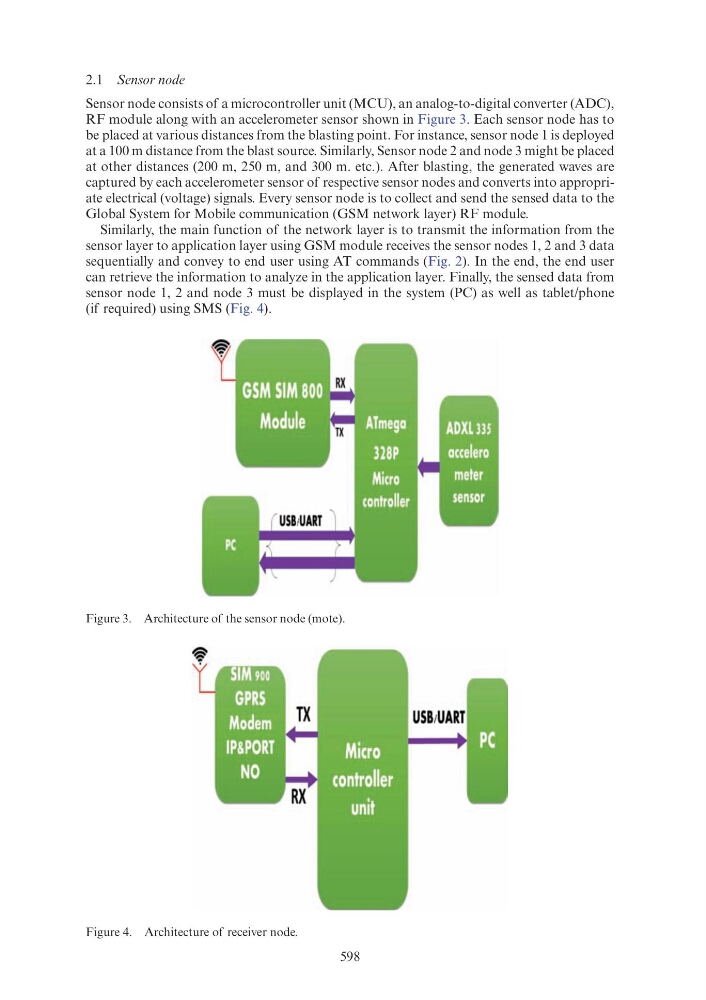
Sensor node consists of a microcontroller unit (MCU), an analog-to-digital converter (ADC),
RF module along with an accelerometer sensor shown in Figure 3. Each sensor node has to
be placed at various distances from the blasting point. For instance, sensor node 1 is deployed
at a 100 m distance from the blast source. Similarly, Sensor node 2 and node 3 might be placed
at other distances (200 m, 250 m, and 300 m. etc.). After blasting, the generated waves are
captured by each accelerometer sensor of respective sensor nodes and converts into appropriate electrical (voltage) signals. Every sensor node is to collect and send the sensed data to the
Global System for Mobile communication (GSM network layer) RF module.
Similarly, the main function of the network layer is to transmit the information from the
sensor layer to application layer using GSM module receives the sensor nodes 1, 2 and 3 data
sequentially and convey to end user using AT commands (Fig. 2). In the end, the end user
can retrieve the information to analyze in the application layer. Finally, the sensed data from
sensor node 1, 2 and node 3 must be displayed in the system (PC) as well as tablet/phone
(if required) using SMS (Fig. 4).
Figure 3. Architecture of the sensor node (mote).
Figure 4. Architecture of receiver node.