

597
1.1.2 Reliable transmission
Sensing object information can be available at any time through multiple radio networks, telecommunication, and the internet. Communication technology includes wire, wireless transmission, switching, and gateway technologies. Further, WSN provides an interactive platform
among the real physical world, the digital world, and the machine to machine (M2M). The
important technology of networks of things is established and communicated between M2M
as well as machine to human.
1.1.3 Intelligent processing
After receiving the information, it stores in the database including computing technology like
cloud computing. The available network service providers process the billions of messages
immediately using cloud computing technology. Thus, this technology is the main promoter
of WSN applications.
In this context, the main aim of this study is to help mine administrations, blast experts, and
nearby residing community to obtain real-time information such as BIGV data from an end user
(sink node) through wireless sensor nodes. A Global System for Mobile (GSM) RF module has
been placed in the sensor node as an RF protocol conversion in between blasting point to end
users such as mine managers, experts of blasting as well as rural peoples who live in and around
the mine area. The designed wireless system was installed successfully at different locations in
Mine-A, India and monitored the vibration levels (in terms of PPV) over a period of eleven days.
2 SYSTEM ARCHITECTURE
Usually, ground vibration due to blasting is a low frequency and low amplitude waves. Thus, it is
very difficult to capture. An accelerometer sensor is used as a sensing device which captures the
vibration as well as earthquake waves. It is essential to measure low frequency and low amplitude
signals, choose high sensitivity and low noise density MEMS-based accelerometer sensor. The
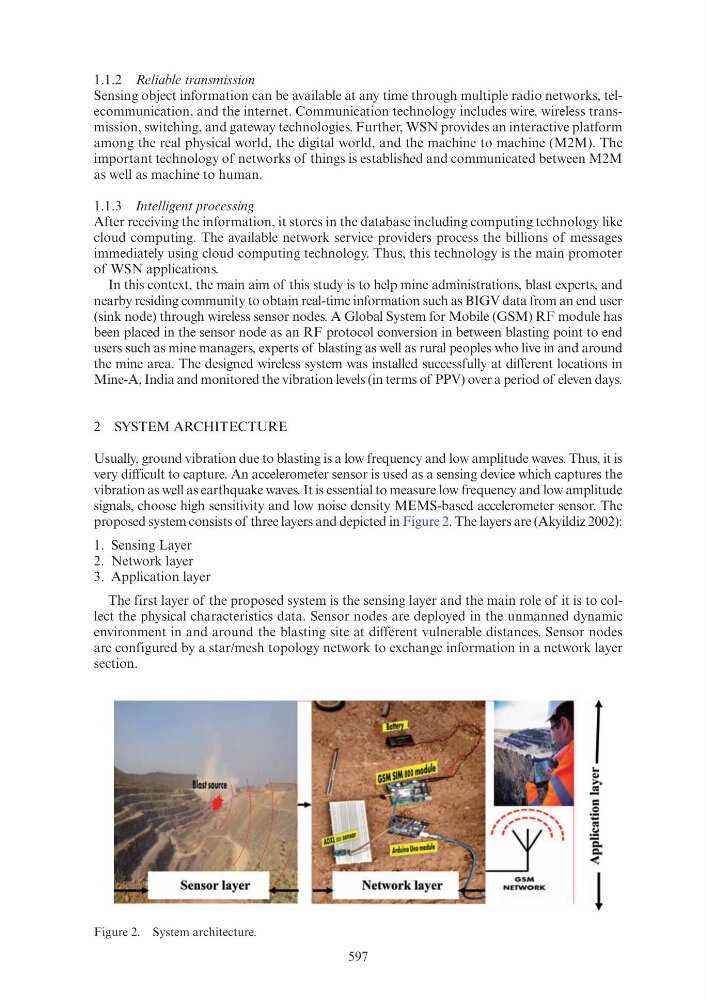
proposed system consists of three layers and depicted in Figure 2. The layers are (Akyildiz 2002):
1. Sensing Layer
2. Network layer
3. Application layer
The first layer of the proposed system is the sensing layer and the main role of it is to collect the physical characteristics data. Sensor nodes are deployed in the unmanned dynamic
environment in and around the blasting site at different vulnerable distances. Sensor nodes
are configured by a star/mesh topology network to exchange information in a network layer
section.
Figure 2. System architecture.
1
-
a.>
.....
~
= <:>
;
~
.!::!
Q.
c.
<
GSM
1
NETWORK