

596
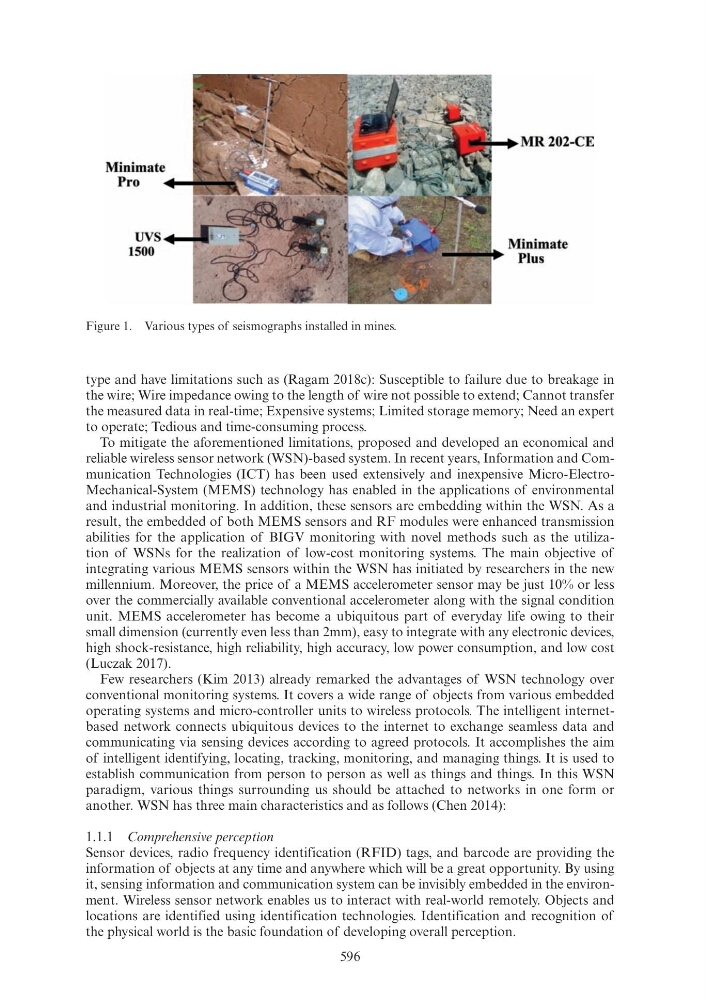
type and have limitations such as (Ragam 2018c): Susceptible to failure due to breakage in
the wire; Wire impedance owing to the length of wire not possible to extend; Cannot transfer
the measured data in real-time; Expensive systems; Limited storage memory; Need an expert
to operate; Tedious and time-consuming process.
To mitigate the aforementioned limitations, proposed and developed an economical and
reliable wireless sensor network (WSN)-based system. In recent years, Information and Communication Technologies (ICT) has been used extensively and inexpensive Micro-ElectroMechanical-System (MEMS) technology has enabled in the applications of environmental
and industrial monitoring. In addition, these sensors are embedding within the WSN. As a
result, the embedded of both MEMS sensors and RF modules were enhanced transmission
abilities for the application of BIGV monitoring with novel methods such as the utilization of WSNs for the realization of low-cost monitoring systems. The main objective of
integrating various MEMS sensors within the WSN has initiated by researchers in the new
millennium. Moreover, the price of a MEMS accelerometer sensor may be just 10% or less
over the commercially available conventional accelerometer along with the signal condition
unit. MEMS accelerometer has become a ubiquitous part of everyday life owing to their
small dimension (currently even less than 2mm), easy to integrate with any electronic devices,
high shock-resistance, high reliability, high accuracy, low power consumption, and low cost
(Luczak 2017).
Few researchers (Kim 2013) already remarked the advantages of WSN technology over
conventional monitoring systems. It covers a wide range of objects from various embedded
operating systems and micro-controller units to wireless protocols. The intelligent internetbased network connects ubiquitous devices to the internet to exchange seamless data and
communicating via sensing devices according to agreed protocols. It accomplishes the aim
of intelligent identifying, locating, tracking, monitoring, and managing things. It is used to
establish communication from person to person as well as things and things. In this WSN
paradigm, various things surrounding us should be attached to networks in one form or
another. WSN has three main characteristics and as follows (Chen 2014):
1.1.1 Comprehensive perception
Sensor devices, radio frequency identification (RFID) tags, and barcode are providing the
information of objects at any time and anywhere which will be a great opportunity. By using
it, sensing information and communication system can be invisibly embedded in the environment. Wireless sensor network enables us to interact with real-world remotely. Objects and
locations are identified using identification technologies. Identification and recognition of
the physical world is the basic foundation of developing overall perception.
Figure 1. Various types of seismographs installed in mines.