

599
3 DEVELOPMENT OF WIRELESS SENSOR SYSTEM
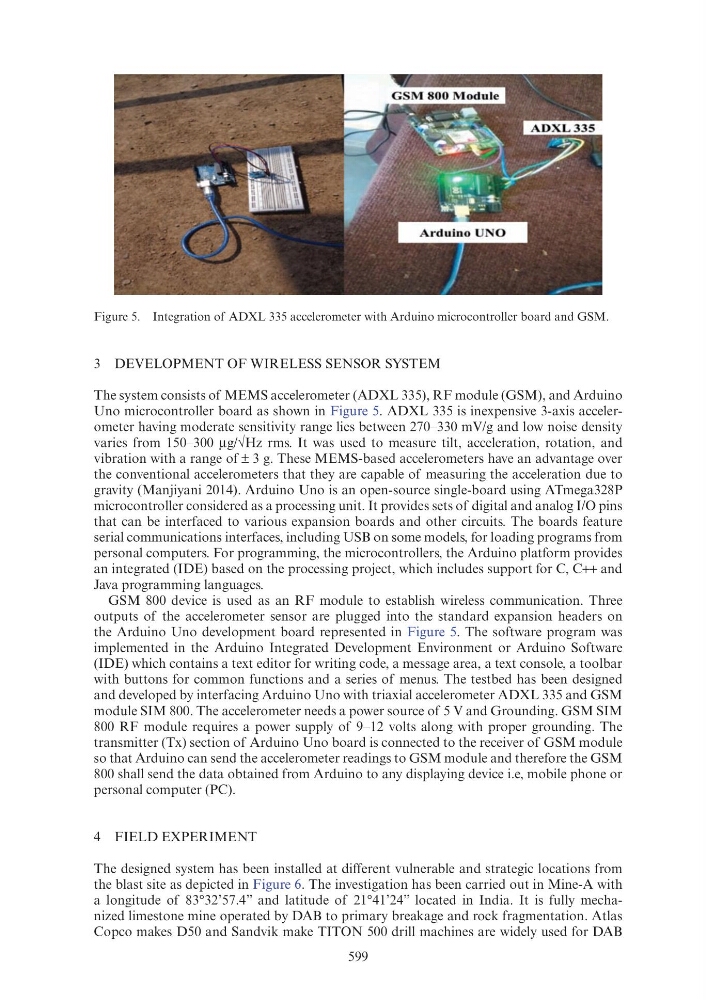
The system consists of MEMS accelerometer (ADXL 335), RF module (GSM), and Arduino
Uno microcontroller board as shown in Figure 5. ADXL 335 is inexpensive 3-axis accelerometer having moderate sensitivity range lies between 270–330 mV/g and low noise density
varies from 150–300 μg/√Hz rms. It was used to measure tilt, acceleration, rotation, and
vibration with a range of ± 3 g. These MEMS-based accelerometers have an advantage over
the conventional accelerometers that they are capable of measuring the acceleration due to
gravity (Manjiyani 2014). Arduino Uno is an open-source single-board using ATmega328P
microcontroller considered as a processing unit. It provides sets of digital and analog I/O pins
that can be interfaced to various expansion boards and other circuits. The boards feature
serial communications interfaces, including USB on some models, for loading programs from
personal computers. For programming, the microcontrollers, the Arduino platform provides
an integrated (IDE) based on the processing project, which includes support for C, C++ and
Java programming languages.
GSM 800 device is used as an RF module to establish wireless communication. Three
outputs of the accelerometer sensor are plugged into the standard expansion headers on
the Arduino Uno development board represented in Figure 5. The software program was
implemented in the Arduino Integrated Development Environment or Arduino Software
(IDE) which contains a text editor for writing code, a message area, a text console, a toolbar
with buttons for common functions and a series of menus. The testbed has been designed
and developed by interfacing Arduino Uno with triaxial accelerometer ADXL 335 and GSM
module SIM 800. The accelerometer needs a power source of 5 V and Grounding. GSM SIM
800 RF module requires a power supply of 9–12 volts along with proper grounding. The
transmitter (Tx) section of Arduino Uno board is connected to the receiver of GSM module
so that Arduino can send the accelerometer readings to GSM module and therefore the GSM
800 shall send the data obtained from Arduino to any displaying device i.e, mobile phone or
personal computer (PC).
4 FIELD EXPERIMENT
The designed system has been installed at different vulnerable and strategic locations from
the blast site as depicted in Figure 6. The investigation has been carried out in Mine-A with
a longitude of 83°32’57.4” and latitude of 21°41’24” located in India. It is fully mechanized limestone mine operated by DAB to primary breakage and rock fragmentation. Atlas
Copco makes D50 and Sandvik make TITON 500 drill machines are widely used for DAB
Figure 5. Integration of ADXL 335 accelerometer with Arduino microcontroller board and GSM.